
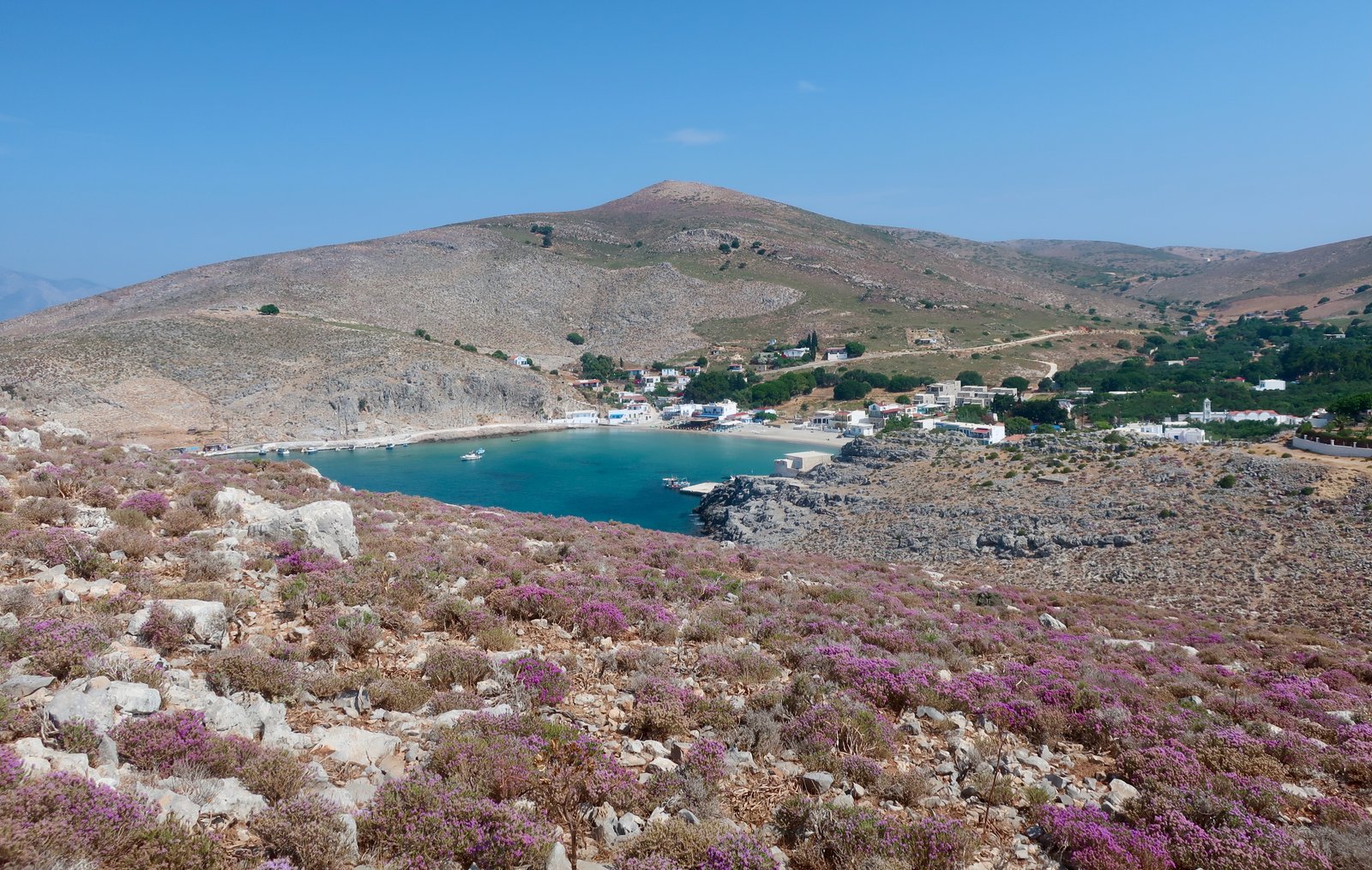
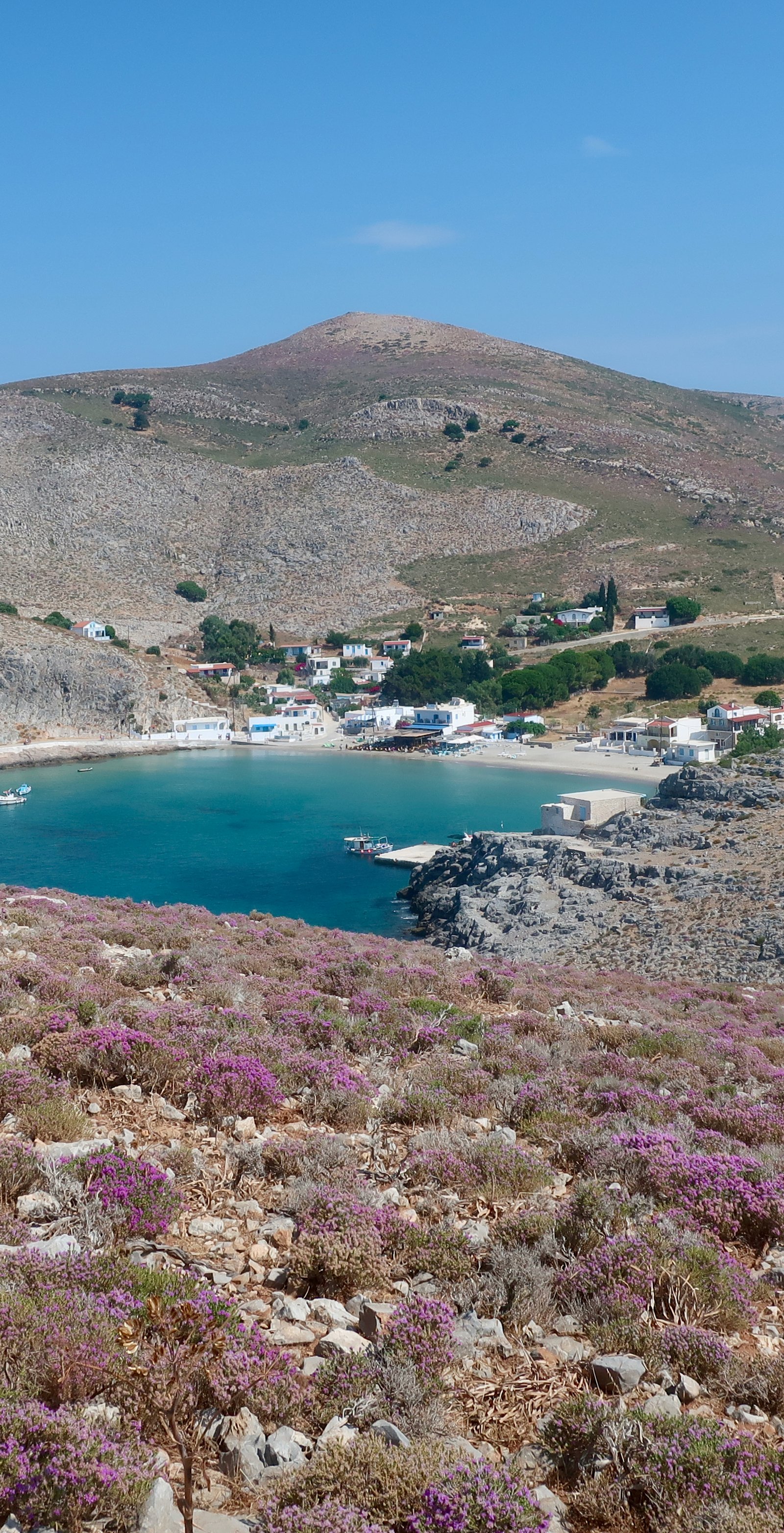
Pserimos port, the only settlement on the island, is a horseshoe sandy beach with a couple of dozen white buildings around it. The water, transparent and turquoise, shelves gradually out. If it was a film you’d think it couldn’t exist, the bay, the beach. It’s too perfect.
In the pre-tourism past, there were different metrics. How productive was the soil? How many people could the island support? How easy was it to defend in case of attack? How safe was the anchorage when the northern gales blew? Not how pretty. What would be the point in that?
We were there for nearly a week towards the end of June. Days began with a swim in the bay. Just us going back and forth. Maybe a few children splashing about, whose parents were there to work. There was a small gang of them, it was their summer play-space.
After swimming we’d stroll back to our accommodation, a studio a few dozen metres off the beach. Nothing is far. On the left of the little alley we’d take are some old stone steps. They don’t go anywhere now, they’re just a photogenic detail, with a fig tree hanging over them, sunlight filtering through its great big pretend-leaves. Only chickens go up and down them these days. The heat and the sand and the tumbledown steps and the chickens, it’s a distillation. Heading home in the mornings, just at that spot, for a moment we might think we were on a Greek island like any other.
Half an hour later we’ve showered, had breakfast and are sitting in the café drinking coffee. It’s almost time.
Pretty much at the same hour every day the first pirate ship comes into view, motoring past the headland and turning into the bay. It does have a couple of masts but the masts are too short to be of any use. Besides, sailing would waste so much time.
As it gets closer we can see the deck is heaving, dozens of people in swimwear crowded together into a brightly-coloured, pointillistic mass. There’s the whole palette of skin-colours and then the splash of cozzies. Red! Yellow! Orange! Before it docks, another boat appears behind it, just the same. And then another.
They troop off in flip flops or sandals or just bare feet. Once past the stalls on the concrete walkway on the side of the bay the children make a dash for the water. Some of the adults go directly into the first café on the beach. Others walk along the sand for a few metres before stopping. They’re carrying bags in which they have everything necessary. They look around, take it all in. Seeming to say, Hmmm. So this is today.
The cafes, there’s a line of them along the beach, they fill up like those old penny-drop machines at the amusement arcade. When the top level gets overcrowded some pennies get pushed onto the second level. When it gets full the same thing happens again. The good fortune of being at the beginning of the beach is not inconsiderable. There’s one small taverna at the far end of the beach and about fifty metres back from the front in a side-street. Hardly anyone goes. One day we walked past on the way out of the village, heading cross-country. The woman in there practically begged us to come in and try her octopus.
Within half an hour or so of the first tourist boat arriving, five or six more have come in. There are people everywhere. The beach is jammed, the cafes/tavernas are doing great business. Hundreds of people are hooting, splashing, shouting, drinking, eating, milling, talking. It’s a Greek-island-themed aqua park.
About an hour after the first load came ashore, a siren sounds. Those who came on the first boat gather their towels, sun creams and children. They tug water wings from thin, stretched-out arms, pay their bills in the cafes and troop back along the concrete jetty. Within another half hour, everyone has gone. There’s a collective sigh of relief as tables are cleared and wiped, detritus is scooped up. A sort of braking, a slowing, even as everything is being prepared for the afternoon’s onslaught.
At this time of year there are six or seven boats every morning, six or seven every afternoon. You should see it in August, says the woman who runs the café we go to. It’s much worse. But then, six months here, six months looking after the children on Kalymnos in the winter. She shrugs.
Pserimos, with its roughly fourteen square kilometres, is halfway between Kalymnos and Kos. The boats come from both directions. Kalymnos receives a fair number of seasonal visitors, but Kos, Kos is one of the Aegean mass tourism hubs with over a million visitors per year. Of course a trip to a paradise-like tiny Greek island is a popular day out.
It’s so easy to see how one thing leads to the next and so on and on, how because of its particular situation, its size, its neighbours, its unusual loveliness, all this could happen.
***
We came over on a small boat from Pothia, Kalymnos. It was mostly mothers and children. Everyone knew everyone. We sat for ages in the heat inside the ferry waiting to go while mopeds or three-wheeler vans came down the jetty loaded with bags from the local supermarkets. The women were deposited by their partners, sent off with a kiss. The children treated the boat and jetty as a runaround playspace. There were some elderly people too, women in shapeless island dresses the washed-out colour of winter skies, their husbands leathery, with sticks, whiskers, feet as dry and cracked as elephant skin. They were politely greeted, their health enquired after.
All the way across there wasn’t a ripple on the water. Then we rounded the headland and saw it. It’s startling. You feel like rubbing your eyes it’s so impossible. But then, the line of tavernas/cafes along the beach, there are too many for such a tiny place with hardly any accommodation.
Avlaki, it’s called, the port. That it should have a name creates unexpected dissonance, implying as it does an unbroken link with the past, as if this ‘Avlaki’ was analogous to the Avlaki that used to be.
One day we went walking. On the other side of the Anavasi map of Kalymnos there’s a map of Pserimos. Strictly-speaking you don’t need a map. Even so, it is useful to know where you are and to have some idea of the shape of the thing you’re walking over.
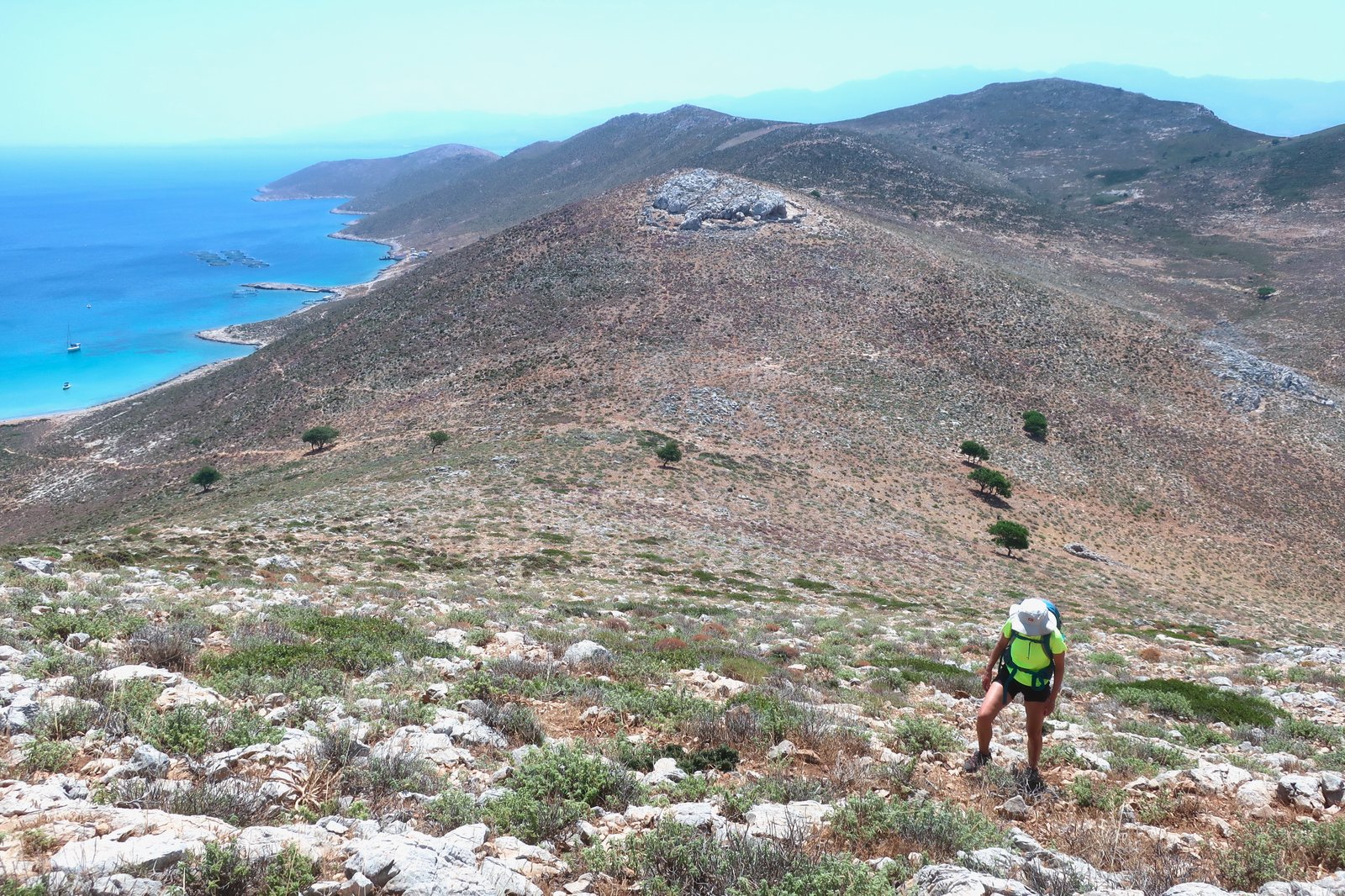
It was exceptionally hot when we were there, an early-season heatwave. We had only intended to go up to the top of the hill overlooking the port. Predictably, in the end we did much more, a tour of all the little hilltops of the eastern side of the island. The high-point is only two hundred and sixty-eight metres. It’s not much but not quite nothing. Of course it’s a very small island, but once you start walking it’s actually just a bit of a big island. That’s how it feels.
It’s fun, not walking on paths, not giving a thought to them. We treated it like a succession of high-points whose dots had to be joined. There was a lot of purple-flowered thyme among the rocks. Sage too, so strong it begins to make the eyes water. We reached the ridge of one hill and found that one side, the whole flank, was covered in thyme, while all the other was thick with sage. The dividing line was sharp. Long before we came hiking in the islands for the first time, we spent a summer mostly in the Peloponnese. Some friends of friends, hearing we were going, said, Ah, the hills, thyme and oregano and wild herbs. The smell of them. I thought they were exaggerating, a long-ago holiday passed into legend. But no, it’s true.
From a hilltop overlooking the straights between Kos and Pserimos in the southeast of the island we saw them coming like D-day. Eight ships, the morning’s squadron on its way over.
Coming back down towards the port you get a full view of the olive grove in the valley behind. It looks neat and is probably still harvested, an extra, out-of-season reason to come to the island and a way to maintain contact with, what? history? family? the land? the Pserimos that was? At the same time, because there are almost no other trees on the island, because there’s almost no evidence of any other agricultural activity, this olive grove, with its hard borders, seems almost as counterfeit as the port.
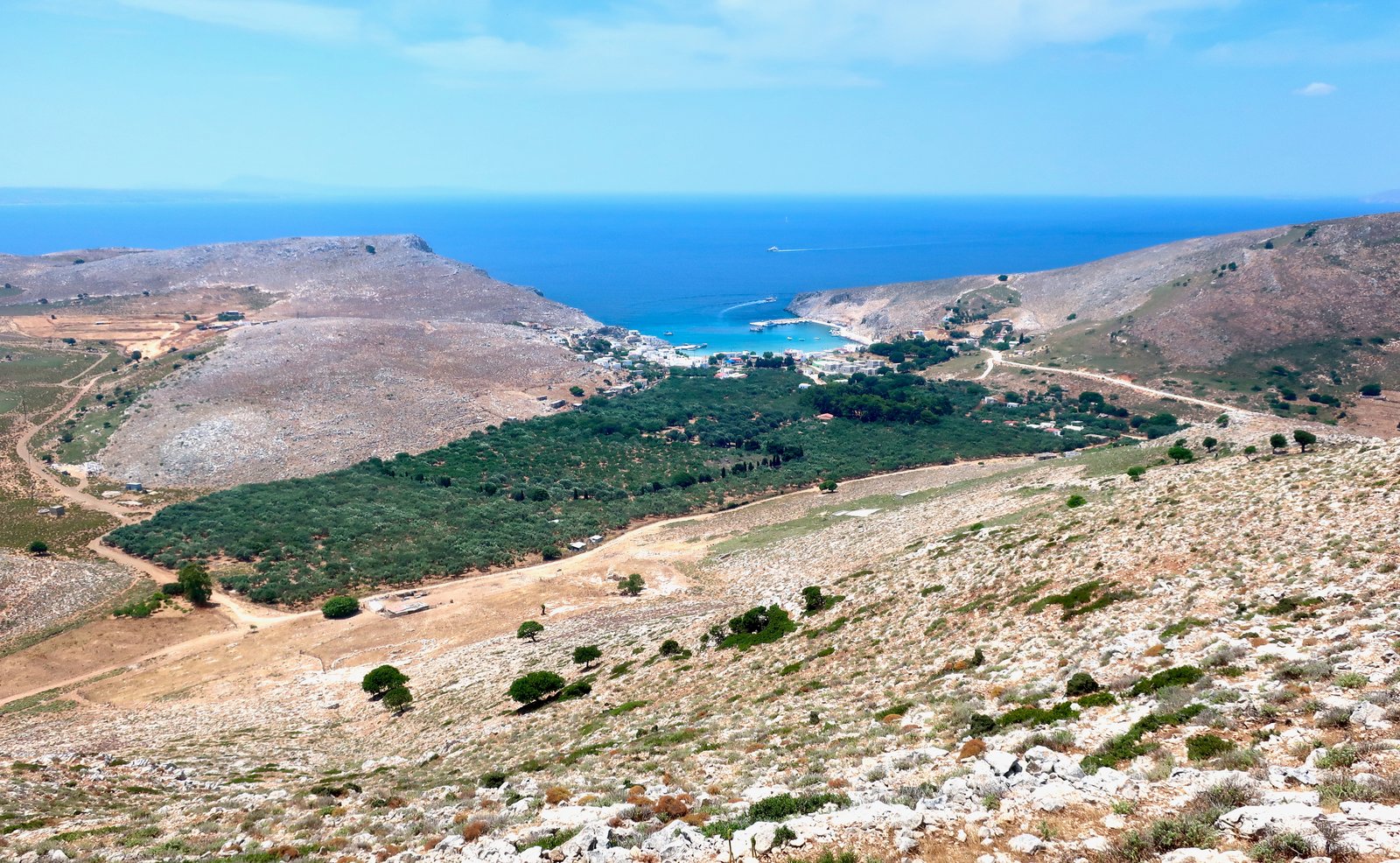
We got back as the flotilla of boats from Kos were pulling in. The rhythm of summer life, one hour in the morning, one hour in the afternoon. As usual everything was ready. Cafes, tavernas, tacky stalls, at one of which an elderly couple sell natural sea-sponges. Just before the boats arrive they each put on one of these sponges, very roughly fashioned into a hat. Then they wave at the people in bikinis and swim-shorts walking past.
We sit on the end of the beach and watch the pop-up world playing out and wonder if any of these visitors knows what’s happening? Do they ever go up behind the beach to see that just one hundred metres back the technicians, stage managers, controllers are checking that everything’s running smoothly, making sure the water’s clear, the ice-cream is varied, the beer comes in frosted glasses? Making sure that the old couple, who wave like Mickey and Minnie Mouse when the tourists arrive, who wave like Mickey and Minnie when they go, are wearing their sponge-hats, as they should be?
***
We sit around in the café in the morning imagining Zeus ranting in his unignorable Zeus voice, thundering how in the past there was Sparta and Athens and Corinth, there were naiads and dryads and deities in all the olive groves and streams, there were great heroes, there was Helen who launched a thousand ships, there were cyclops and harpies, the kraken, there was endless bacchanalia… all this and so much more and now there’s what? this future?
But when we lie awake at night listening to the chickens that the hundred-year-old woman next door still keeps, that start their squawking at four or five, as we toss and turn and stew, it’s not Zeus we’re thinking about and the future, the thing we really can’t get our heads around is that before it was a day-trip film set tourist destination, Pserimos, a real Pserimos, actually existed.