Hikers don’t go to Agathonisi. There are no trails. You can stroll around, on roads, off roads, through the low hills. Wherever you are, whatever island, you can always explore. You can discover bays and bits of coast that no-one ever goes to. You can have a small adventure.
People wanting to do nothing on holiday but sit around and read, swim, relax, go to cafés and tavernas – but not the fancy sort, and not a wide choice – they might go to Agathonisi. People wanting to get away from it all in a Greek island context – really get away from it all – who’ve stumbled across Agathonisi online and gone for it, might well be pleased with their choice. What with all the photos and come-hither holiday descriptions – even for Agathonisi there’s no shortage when you start looking – you never really know what it’ll be like until you get there, but Agathonisi actually is about as uncomplicatedly stripped-down a Greek island as there is.
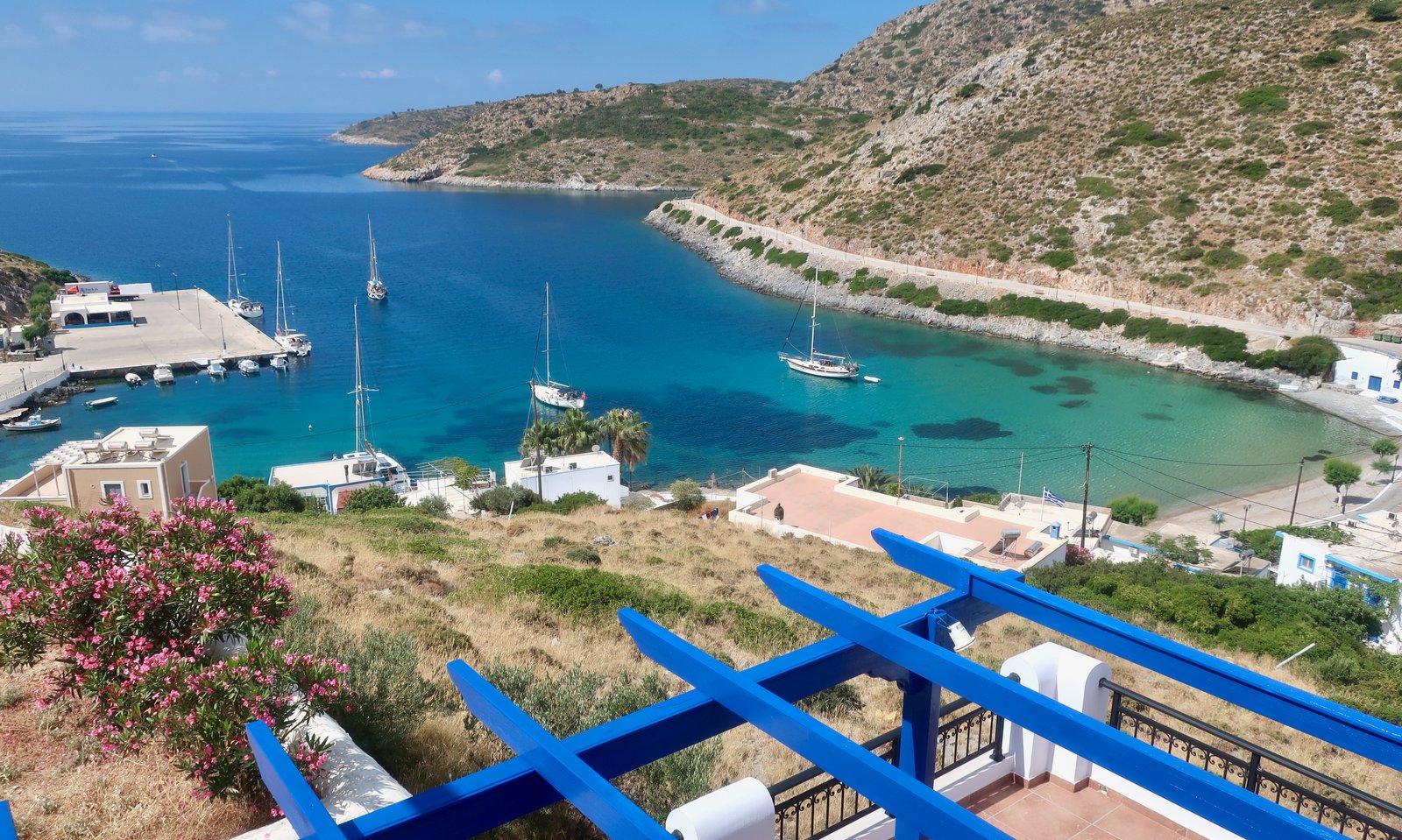
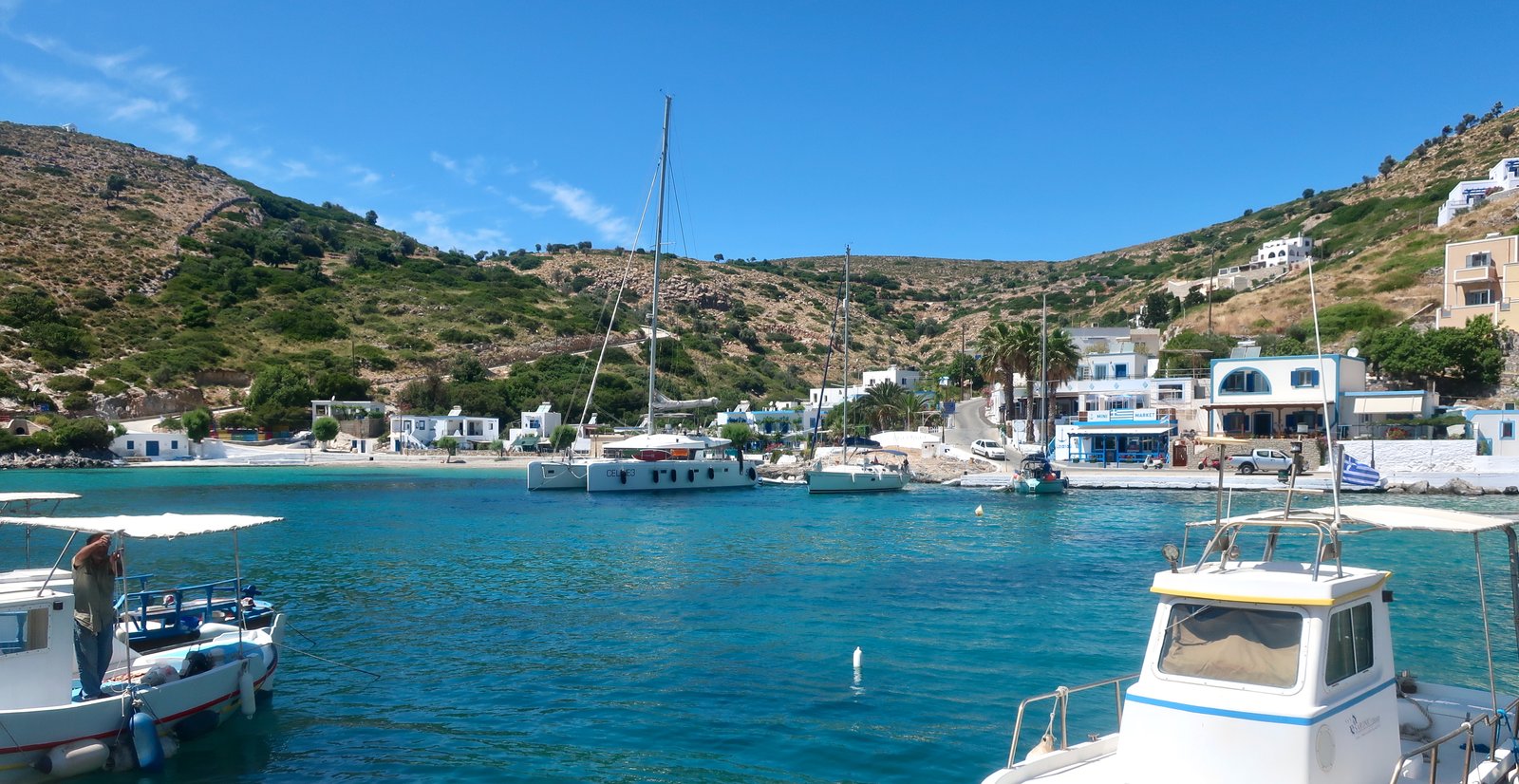
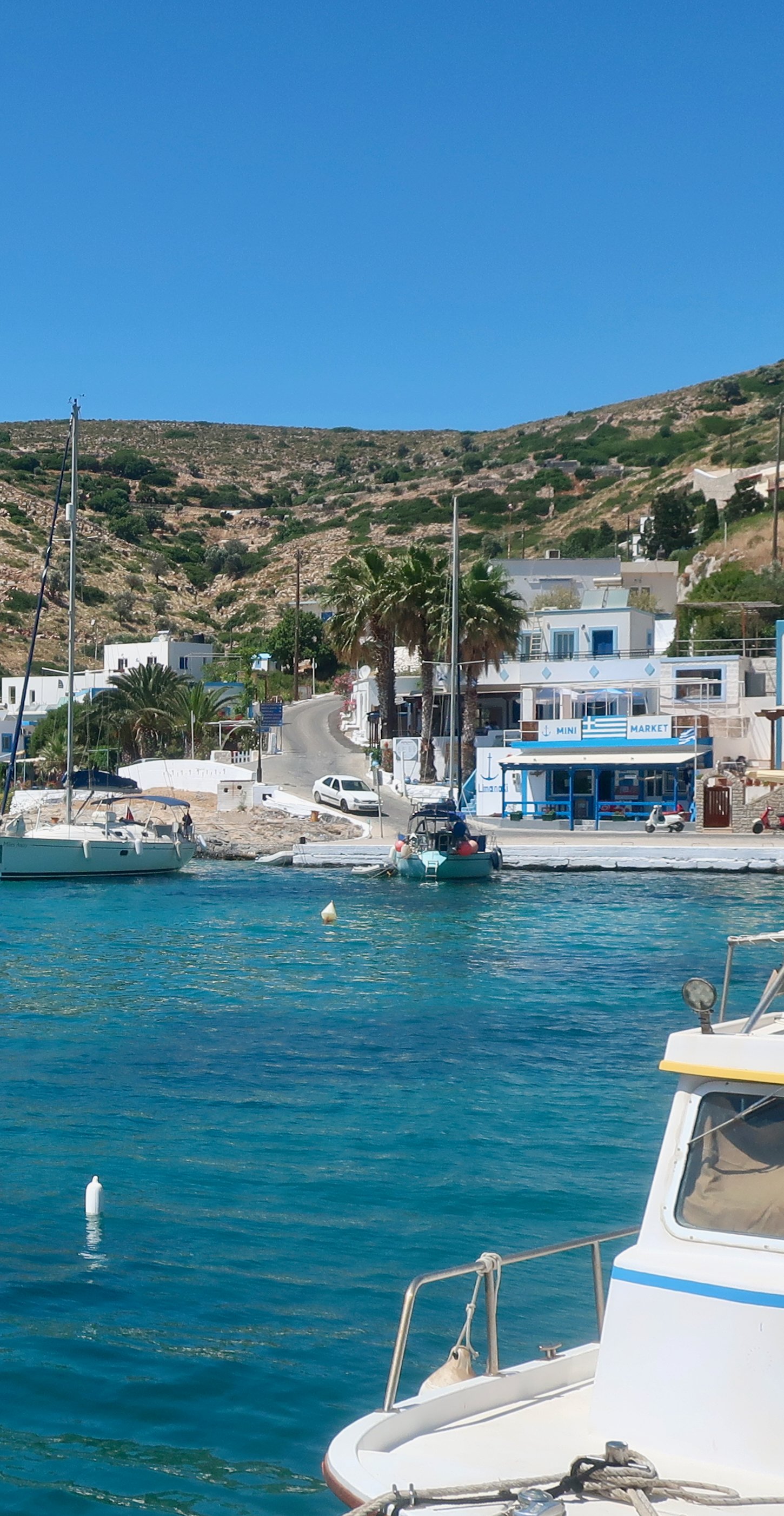
Coming in on the ferry on a sunny day it would be hard not to be a little bowled over. In the port there are a couple of dozen white buildings, a small pebble beach, a couple of cafés, and no wind – it’s on the protected, south side of the island. Always the question of wind; if you’ve spent much time in the islands – particularly, but not only, if you like to swim – it’s understood that wind can be a problem. But not here.
The only people who might not like the look of it on arrival would be those hoping for action of some sort. They haven’t done their homework.
This is Aghios Georgios, the port, according to a Greek holiday site:
A small place, with just enough activity going on down by the sea as is needed to prevent it from slipping into total somnolence.
Google translate might have missed a nuance there.
According to the internet, around 800 people visit each year. In Greek island terms, it’s nothing. Even so, when you start to divide it up a little, let’s say 80 people a week for ten weeks, it seems unlikely. Eight weeks? 180 a week for four weeks is probably closer – although it still seems a lot – with the rest coming in dribs and drabs. We were there in the first week of June and didn’t see anyone else, except that half a dozen yachts came and went, with maybe an average four to six people on board each one. Are they all included in the 800? That would make the numbers easier to understand. Where would everyone stay otherwise?
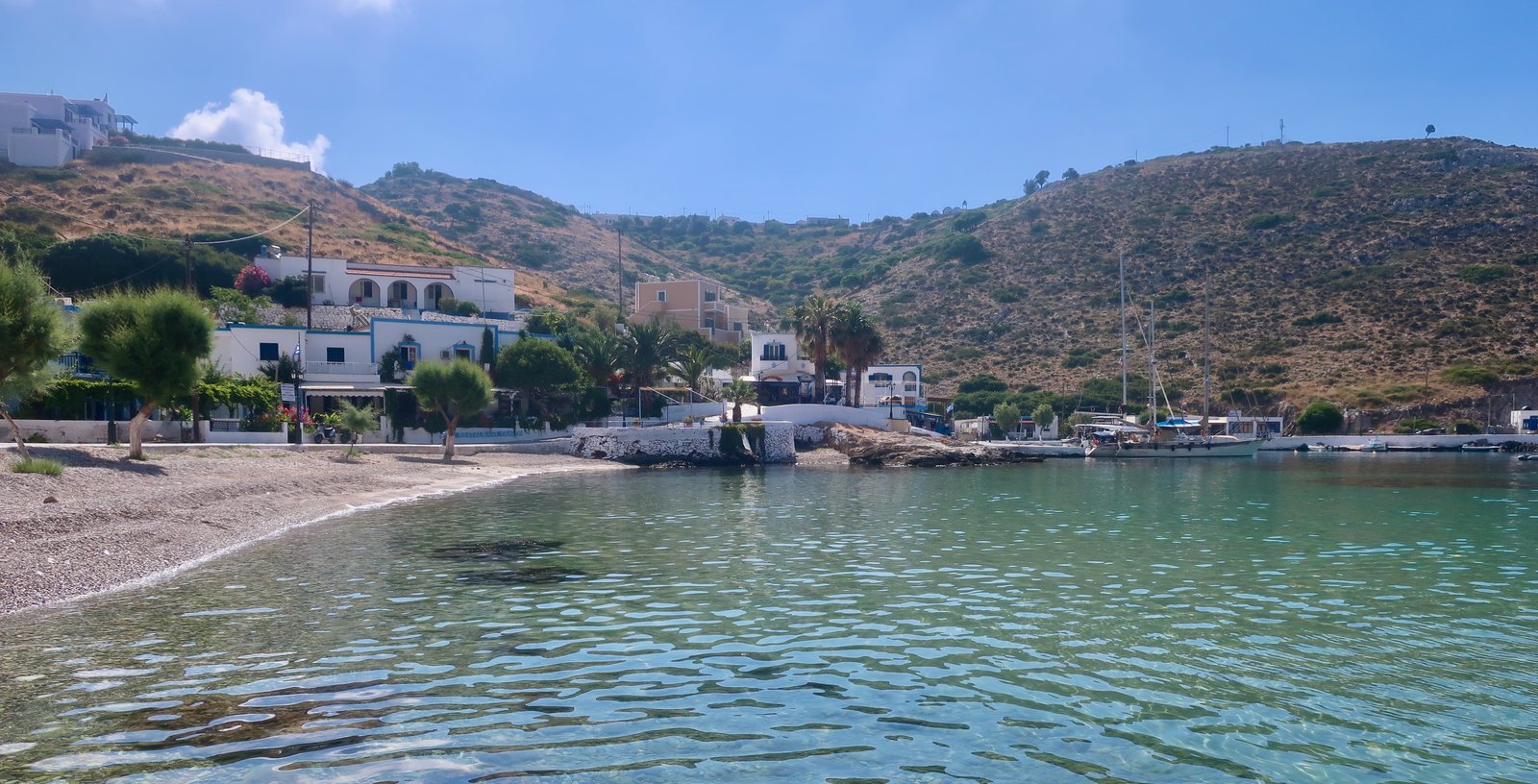
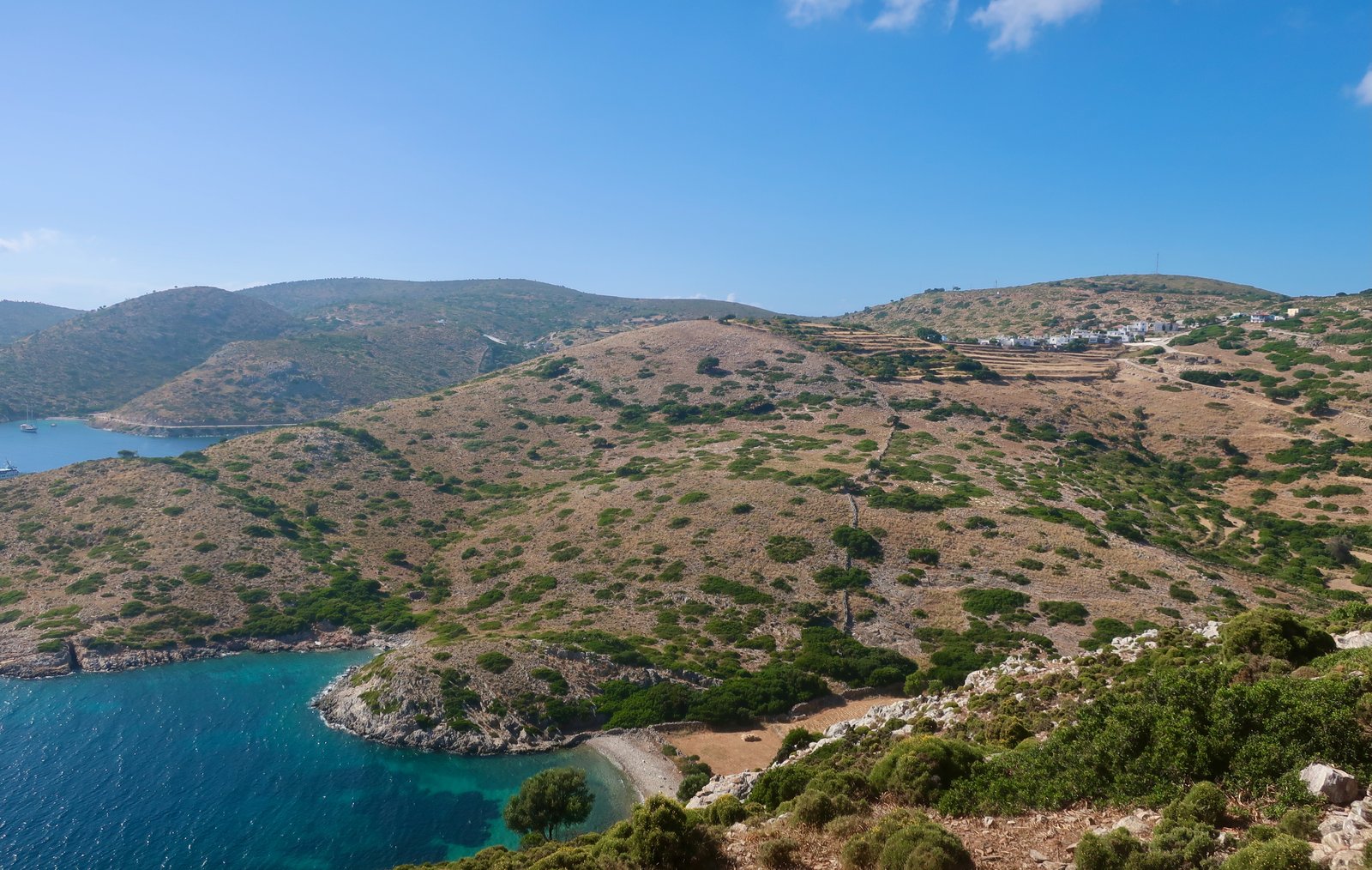
There are three settlements. The port, permanent population about fifteen. Mikro Chorio, less than 500 metres away just above the port to the left, permanent population fifteen, at most. Megalo Chorio, 500 metres away, just above the port to the right. Everyone else lives there. The total population therefore is…
…the first six results on google give the following figures: 185, almost 100, 200, 120, 190 and 112.
Information about the name of the island is similarly imprecise. In the distant past it was perhaps called Yetoussa, meaning island with many waters. Although that does seem unlikely in that there are no decent water sources at all, only a few brackish springs. At some stage it was also called a version of Tragaia/Tragaiai/Tragia, which may or may not have some grammatical link to the word tragedy. It was – may still be, locally – known as Gaidaros/Gaidaro, donkey in Greek. It’s supposed to have the shape of a donkey. In Turkish it’s called Eşek Adası, donkey island.
Agathonisi, the modern name, may alternatively come from a corruption of agnathia, thorns, and nisi, island. Island of Thorns. Not much grows on the island, the soil is poor, so this one makes sense. (But how many other Thorn Islands might there be in the Aegean?)
Tourist material about the island makes much of the friendliness of the inhabitants. Agathos can mean nice, or kind, in Greek. Come to Agathonisi, Kind Island. Several sources suggest that the islanders chose the name themselves, relatively recently. Maybe fifty years ago. Maybe at the beginning of the twentieth century. Possibly they didn’t like Donkey Island.
Several more sources tell how the name Agathonisi was given to the island by a priest, around the beginning of the last century, and that it means not island of the good, but island of the naïve, or foolish. Isle of Fools. It’s easy to imagine a new priest turning up on the island and being frustrated in some way by the obtuse islanders.
Island of the Waters, Island of Thorns, Tragic Island, Donkey Island, Island of the Good, Island of Fools.
The people were very nice when we were there. It’s possible they simply are nice, but also that they’ve been influenced by their own tourist blurb. It’s equally possible that we were influenced by the tourist blurb ourselves and interpreted every gesture in the best possible light.
The island is seven kilometres long and four wide, with a maximum height of around 250 metres. By Greek island standards it’s almost flat, nothing but a gathering of soft hillocks. Throughout its history it has been only sporadically inhabited. Doubtless one of the reasons for this inconstancy is the absence of a defensible crag or good hiding place. It’s only since the eradication of piracy in the nineteenth century that Agathonisi has been uninterruptedly settled.
In or around Aghios Georgios there’s some tourist accommodation, a seasonal minimarket, and three or four places to eat and drink. In Megalo Chorio there’s a bakery, open from 08:00 to 08:30 every other day when we were there, and a minimarket. There are no buses, very few cars. You can buy ferry tickets from the local priest, who doubles as a travel agent, who when the boat comes in climbs on board in his sombre garb to hand over the takings. Sitting in the shade of the tamarisk trees along the beach you can watch the policeman, who directs the ferry’s arrival as if in Piraeus – clear hand signals, (almost non-existent traffic), This way please, No closer, Wait… Wait… – who will perhaps strip off his uniform later, don a wetsuit and flippers and dive down to dislodge a stuck anchor for one of the visiting yachts, as we saw him do one unusually animated afternoon.
There was a classical settlement called Kastraki on the mid-north coast, built on a small promontory sheltered from the north wind by the long finger of Cape Lianovaki. As with Irakleia, it too with no fresh water and yet the same imperative to build, to be protected within their own massive walls, you cannot help but wonder at the doggedness. It’s easy to imagine that on both islands water, the dearth of it, was always at the centre of things.
When we were there in 2019 they had almost finished building a brand new museum at Kastraki, an incongruous concrete bunker of a thing. Way out there, on an island that hardly anyone visits. Presumably the idea is to showcase whatever has been and will be found at the adjacent classical site and in so doing attract visitors. The raising of the money for this whitish elephant must be a story. For now, it appears to be in a state of suspension, not visited by tourists, according to the Exploring Greece site, but by hundreds of wild goats. There were a fair number sheltering in the shade of the museum’s walls when we arrived and countless thousands of their chickpea-sized pellets all over the museum’s unfinished terraces.
If you visit the site you’ll almost certainly have it to yourself. The remains are limited, the choice of location for the original town restricted but logical, on a low nose of land between two miniature beaches. It must have been a poor little backwater place, very far away from the enormity of the citadel on Nisyros, a little further to the south, or the large settlement near Pythagoreio on Samos just to the north, where significant fragments of the defensive walls testify to a wholly different scale of size and prosperity.
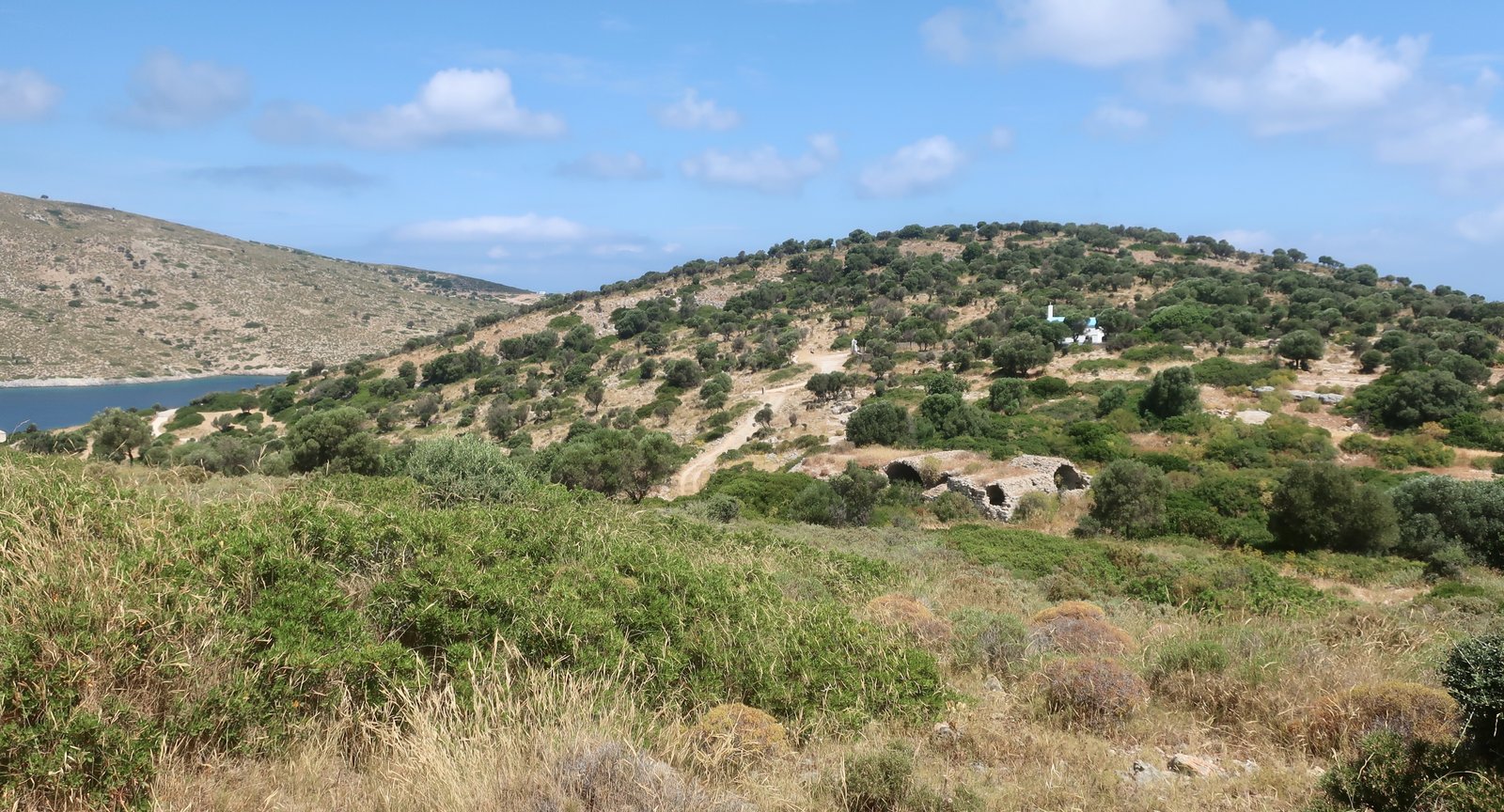
In guides to Agathonisi, the other historical vestiges generally mentioned are the tholoi, domed Byzantine warehouse-structures in the far east of the island. The site however is closed, and even for history buffs, at the outer limit of interesting. But the stroll is nice and if you do go cross country, here or elsewhere, there’s the usual headfilling smell of wild herbs, especially sage. Much of the island is thick with its bittersweet smell.
From Palos Bay, a kilometre and a half due east of the port, it’s a nice, casual wander to the eastern headland of Aghios Georgios Bay, on top of which sits Agios Charalambos, where, in order to facilitate access, an unnecessary dirt road has been savagely cut into the hill.
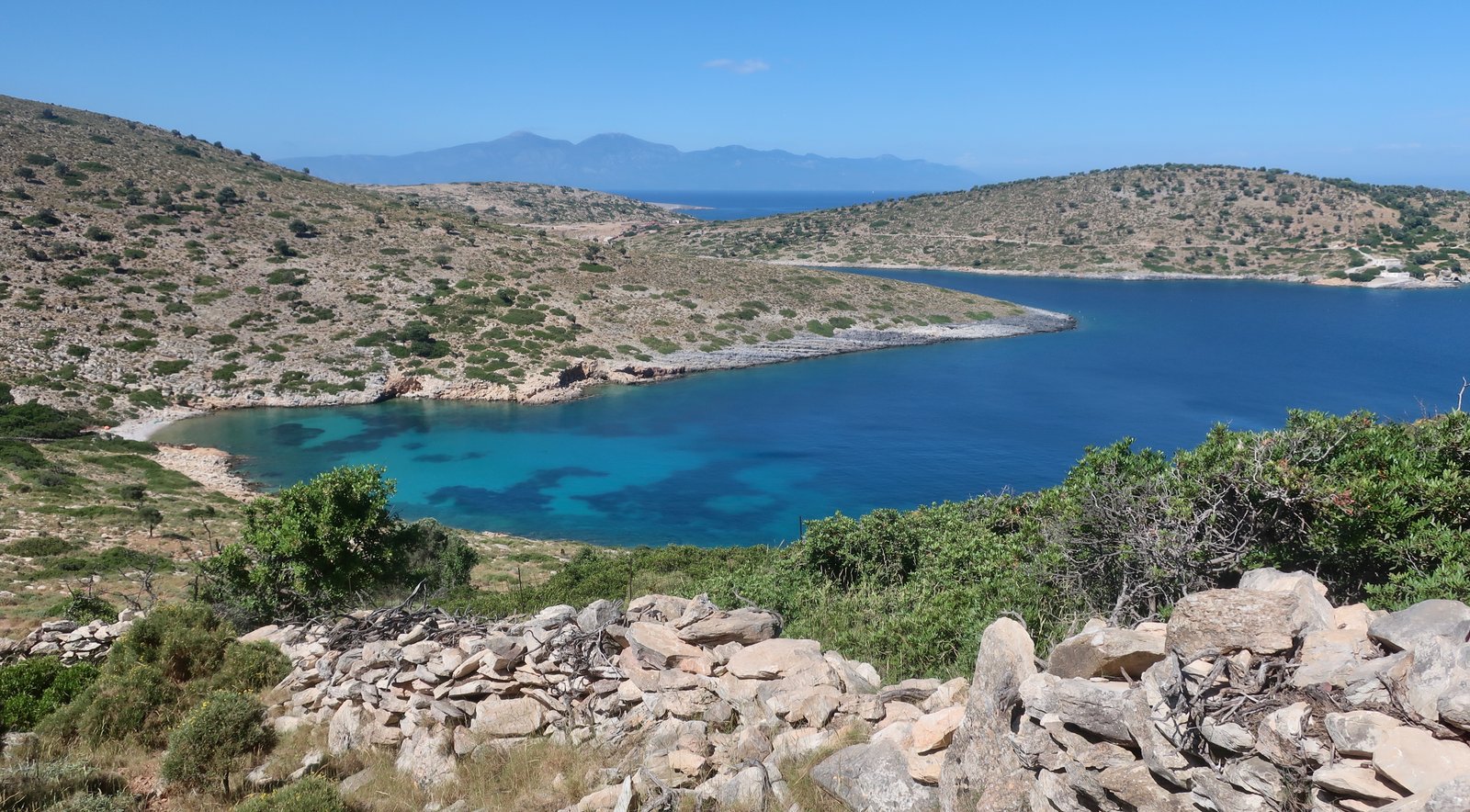
On the western half of the island there’s nothing at all but a short road out of Mikro Chorio that soon comes to an end. There are not even any churches after Agios Panteleimonas in Mikro Chorio.
Agathonisi has the Greek island recipe pared to a minimum. It’s another of the places we think maybe we’ll revisit, sometime, not quite yet, where we’ll swim from the beach in the port in the morning, out around the bay into Spilia Beach next on the right, maybe further still to Little Donkey Beach. Then who knows, perhaps we’ll continue on. Because you can, stopping and starting as you like, Aghios Georgios Bay is so large, and calm. At some point we’ll cross the bay, gliding through bottomless water while looking out for the ferry, and will explore the other side before turning back. Achy-exhausted, pleased with ourselves, we’ll sit underneath the tamarisk trees on the back of the beach then go to the café for breakfast. After that we’ll read, swim some more, read a lot more, cook some nice food, go to the bar. From time to time we’ll go for a stroll. Maybe, if the mood takes us, we’ll examine more closely the idea of an island-circumnavigating hiking path, about which we’ve wondered. And we’ll talk. That’s it. And then the next day we’ll do the same again, and it’ll be perfect.