Few people visit Psara. For most of the year there’s one ferry a week from Piraeus, one from Chios. There’s no car hire on the island. No public transport. The port is the only settlement, with barely any accommodation for visitors.
As with other out-of-the-way islands, ferry times are invariably antisocial. We arrived in the middle of the night. Our host showed us in, gave us a minimalistic map, indicated on it the minimarket, the bakery, and crept back to bed. Full of the commotion of arrival, we went for a night-time stroll through the town. There was enough erratic streetlighting to get around but still an impression of absolute blackness.
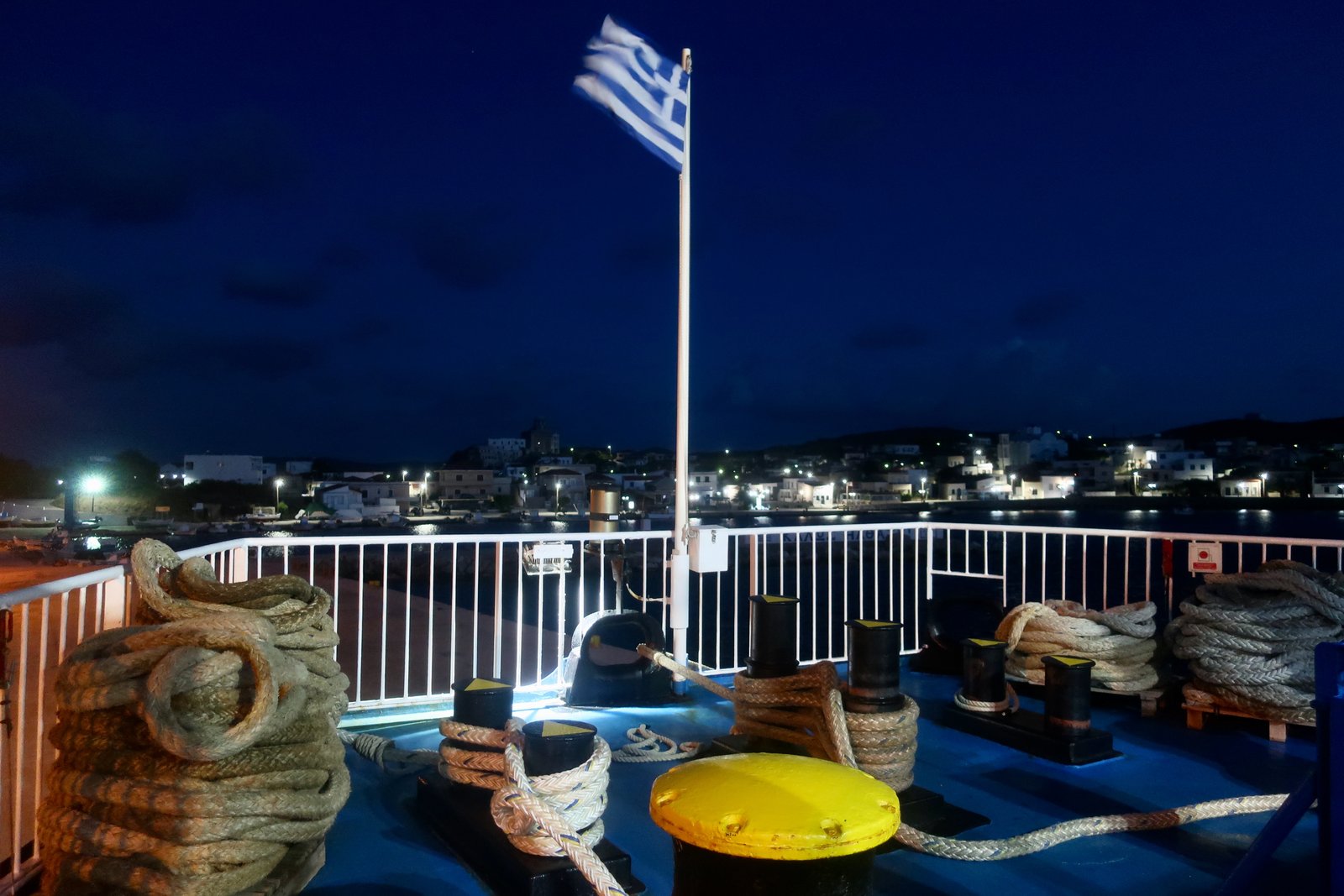
In the morning, just in front of our room, wavetops were being torn apart by the wind. Two or three children on bicycles paused to stare at the wonder of foreigners in shorts. Psara seemed almost as ramshackle as Antikythera, but where only twenty-five people live on Antikythera, on Psara there are four hundred and fifty. On the internet it says the population can double in August, when Greeks with roots on the island come home. As if doubling is a thing in the Aegean where the biggest ferries can disgorge nearly two thousand people at a time.
The bakery is not so much bakery as anonymous door slightly ajar. No reception area, no shop to speak of. On a cooling rack just inside, a dozen loaves. We’ll be closed tomorrow, the baker warned, do you want two?
There was one open café. Three very old men sat curved over their coffees.

SOME HISTORY
In 1821, at the beginning of the Greek War of Independence, Psara had the third biggest navy in Greece after Hydra and Spetses. There’s little agricultural land on the island, Psariots have always been fishermen and mariners.
The poverty of its land, with not even enough vines to make the customary libations to Dionysos, was noted in antiquity.
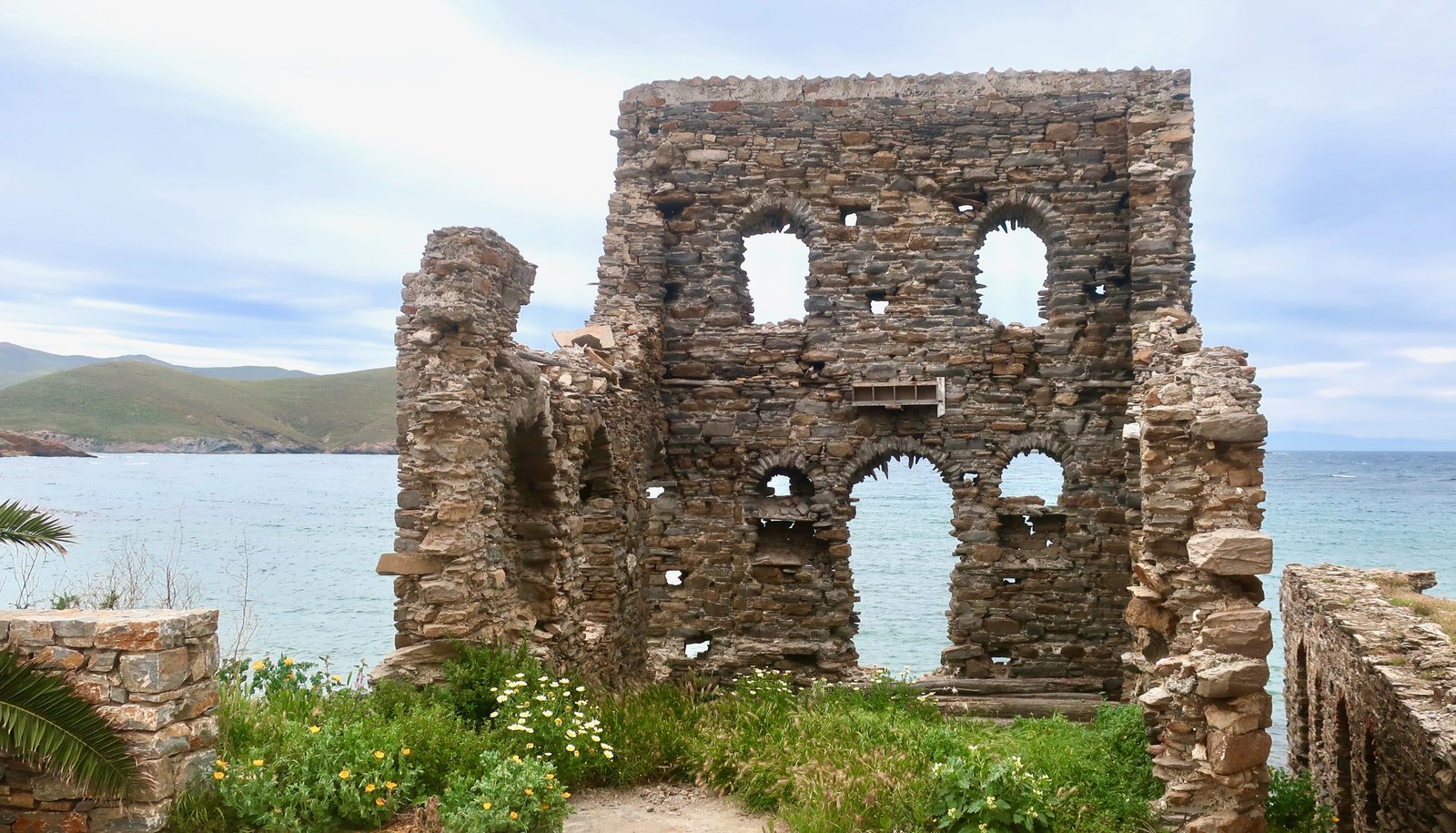
In 1824 the Ottomans, stung by the damage the Psariot ships were inflicting on their navy, launched a massive attack on the island, home at the time to seven or eight thousand Psariots plus between ten and twenty thousand refugees. At the end of a brief siege, the last several hundred men, women and children, having barricaded themselves inside the old fort on the Black Ridge, the promontory next to town, threw out a flag on which was written “Ἐλευθερία ἤ Θάνατος” (Freedom or Death). When the Ottomans forced their way in, the defenders set a match to their own gunpowder store, killing themselves and many of the Ottomans. An eyewitness likened the blast to the eruption of Vesuvius. For the next hundred years the island was uninhabited.
***
Today, in all Greek schools they learn about the Destruction of Psara. Looking it up on google, Destruction, Massacre and Holocaust are interchangeable.
The island never recovered. The whole of history comes back to this event. Still today on Psara you could almost believe in the Homeric Hades, the living and reliving of one defining moment for eternity. When we left to make the short hop to Chios, it was on the island’s own small vessel, the Psara Glory.
There’s not even any obvious evidence of another past. Because of the poor soil, the ubiquitous terraces, scraped and scoured into hillsides all over the islands, are absent.
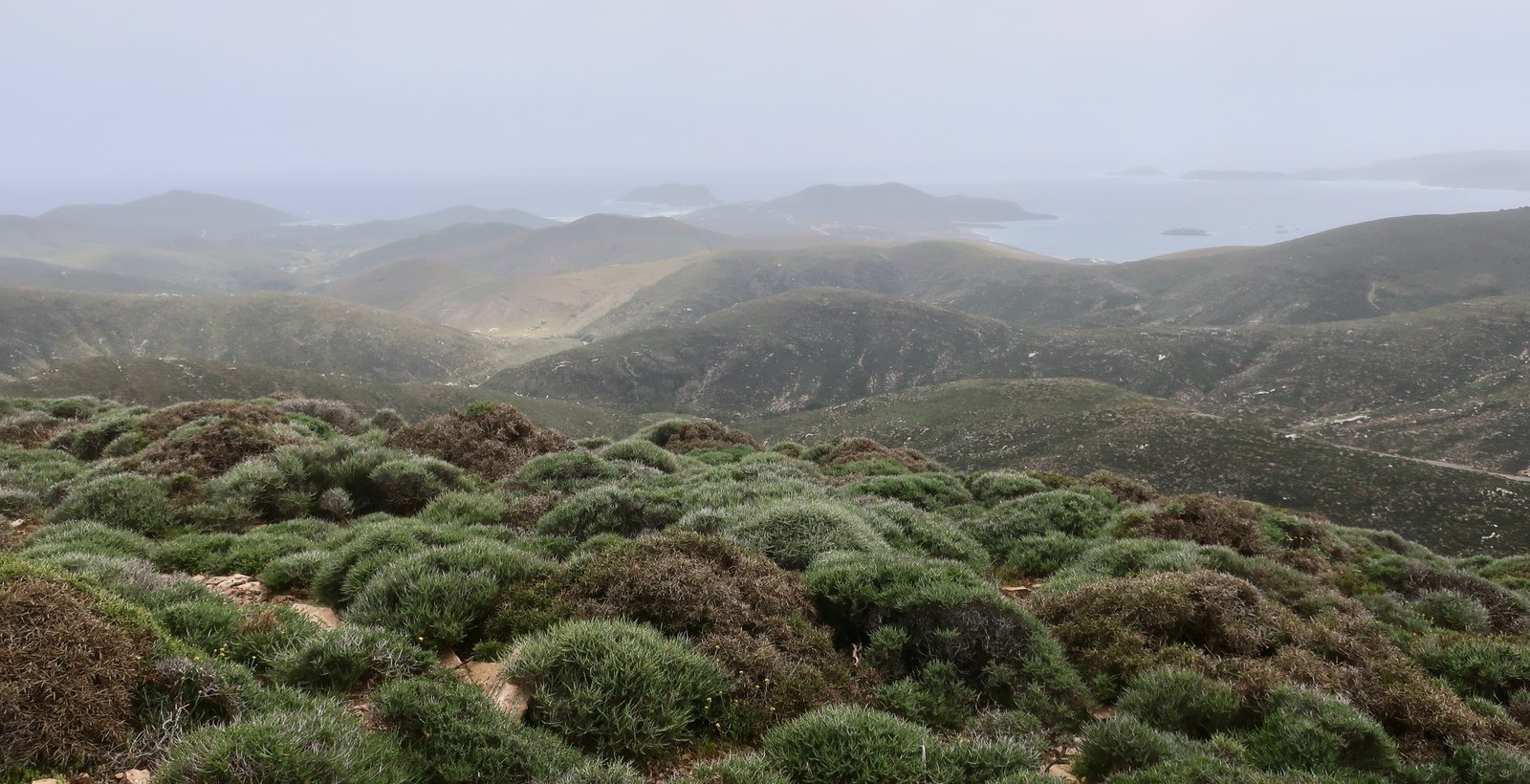
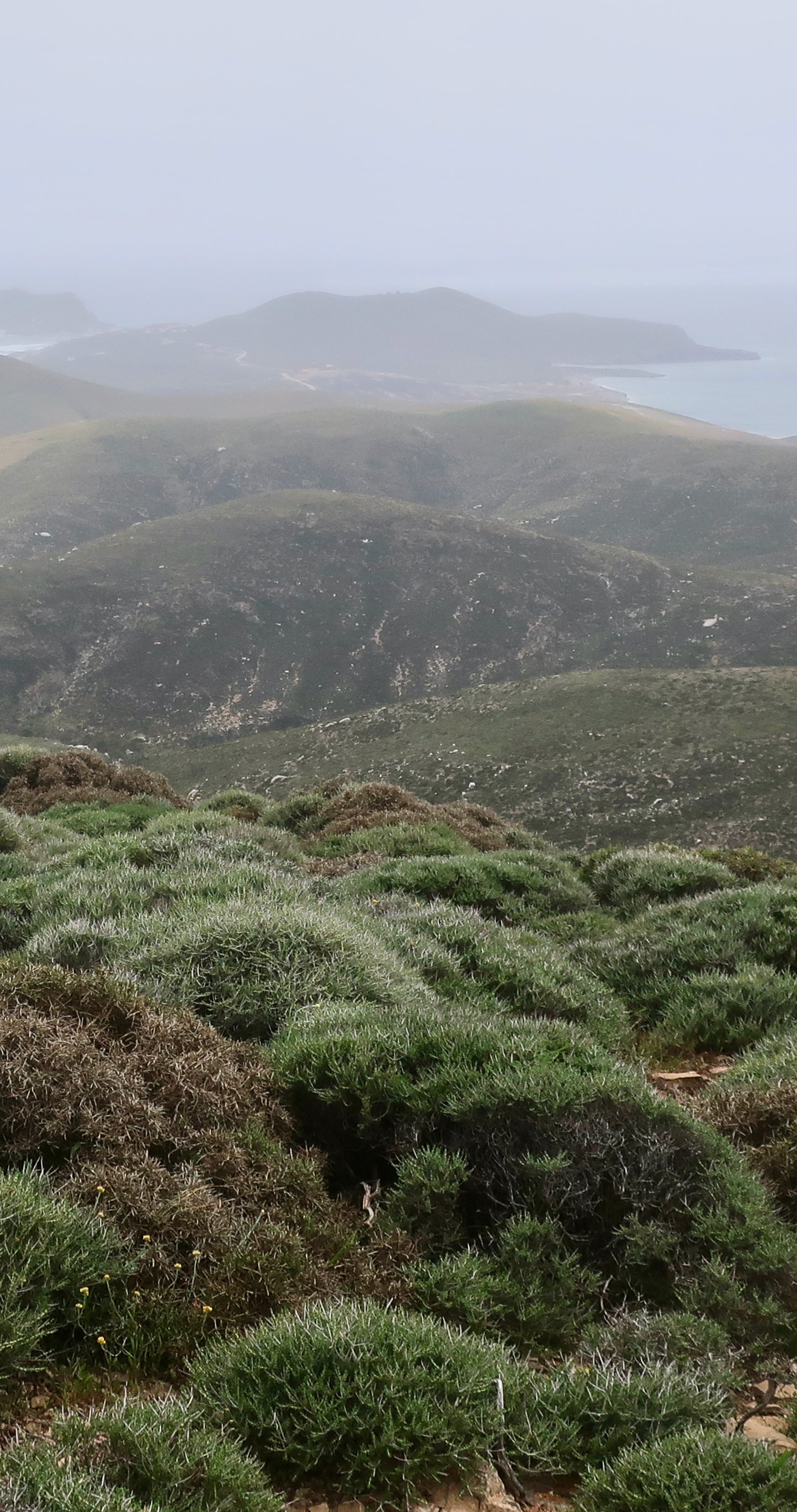
Psara is almost completely without trees. There must have been some in the past, even with the poor soil. How else would they have built their ships? It seems likely that the shaved landscape of today’s Psara is the price paid for the high days of the Psarian navy. In early springtime when we were there, it was an origami island, an olive green nest of folds and creases.
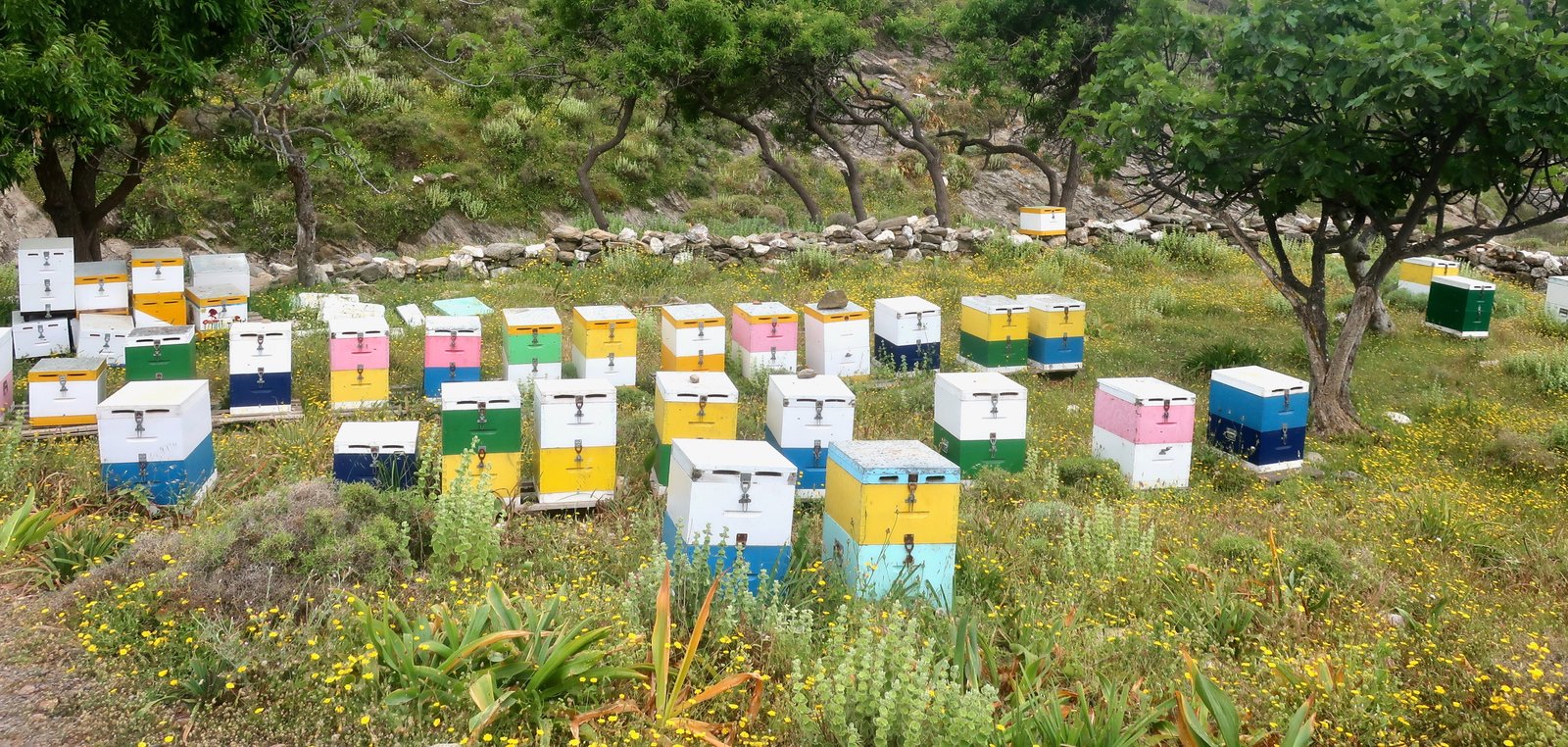
Now they produce thyme honey. Whole hillsides are covered in thyme plants, more than we have ever seen. In order to be classified as thyme honey, there has to be a concentration of at least 18% thyme pollen, whatever exactly that means. Psarian honey has been measured at over 91%.
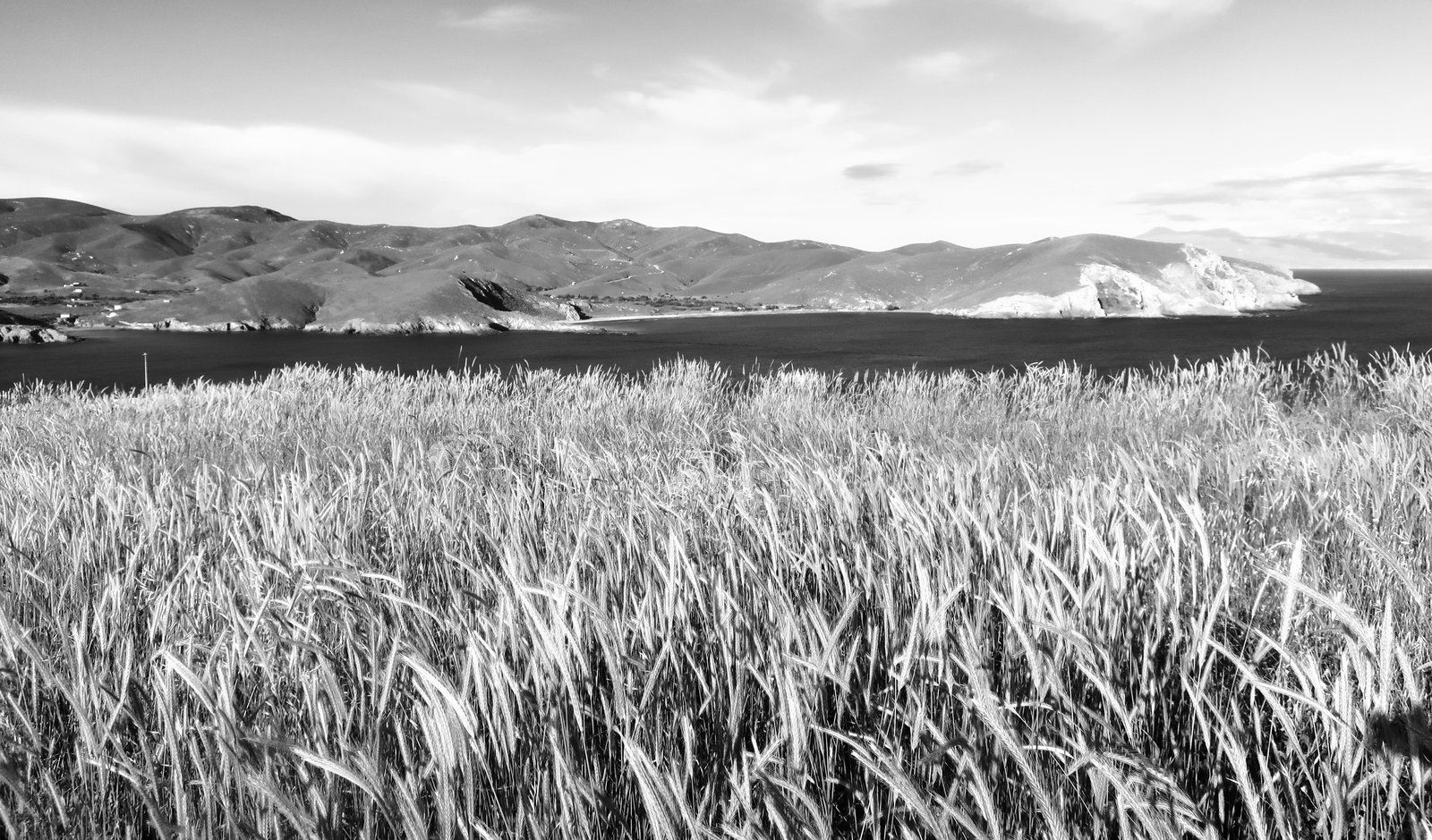
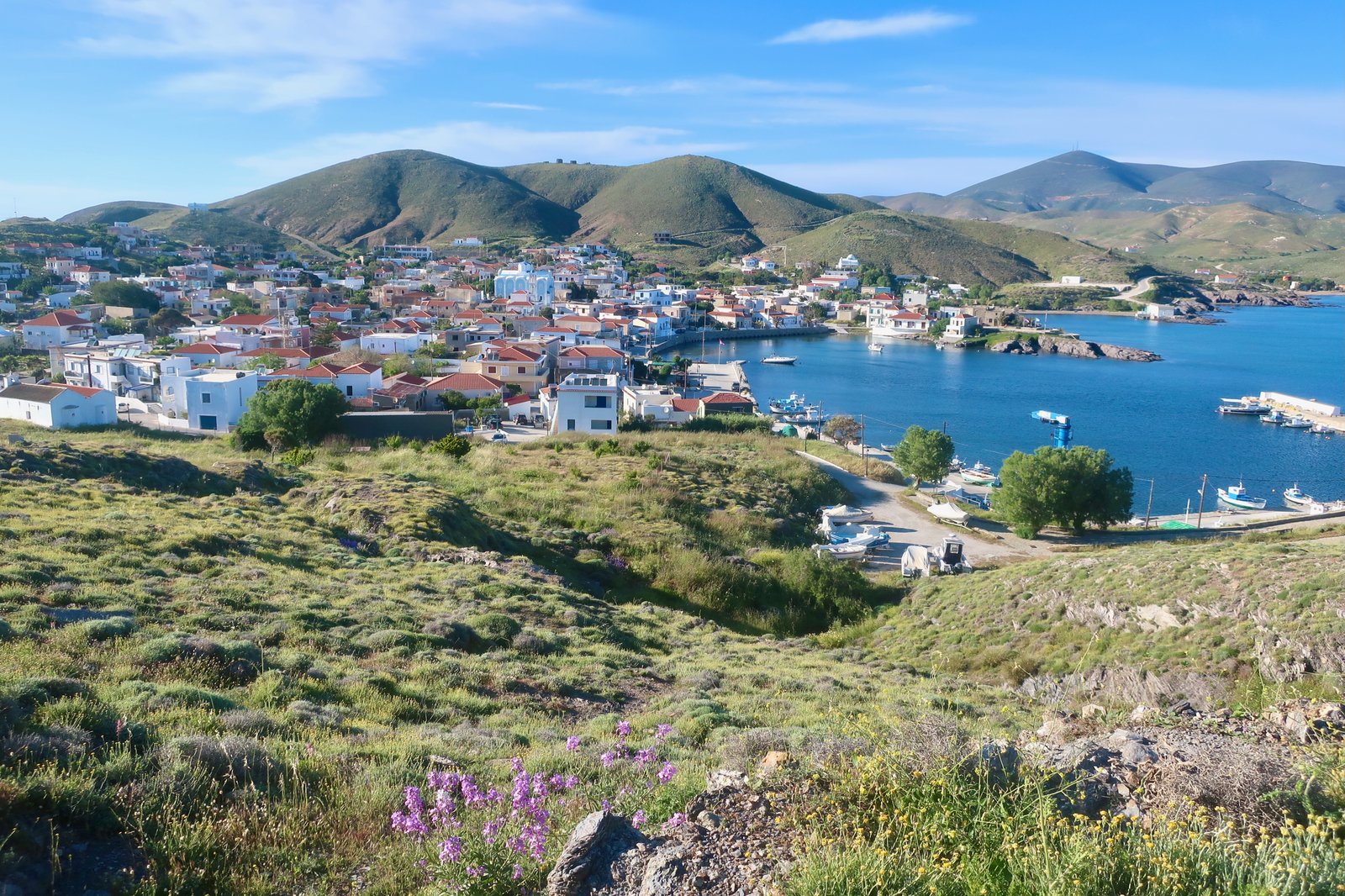
Rain and wind and a landscape you could wring out, and then the sun comes out and the illusion of photography can almost make Psara look like some sweet Nordic fishing port.
On our last day we checked the weather forecast as usual. Drizzle, it said, and strong wind for the afternoon. Beware of falling branches. The person who wrote that has never been to Psara.
HIKING
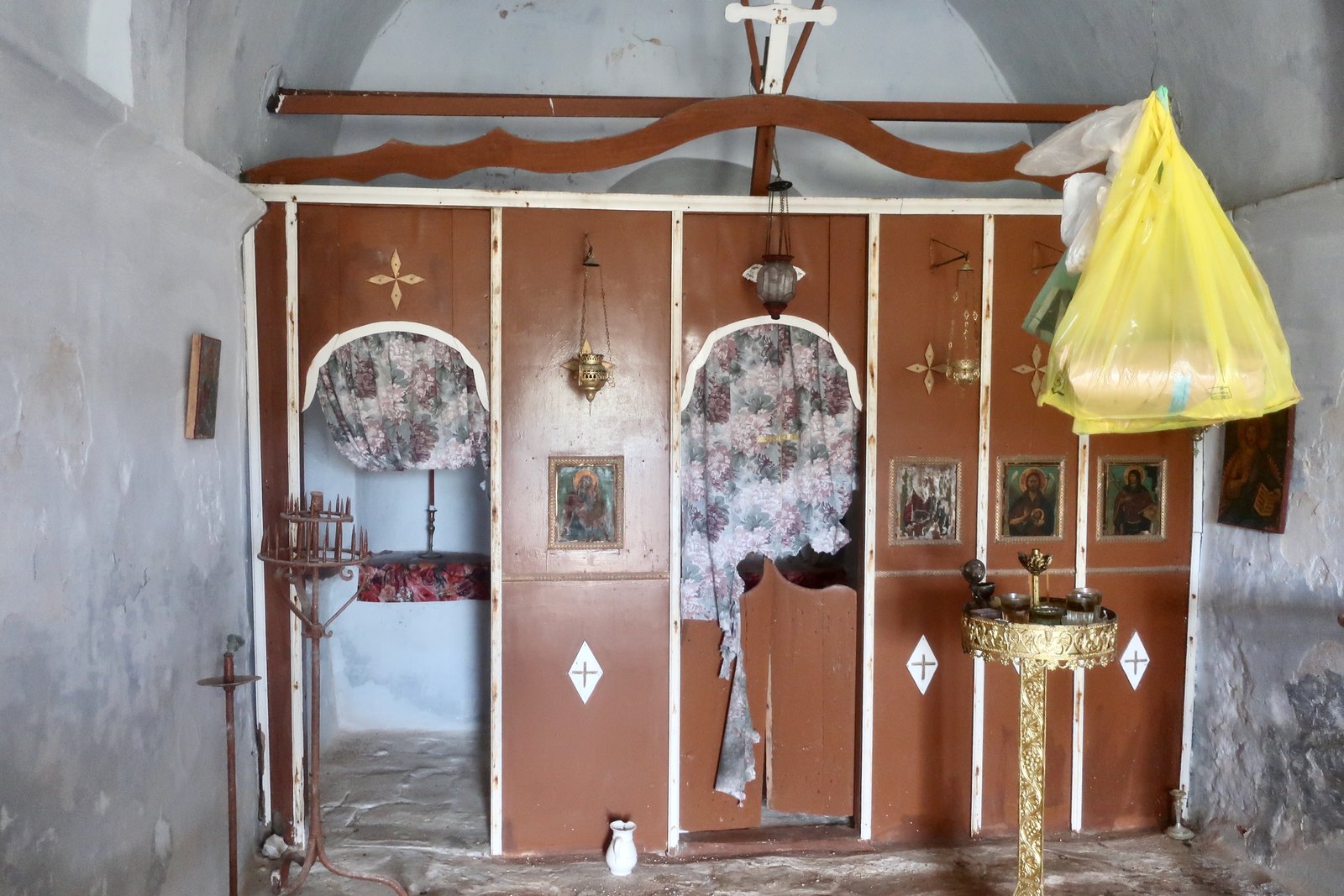
Because there was never much agriculture on Psara, because there’s only one settlement, there was probably never any need to make the network of paths that formed the arteries and veins of life on most other islands. The churches – and on the Terrain Map more than fifty are still marked – are small and terribly basic.

The three numbered trails on the Terrain Map, that together make a total of less than six kilometres, are pretty much irrelevant.
HIKE 1
Approximately 18 kilometres
We walked through the hills along the south coast to the lighthouse on the southeastern tip between Cape Aghios Georghios and Fournos Beach, passing by Trail 2, which we ignored. There were no paths, just a picking between spike bushes, thyme and rocks over easy terrain.
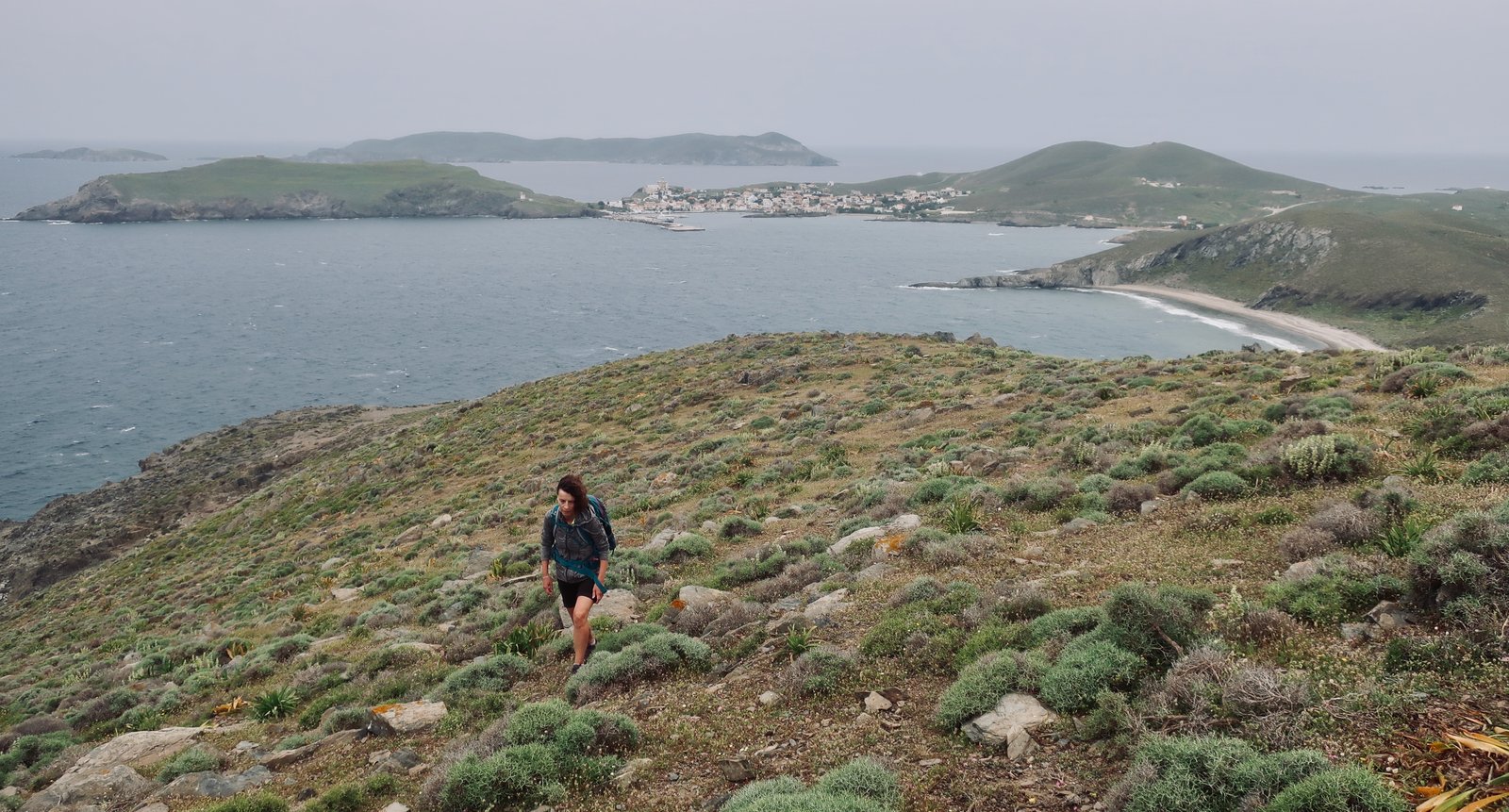
From time to time there are beaches to descend to – Limnos, Limnonaria, Fanari. It’s not possible to hug the shore because of the many cliffs.

Somehow we managed to do about eighteen kilometres, wandering around, exploring, up and down small hills.
HIKE 2
Approximately 25 kilometres
A three-church-circuit through the heart of Psara, loosely following a hypothetical path that mostly didn’t exist, marked on the Terrain Map as faint.
Leaving town on the road heading east, after a couple of kilometres we turned left on a dirt track heading for the church of Aghios Ioannis. But instead of going there, we turned right after about half a kilometre, towards the tiny church of Aghios Georghios. As mentioned above, the path basically doesn’t exist. You need the map and GPS.
Up and down small hills all day, never more than 300 metres of ascent. The highest point on the island is only just over 500 metres. In some places it’s hard going through a landscape that from a distance might be tight-curled greenish fur, or even dark bread-mould, but which from close up is all spike and thorn. You walk on tiptoes from small clearing to small clearing, a mazy course. In these prototypical Aegean landscapes an ancient army, in sandals, bare-legged, or even with the partial protection of greaves, would be a hobbling horde.

In April the whole island was shades of unbroken, pointillistic, grey-green.
Wind swings its way through the hills, down valleys, around small summits. High-points are rarely high enough to offer much protection. Everywhere the smell of thyme. Never have we been anywhere quite like this. Here and there small tracks lead to clusters of multicoloured bee hives, places through which we move quickly, where the air is full of deep humming and seems almost to be moving.
From time to time we catch sight of Psara town, but mostly there’s nothing but wilderness over which the damp wind blows. Occasional small streams seep.
Whereas on most islands we’re wary of the goat-paths that lead us astray, here at times there are nothing but goat-paths to follow. They twist and turn over the hillsides. When they come to an end, we find ourselves stranded, again, in a quilt of thick, knee-high thyme and spikes, and have to go back, divert off, search all around for a way out.
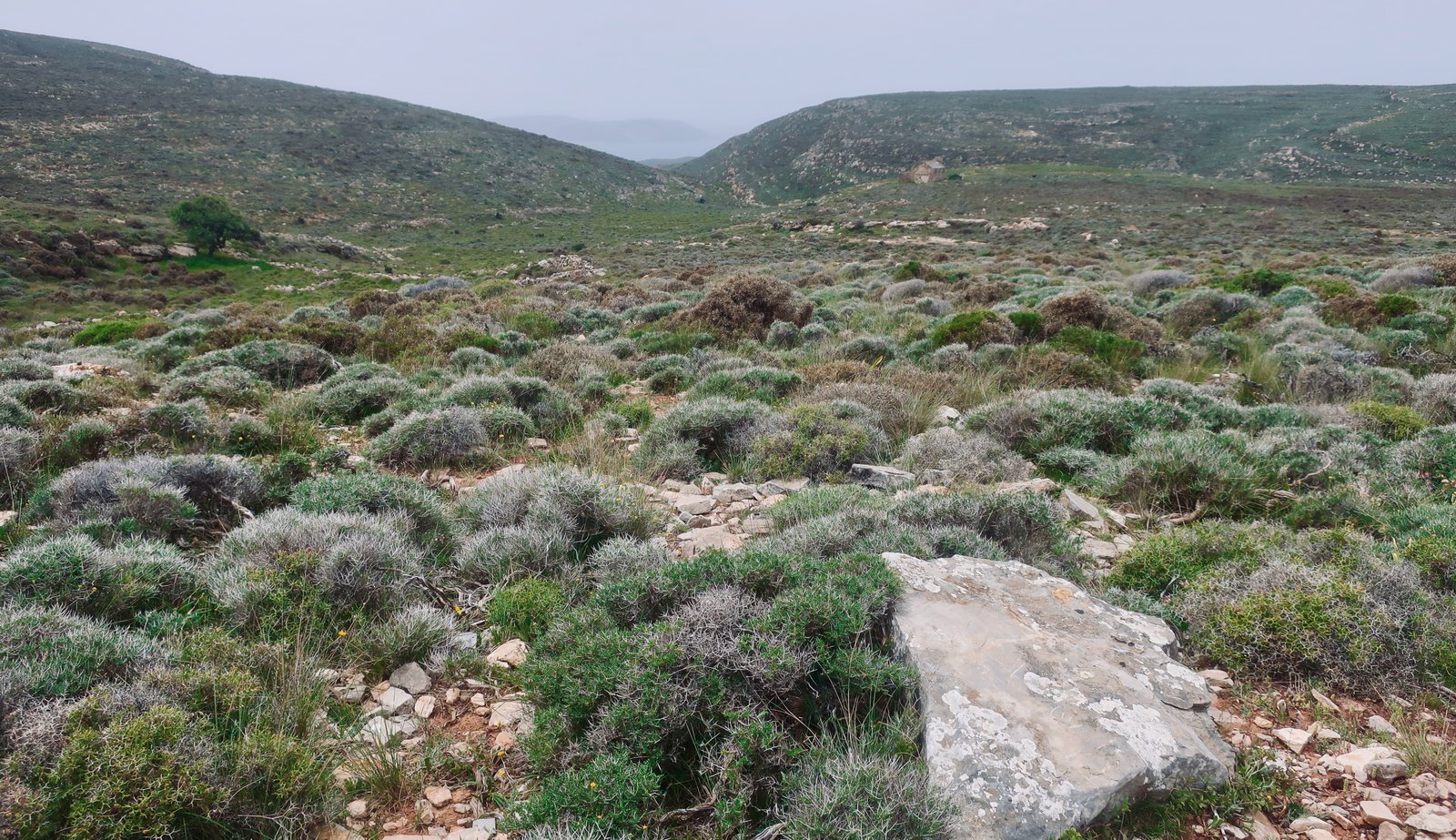
The second of the churches, Aghia Kioura (Matrona) is slightly the highest of the three. Rather than go around the little hill of Ambelia to get there, we went up and over. The church blends into the landscape, a wintry mirage.
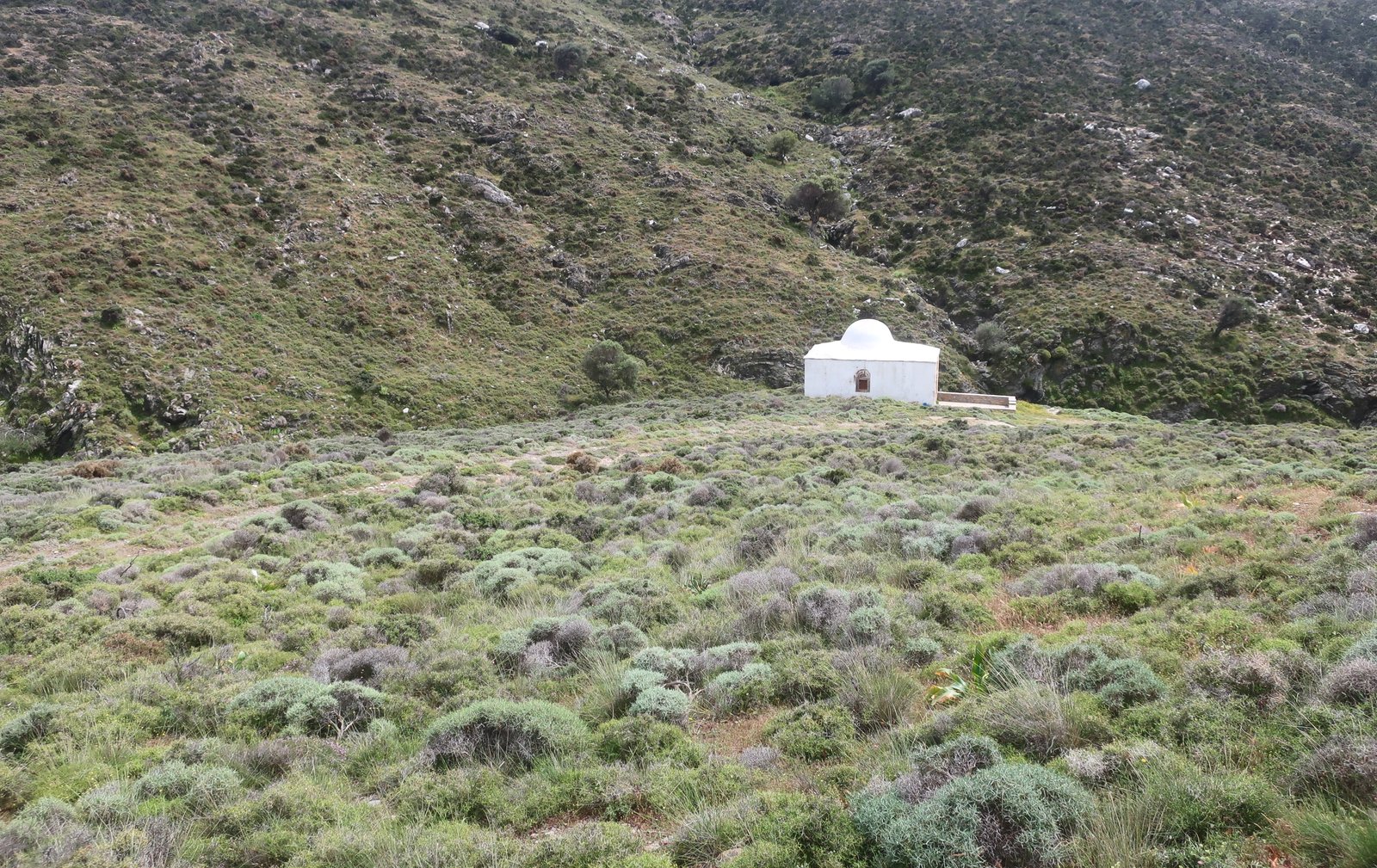
The third church is Panaghia Spiliani, a blob of confectionary just above the bottom-point of another small valley.
From there, a track leads northwest onto the main road connecting Psara town with the Theotokou monastery in the middle north of the island. Road’s-end. There really is nowhere else to go from town but north to the monastery and east to the lighthouse.
As we approach the road and lose all shelter, the wind gets stronger and stronger and Yvonne says You have to record that sound, the wind screeching so loud through the overhead wires we have to shout to be heard. Sometimes it’s so powerful we have to lean far forward before lifting a foot off the ground. We move like undersea creatures, battling not to be swept away in the current.
A car, the only car we saw all day, stopped to offer us a lift. The woman driving must have been to the monastery. But the wind! she said, when we turned her down. And, Where have you been? When we pointed, she shook her head at the inconceivability of it. Still she wanted to talk. The important questions: Where are you staying? How long? Do you love my island?
We told her it was very beautiful, that we like all the islands.
We have no trees, she said. Then appeared to think about it. The Turks.
I told her I didn’t understand.
She paused. They must have burnt all the trees.