
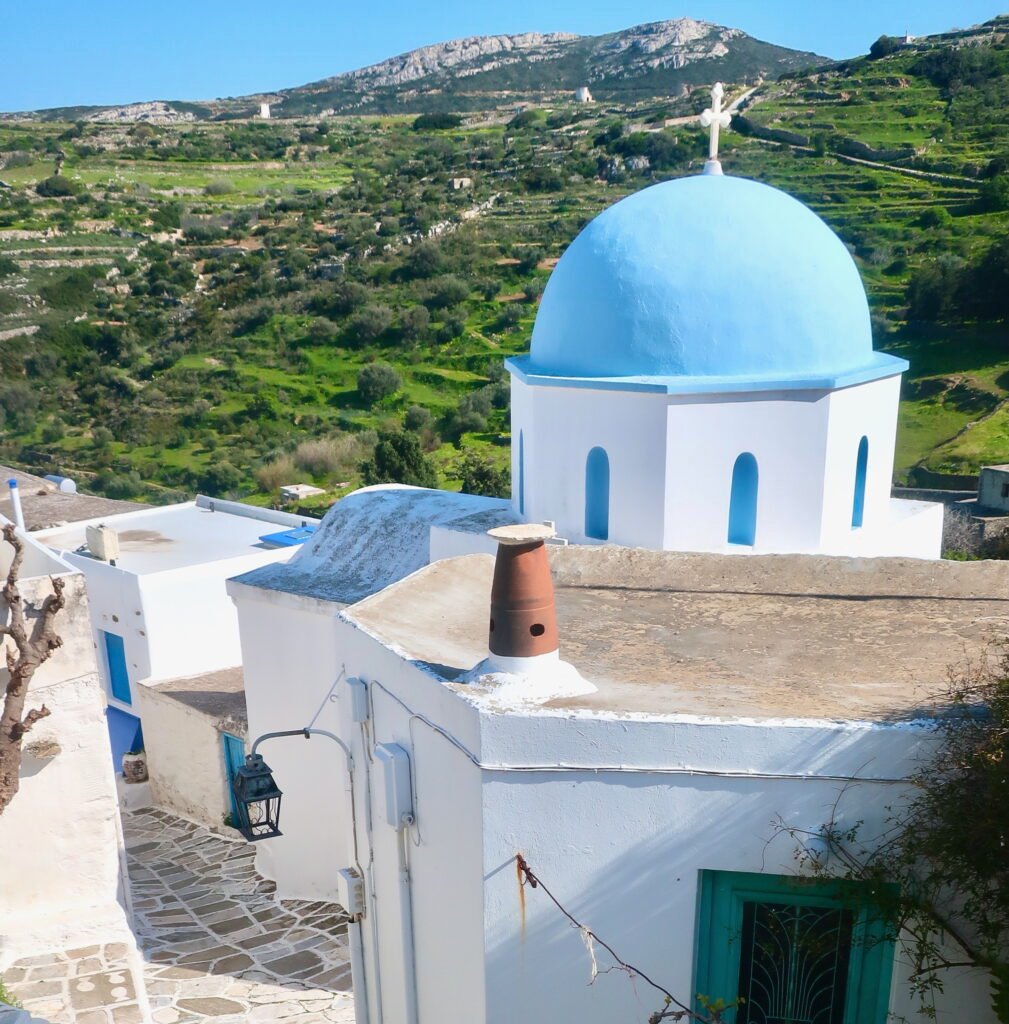
Sometimes it seems that something like soul is slipping away, island by island. Mykonos has gone. Pserimos has fallen. Others are teetering. As if battles are being lost.
On Paros we got tangled up in the question of what the islands will be like in the future, what will be left. Afraid that it’s all disappearing, that this wandering around we do is not so much a record of the islands and the old ways through them as an elegy undertaken on the cusp of disappearance.
It doesn’t help that Naousa, second port of Paros, is going the way of Mykonos, due north just twenty kilometres across the water. Or that large swathes of Antiparos are being developed as a hideaway for the super-rich. You can practically feel Antiparos lurching with the weight of the new state-of-the-art-super-homes nestled exquisitely into the hillsides. All the stories in the papers of this or that celebrity on holiday. Look out for Tom Hanks, a friend said when she heard where we were going next.
It doesn’t help either that on Paros most of the old stone-paved hiking paths are gone. It’s subjective, but this is our Greece, we walk it. Coming here there’s no reason to think that for hiking it won’t be like Sifnos or Naxos, Tinos, Sikinos or Serifos, all of them within shouting distance, all of them meshed with old paths. But it isn’t.
Nowadays all the islands live more or less for the summer season, and Paros is no different. We unthinkingly fell into seeing it uniquely through the prism of its new vocation. Parikia, the port and capital, how many people visit? When do they start coming? Naousa, recently made elegant. The beach places in the east and south, each a resort in its own right. Lefkes, the old capital in the central hills, molding itself now to its role as exemplar of the traditional Greek-island mountain village. The west coast beaches, that give onto the wind tunnel between Paros and Antiparos, now windsurf-beaches, kitesurf-beaches. Even the Byzantine Path, the island’s best-known walk, seeing it not as the old trail it is but a tourist attraction.
You have to give yourselves a shake sometimes.
How do you measure the future?
And how anyway do we presume to understand what will happen? If we learn anything at all it’s that our predictions are always wrong.
***
By size and population Paros is the third largest of the Cyclades. It’s a boiled egg, cracked open on top at the bay of Naousa, balancing on its broad, southern end but leaning slightly to the east. Thirteen thousand people live there all-year-round. The topography is unusual for a Greek island. Instead of the characteristic irregularity of multiple crags and cliffs and scarps, there’s a single peak of about 750 metres. It slopes down on all sides towards the coastal plains, or skirts. (The metric altitude of Mt Everest can be googled to two decimal points, [8848.86 metres], but when trying to google the exact height of Agioi Pantes, the tip of Paros, a flurry of possibilities immediately appear, the lowest 724 metres, the highest 777 metres. An almost seven per cent variable. Everest, if equally vague, would be somewhere between 8849 and 9468 metres.)
The port, Parikia, is a tourist hub, the old town a model for such island places: alleyways open into little squares, with ice-cream parlours, gift shops, churches, jewellery and clothes shops along the way; the tavernas and cafes are concentrated along the seafront. In summer it will buzz. In March there was hardly a soul to disturb its grace.
In Lefkes, the centre-point of the island, at the end of March there were no tourists but us. The sun was shining powerfully as so often it does in the islands even before Spring has officially come. So unused were the locals to seeing out-of-season foreigners that they stared when we passed. The girl in the bakers dipped her eyes shyly when I came in the morning for bread. Elderly women with sober dresses and sun-dried faces, who as everywhere in the island hills are the witnesses, the relics, nodded at us.
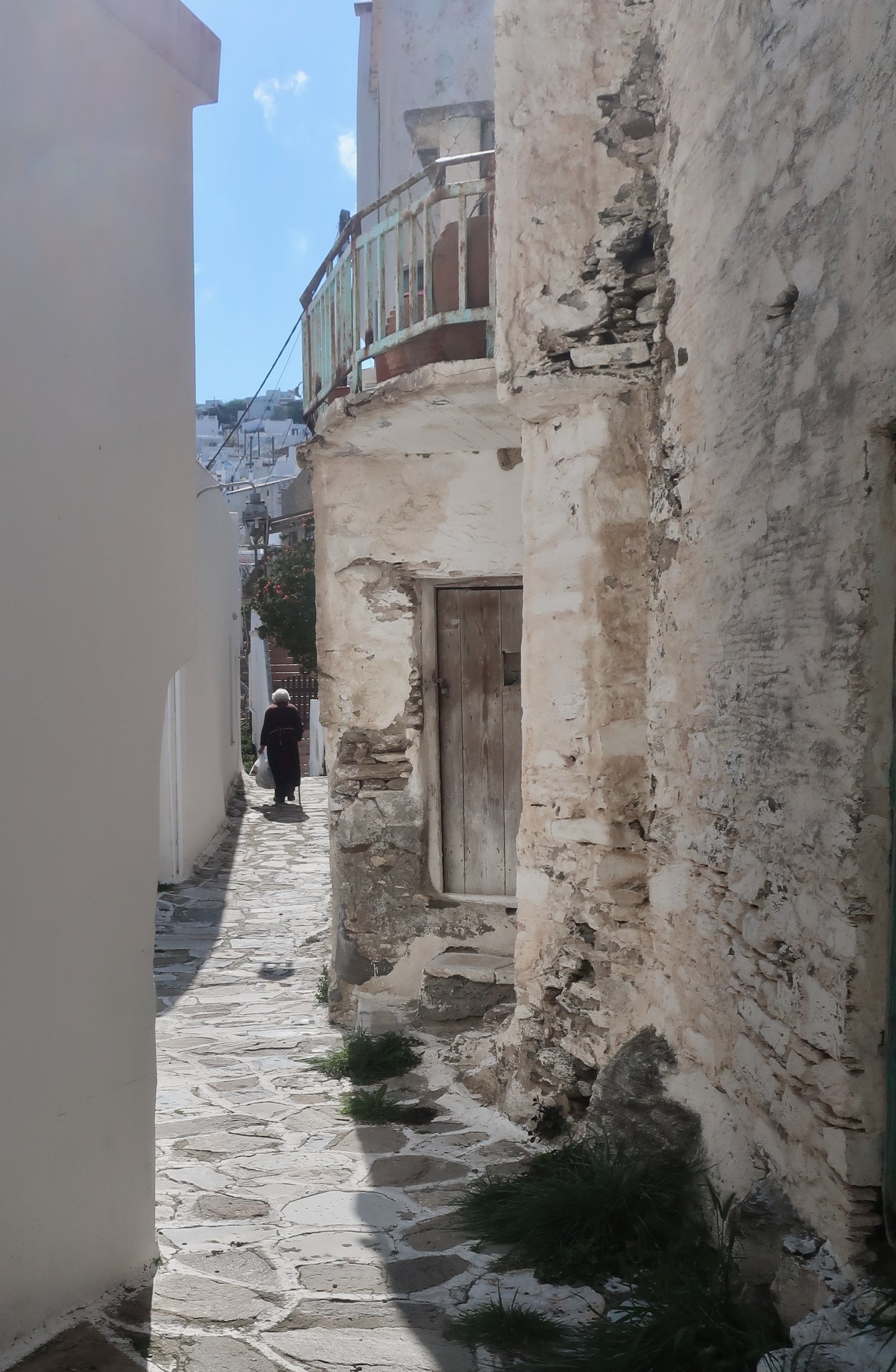
An Easter procession made its way through the village to the church. Everyone at his or her most respectable. There were a surprising number of children, little girls from the nineteen-sixties or seventies, white tights, flat shoes and ribbons.
One afternoon in a narrow alley next to the village shop we passed a young man who had let his pet rat out for exercise. He eyed us dubiously as we approached, put his bulk between us and it, just in case we might be danger.
In Parikia there’s a medieval castle, much of which has been built with marble scraps from the island’s ancient temples. We see this sort of thing often, but never more than here. It’s as if a whole heap of ill-fitting lego temple-pieces have been piled up – colossal stones, sections of column, lintels.
The Church of the Hundred Doors in Parikia dates back to the 4th century CE. It’s one of the oldest Christian monuments anywhere in Greece. Legend says it was commissioned either by Saint Helena, mother of Constantine the Great, founder of Constantinople, or by Constantine himself. Another legend says there aren’t one hundred doors but ninety-nine, that the secret hundredth will open when Agia Sophia in Istanbul becomes an Orthodox church again. Or perhaps when Istanbul itself returns to Greece. We went inside one evening when a storm was blowing so hard that our ferry had been cancelled – one of the big Blue Stars, fit for the North Sea – forcing us to spend an unplanned extra couple of days on the island. A good one hundred and fifty metres from the sea, spray from the waves was blowing horizontally across the square in front of the church, soaking us. The ground was shaking. We ducked inside and found half the town’s winter population in there, doing their Greek Orthodox thing of partly paying attention, wandering both literally and metaphorically in and out, kissing icons, endlessly crossing themselves, fingers competing for the smallest, fastest, movement. There was no sound of wind above the chanting of the priests, no impression of movement. Not the smallest tremor. It was like going into the heart of a mountain, grey and massive and still. Everything in the islands is changing, but the people who constructed the Church of the Hundred Doors might have been pleased to see, all these lifetimes later, how little the essence of it has been altered.
HIKING

If you want to hike on Paros, and don’t want to rent a car or moped, stay in Lefkes. It is almost plum in the middle. Given its size, Paros is unusual in that all the hiking can be done circularly from one point. There are far smaller islands on which it wouldn’t be possible: stretched-out islands like Alonissos; islands divided into two halves like Ithaka. From Lefkes all hikes radiate outwards. Think spokes, even if the wheel is wonky-ovoid and the spoke-lines are scribbles that curve through valleys, across convex and concave slopes, draped over the lumps of the land.
It’s possible to do all the hikes circularly from Lefkes, but it isn’t easy. If you take any of the numbered hikes down to the coast one way, back up to Lefkes another, you will have done at least twenty-five kilometres, sometimes rather more.
We thought at first that the paucity of old stone-laid paths might be a consequence of shape, the fact that away from the central peak the land sweeps quickly down and becomes flattish – never flat flat – over much of the island. But other islands – Naxos just next door for example – have lowland paths that were and still are paved. And like Naxos, Paros has more agricultural land than most, and many settlements for paths to move between. There must have been stone paths all over the island, that now have gone, deliberately erased or just left to fade. It’s easy to imagine that on most islands, during the early days of the move away from agriculture, there was a period during which few voices called out for preservation. Those that did object must have seemed so stubbornly old-fashioned.
Across the islands the clearest visual evidence of destruction is where new roads have directly followed the routes taken by the old ways. Very often this has happened on the more gentle terrain, where paths took a logical, direct route and roads have been able follow. Sometimes they still sit, side by side, the old and the new, stone, flat-paved or stepped, for feet and hooves, and strips of characterless tarmac. Elsewhere, when old paths go too steeply up hillsides, the new ribbons of tarmac, in order to be driveable, are forced to sway back and forth in wide meanders. But where stone paths were built skirting across steep hillsides, on terrain too complicated for most modern road-building, as often as not they hang there still, in some state of decay or other, left to erode away in their own time.
We did three hikes, plus a stroll around Antiparos. Two of them were long days, the third (chronologically the first) should have been long too, except that we set off too late and instead of doing a loop had to be satisfied with a breakneck out and back, hurrying home before the sun set.
Paros isn’t as great for hiking as many of its near neighbours. But it is beautiful like Greek Islands are beautiful, like the Mediterranean is beautiful. If you go walking, track or stone or hard-baked path, you’ll pass remote churches embedded into the land with all their architecture and history, white clustered villages, empty beaches with transparent water, silence. Wild thyme and sage. All the rest.
HIKE 1
Lefkes – Marpissa – Lefkes
12 – 14 kilometres (or the full circuit, including Marpissa to Piso Livadi, Piso Livadi to Drios, then Drios back to Lefkes on Trail 2, probably about 25 kilometres)

The Byzantine Path between Lefkes and Marpissa is easily the best-known trail on Paros.
Mid-March, mid-afternoon, we arrived in Lefkes to find that the minimarket in the village had no fresh fruit or vegetables. Not a tomato, not an onion. It’s unheard-of. Usually we cook for ourselves. On a long trip it would be impossibly expensive to go out every night. We wouldn’t anyway want to. On small islands and in small villages we’re used to the basics. The loaves, the fish and the five thousand, we repeat, content with the unfussiness of it.
Perhaps reasonably this first evening we should have gone out to dinner (although I’m not certain there was anywhere open in the village). We can be too set in our ways. But google said there was an open supermarket in Marpissa, just six or seven kilometres at the other end of the Byzantine Path, the eastern half of the trail that used to traverse the island, west/east, coast to coast, and that was that.
In a marketing sense the name is a masterstroke. It’s far from the only island on which a name has been given to a path. On islands with more developed hiking networks, such as Tinos, Sifnos, Andros, and others, all paths have names. What makes the Byzantine Path so memorable on Paros is the fact that Paros is a more-than-usually touristy island and that it’s the only path with a name. And Byzantine. Through usage, the word has become golden and intricate. (In point of fact, there could be Byzantine Paths on most islands since many of the old paths date back to the long Byzantine period that in many places lasted over a thousand years.)
The path is very gentle, very nice. The unusual variety in the colours of the paving stones, their softness, the width of the path, combine to make it a little bit fairy tale-ish. It leads down from Lefkes through farmland, through the pretty whitewashed villages of Prodromos and Marpissa with their typically etched pavings and flowers and greenery and painted shutters and doors and general loveliness. Photo-prompts for the digital age, both of them.
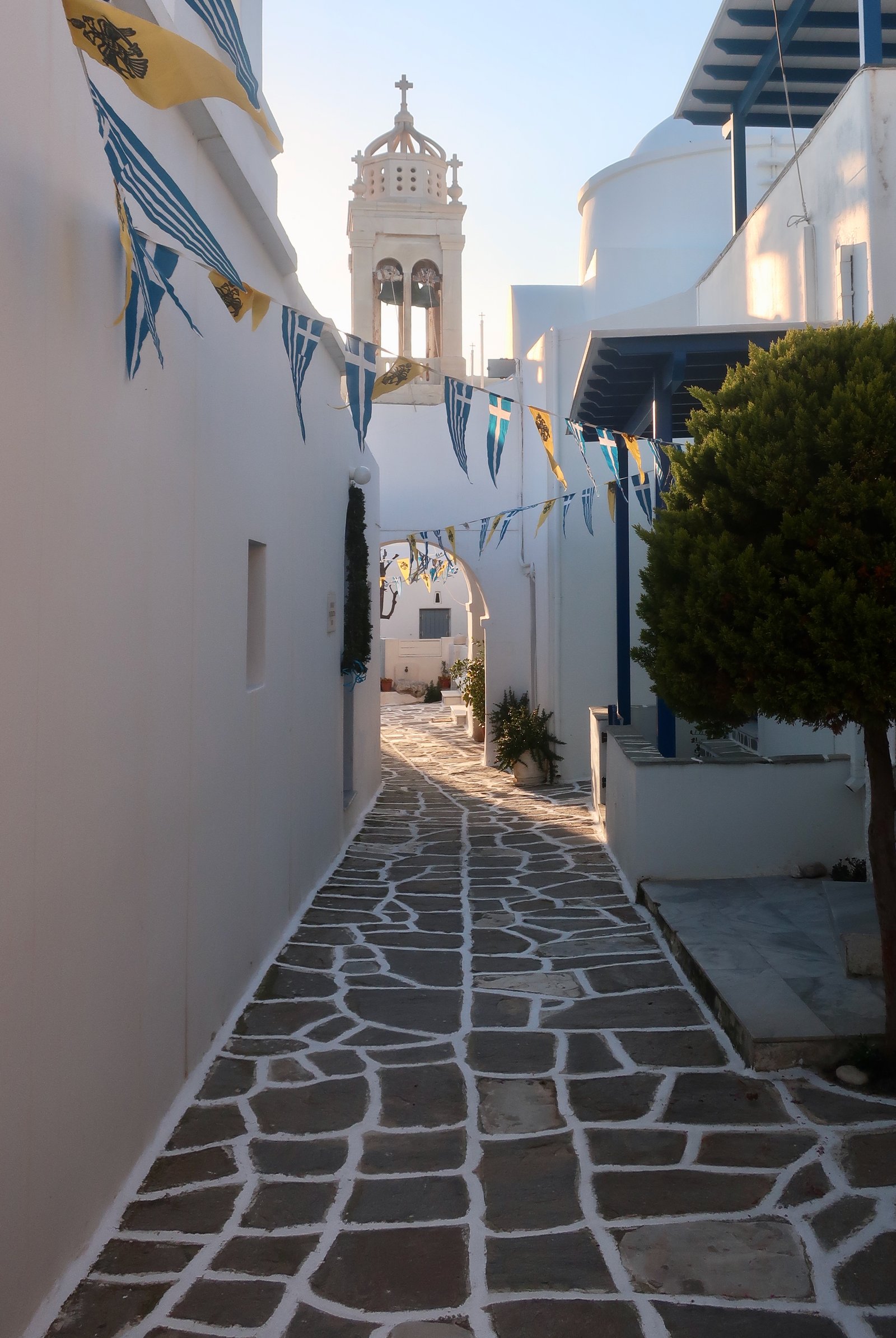
Just a kilometre or so further on is Piso Livadi, a coastal resort village, less fancy than Naousa, with a port and a beach and tavernas and shelter from the wind. A friend has been going there on and off for thirty years. It’s changed so much, he laments. Still he goes. He chats over beer or raki with the same taverna owner from all those years ago. They agree that everything is different now, that it’s all being lost. They mourn their younger selves.
We made it back to Lefkes as night was falling, backpacks weighed down by tomatoes and potatoes and onions, and fruit and yoghurt for breakfast and anything else we could reasonably carry.
Had we had more time we would have walked along roads and backways to Drios, then taken Trail 2 back up to Lefkes. We’ve seen photos. It has sections of lovely paving, on and off.
HIKE 2
Lefkes to Akgeria on Trail 4. Then to Aliki, and from Aliki to Parikia staying as close to the west coast as possible all the way.
34 + kilometres
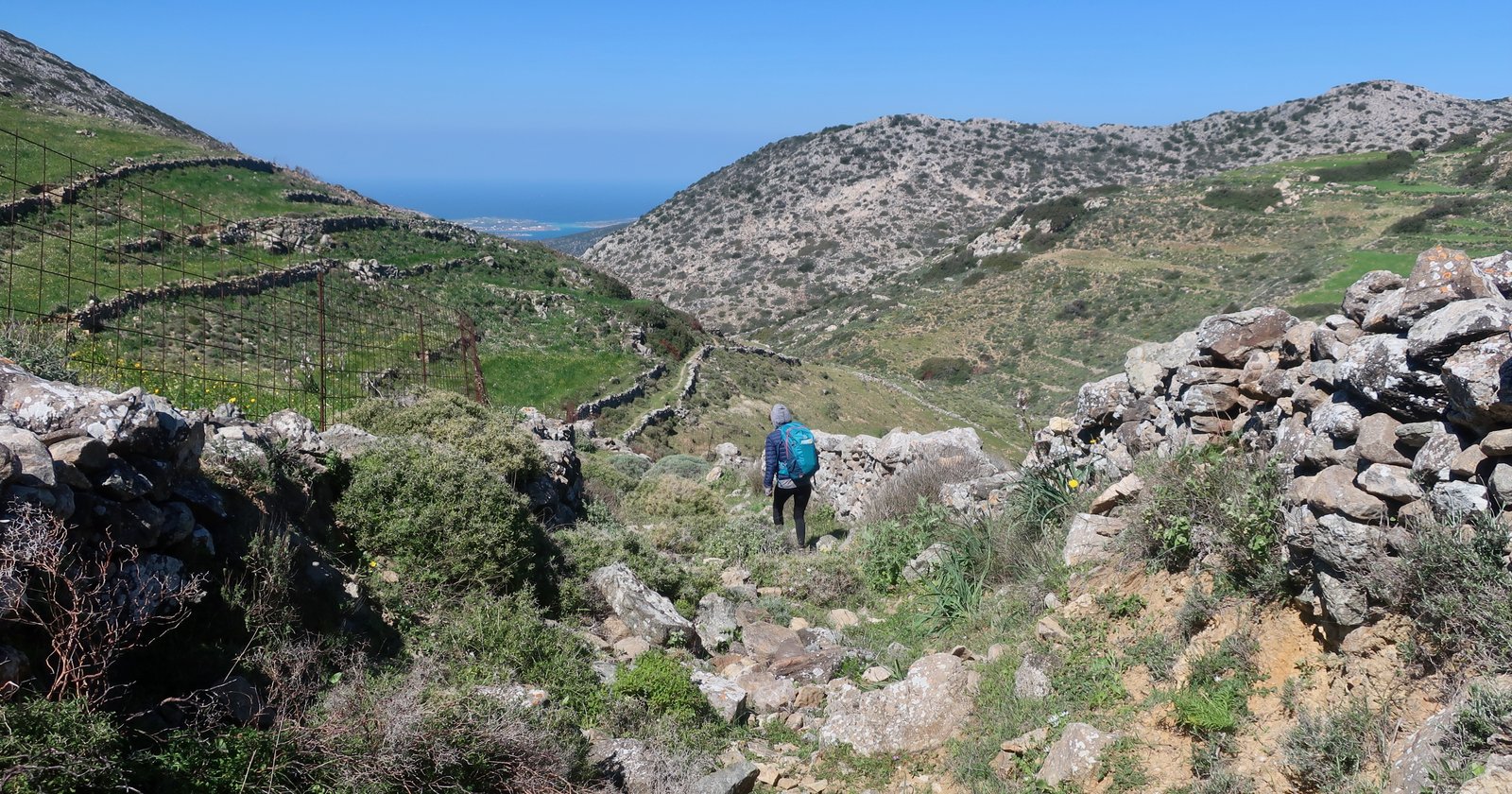
Much of Trail 4 from Lefkes to Akgeria is the remains of an old path. In some places it’s clear, guided by parallel stone walls. Although the surface is mostly overgrown now, there are still sections of rough paving, though now smaller and larger rocks and an assortment of plants and bushes are gradually filling up the hollow chute between stone walls. In other places the old path has gone completely, and sections of wide track and gravel path intersperse the old kalderimi.
Setting off from Lefkes the direction was almost immediately unclear. Within two hundred metres of home we were lost. Within five hundred metres we had been lost several times.
We asked directions from an elderly woman who was stricken not to be able to help. She stroked my arm, reached out to touch Yvonne, as if overbrimming with affection, spilling and slopping it like milk from a churn as she moved.
You go from church to church, like stepping stones. In the valley above Lefkes men were out rotovating scruffy vineyard terraces in the freezing wind. Dogs barked, mostly tethered, although once a shortlegged gang came yapping, as swaggering as ratcatchers, before being easily persuaded to retreat with just the slightest raising of a throwing arm.
Having passed the high ridge at an altitude of about 600 metres, just under the peak of Agioi Pantes, the wind was suddenly gone. This on/off howling wind happens again and again in the islands, land of peaks and ridges and valleys and above all the meltemi wind blowing. The highlands up here are Paros’ wildest, most unvisited region; steep hillsides, abandoned terraces, old stone walls slumping bit by bit back into the ground they came from, and the path that cuts through, that once was the main road south from Lefkes to the coast.
In a café at Aliki, the south coast, we were given Easter raisin olive oil cake. No butter in it, the owner said. No animal products at all. No meat, he added, an afterthought. For Lent.
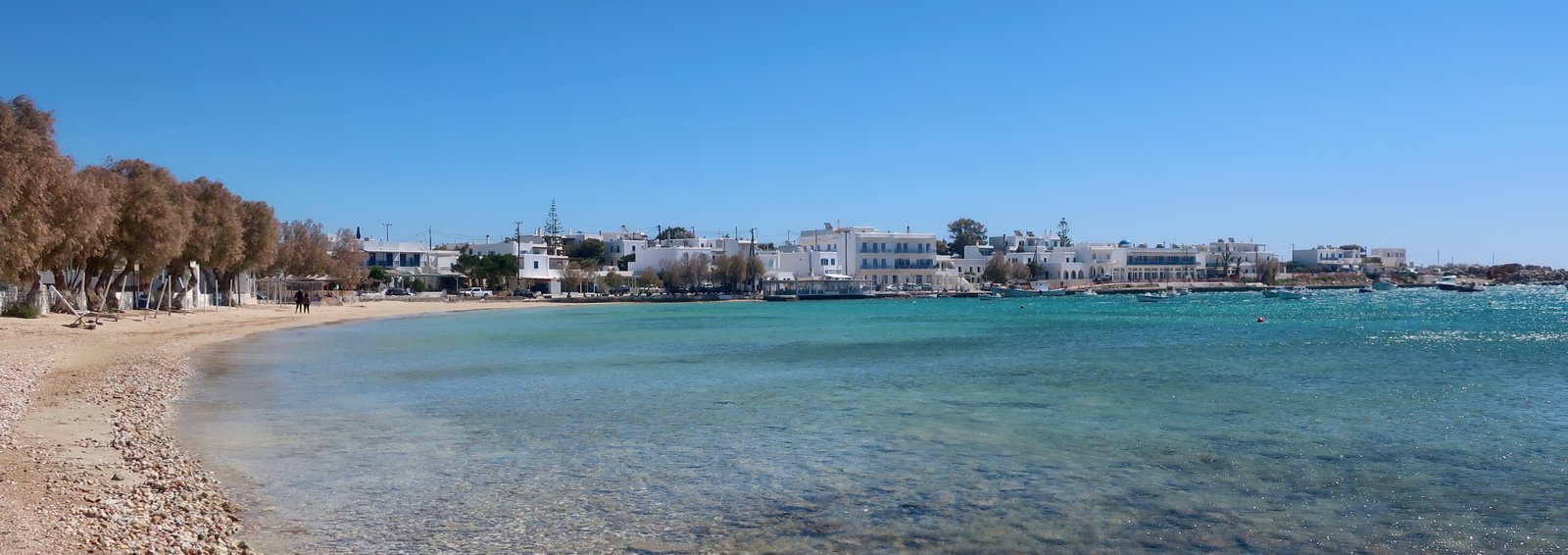
From Aliki you can wander tight along the coast most of the way to Parikia. There are no signs – but then there are few trail signs anywhere on Paros. Beach after beach after beach along the coast. As you round the corner from south to west the wind picks up. The wind-funnel here between Paros and Antiparos is popular with windsurfers and kitesurfers. In March, the view across to Antiparos is a view to the promised land: low green hills, scattered houses mostly close to the coast.
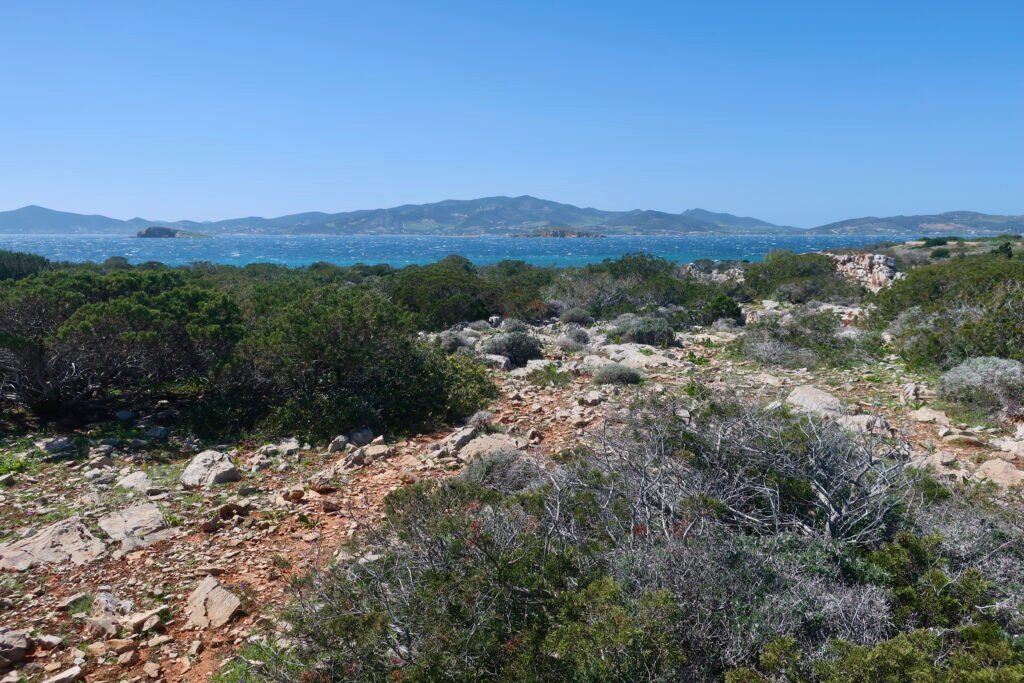

The total distance thes way from Lefkes to Parikia is something over 30 kilometres. Probably considerably more, depending on deviations. With darkness coming in we reluctantly took a taxi back to Lefkes.
HIKE 3
Lefkes to Matzoro to Logovarda Monastery on Trail 1 and Trail 3. After that the road to Kolibithres, and around the bay to Naousa. From there, a cut through the centre of the island due south from Naousa home to Lefkes on dirt track and road, finishing on Trail 1, in reverse.
32 + kilometres
For most of its length the main road between Lefkes and Parikia quite closely follows the western half of the cross-island trail that on the eastern side of Lefkes is now the Byzantine Path. On the section between Lefkes and Matzoro, the old and the new weave back and forth, they race along side by side. Just before Matzoro, when the road bends sharply to the left, the old trail dives off to the right into an agricultural valley. It turns into Trail 3 and goes through the valley, over low hills to the northwest and comes without complication to Logovarda monastery.
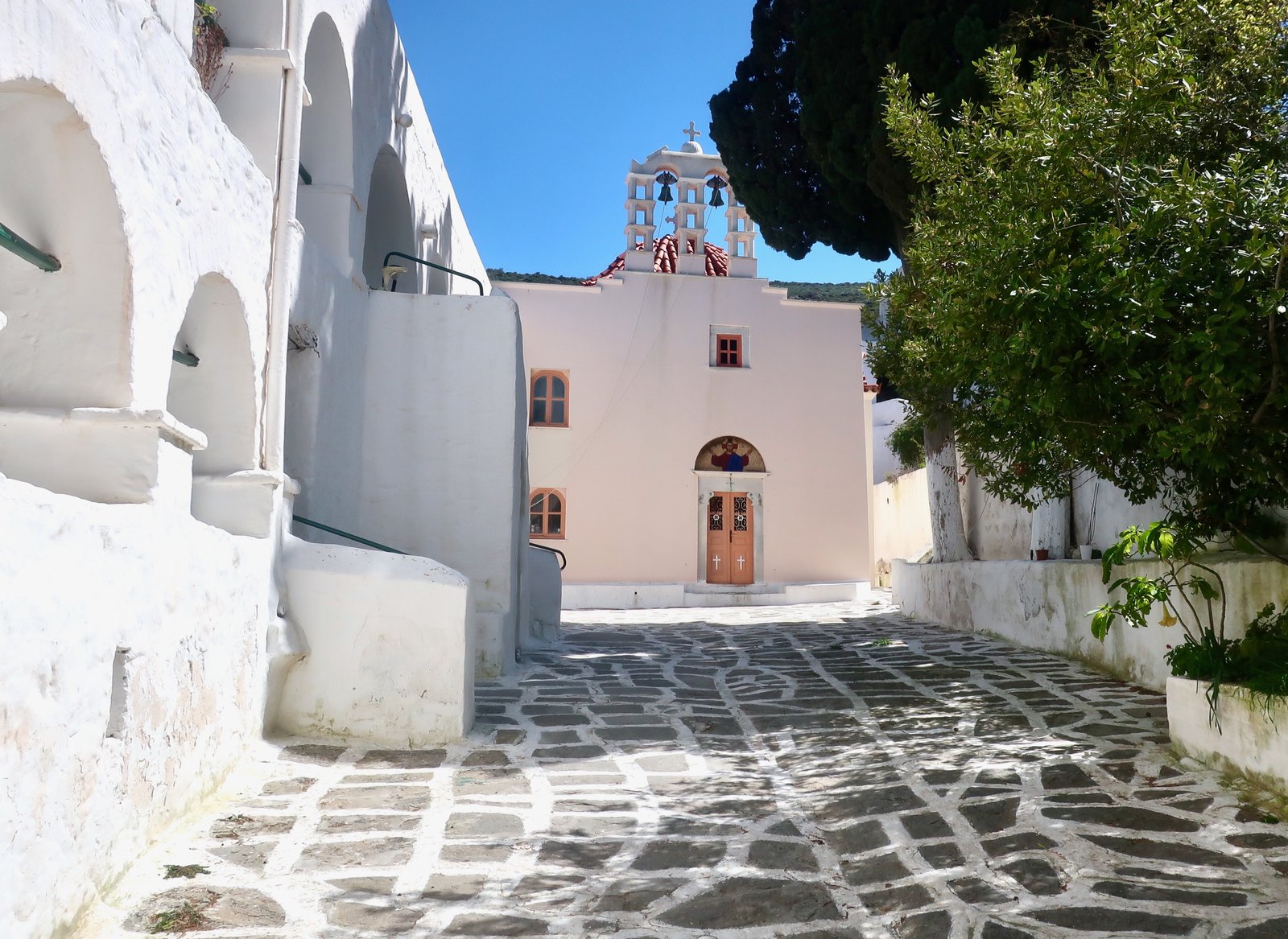
Because the monastery follows the rule of Mt Athos, women aren’t allowed to enter. Yvonne, sitting outside, was given raki and lokum by the monks. I was taken inside, into the church. I have no memory now of its interior. It was doubtless musty, smelling of damp and incense and candles, with icons to kiss and flashes of gold across the iconostasis. I remember rather the key, a standard little Yale-like thing inexplicably attached to a metre-long stick.
From the monastery we walked on roads to the Bay of Kolybithres, on the western side of wide Plastira Bay that has Naousa in the centre-east. The western side of the bay is a shifting pattern of sandbanks and shallow water, patrolled by large gangs of seabirds when we were there.
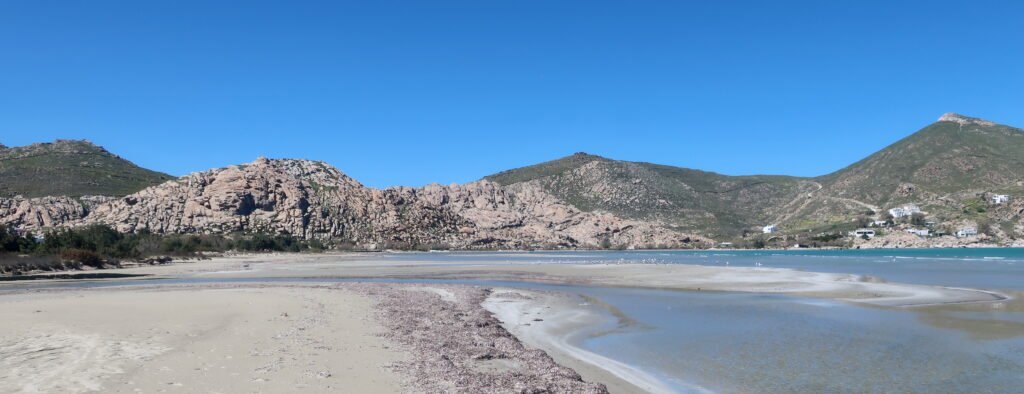
At the end of the peninsula, after the monastery of St John, an eco-park has been created, the internet says. There are seven kilometres of easy walking trails, a lighthouse, several beaches.
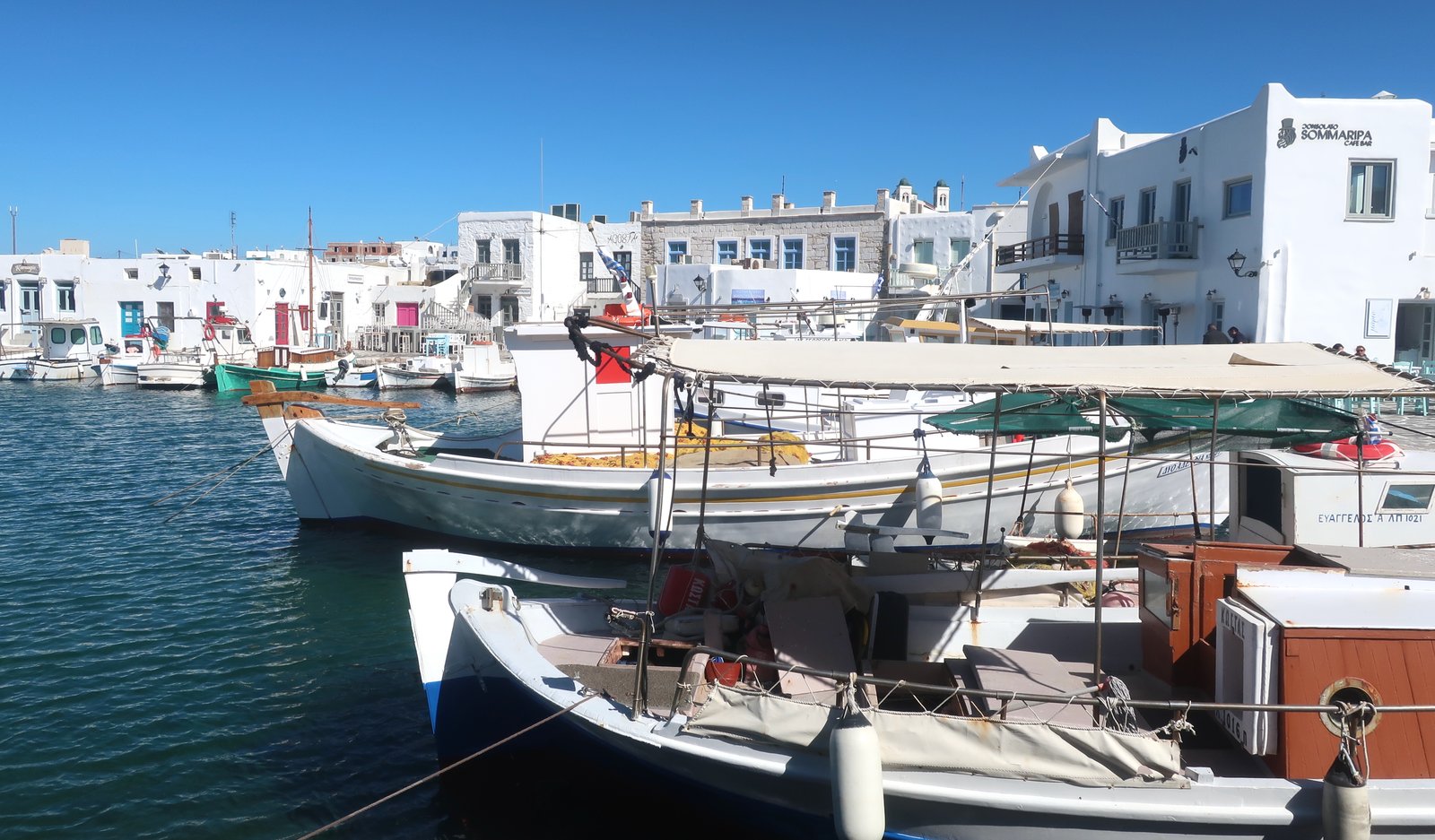
Naousa is unequivocally beautiful. The mini harbour, protected from the north wind by a narrow walkway that goes out to a ruined Venetian fort, is perfectly-proportioned – low white-cubed buildings around the water’s-edge, with fishing boats for decoration and terrace tables in abundance. The winding streets of the town are full of expensive shops and bars and clubs. In its Venetian heyday it must have been a thriving port, full of merchants and fisherman. Too pretty for its own good now, Naousa is leaning vertiginously towards Mykonos.
The walk back to Lefkes is long, on tracks, not paths. It slices along a seasonal waterway between hills back to Matzoro, thence back onto Trail 1 and home to Lefkes.
The whole day is not exactly a hike, more a long walk back and forth across a Greek island, but hardly less lovely for that. In March, it was very, very quiet. Even Naousa was mostly closed.
ANTIPAROS
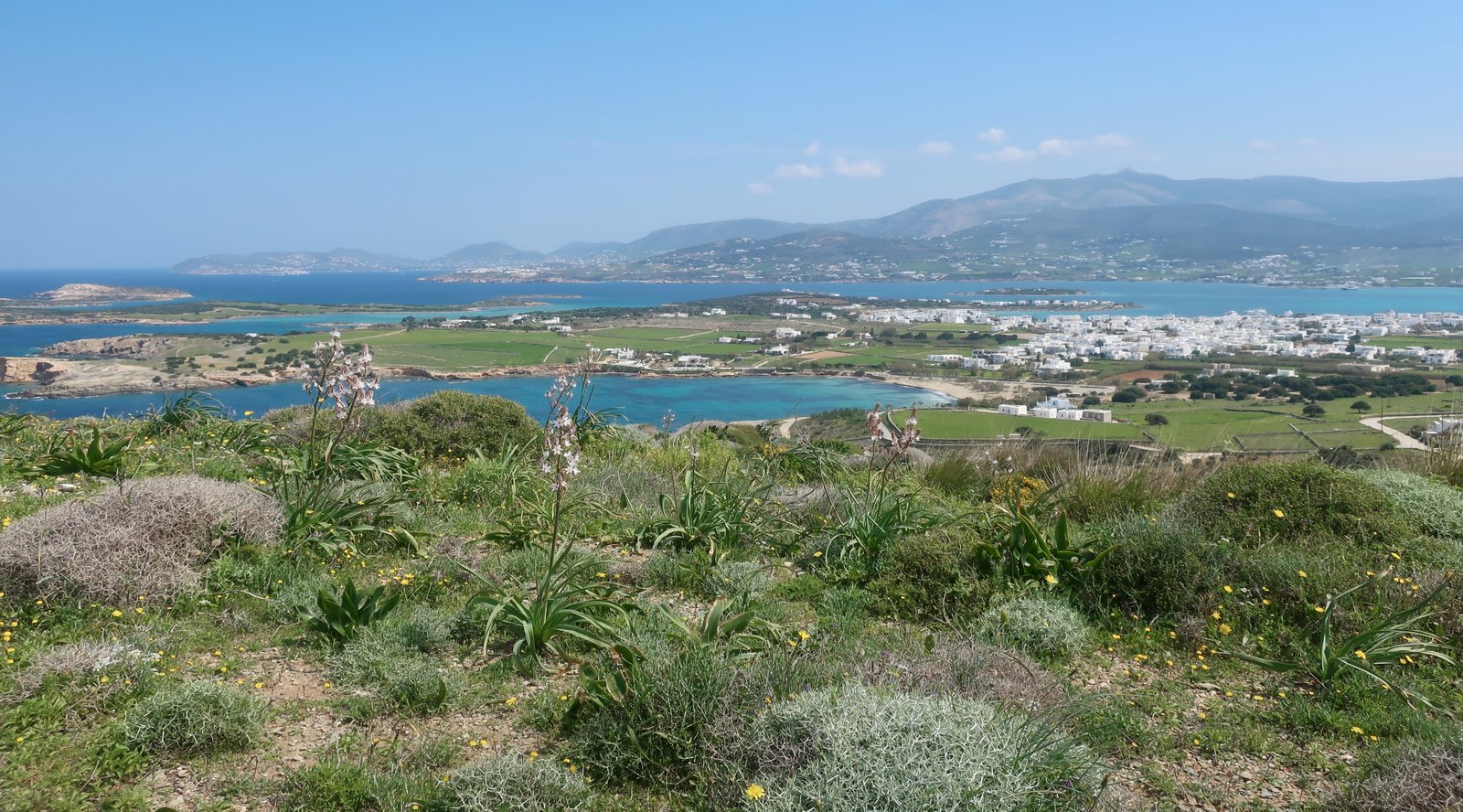
Ferries go to Antiparos at least half a dozen times a day from Parikia. More often still they make the shorter crossing from Pounta, a little further to the south.
We walked around the northern end of Antiparos and down the west coast a little, intending to cut across the middle of the island and trawl our way up the east coast back to the port. Unfortunately we were repeatedly blocked. A real estate development company has bought up large slices of Antiparos. They are building sumptuous, architecturally cutting-edge houses for those with very deep pockets. A kind builder, at work with many of his colleagues on a monster sleek stone house, did eventually let us through some private land in order that we shouldn’t have to do an absurdly long double-back.
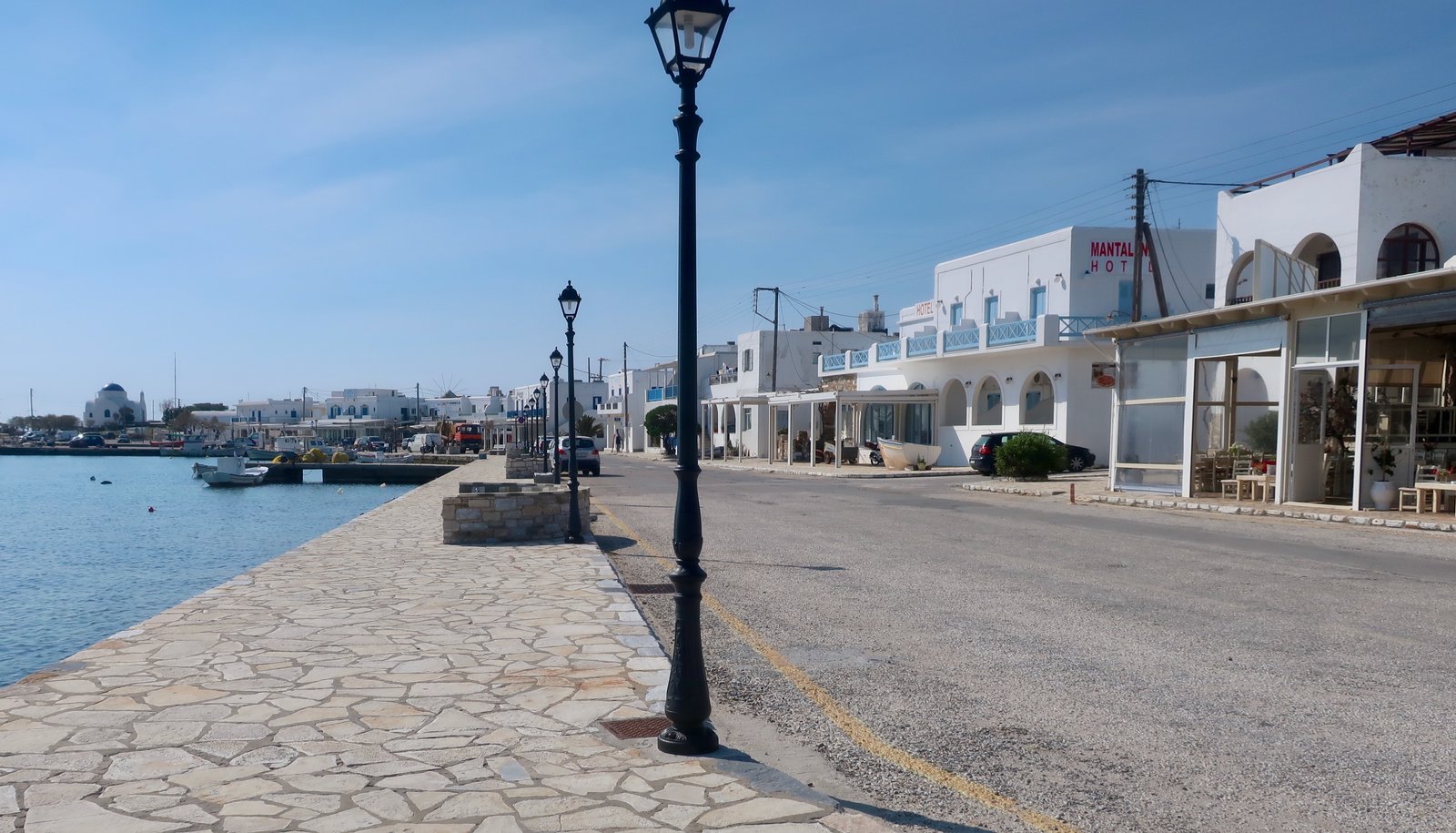
Having begun the day smiling at the sweet charm of the small port in Antiparos, not yet developed in keeping with the incoming jetsetters, even imagining ourselves spending a couple of days there in a seafront hotel straight from the nineteen seventies, by the time we’d done our stroll around the top half of the island, we had decided not even to stay for lunch. We took the ferry back to Parikia, Paros town.
***
According to internet-info, a network of walking-paths is in the process of being established on Antiparos. There are no old paved trails left. These will be short walks, not hikes. But why not.