
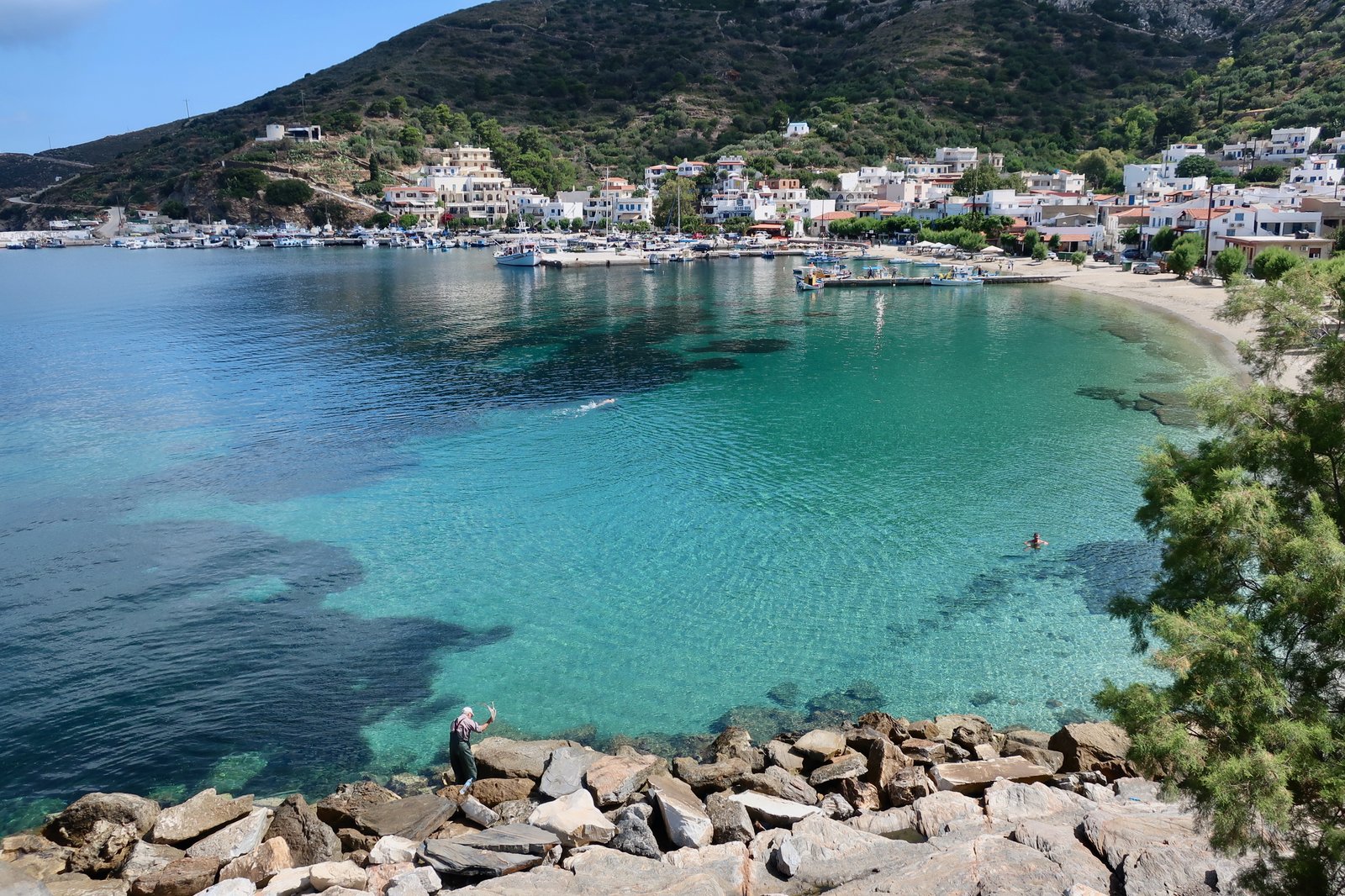

On most islands there were once either hilltop villages, with defensive walls and fortifications, or settlements built precipitously on rocks over the sea, with edges steep enough to dissuade would-be attackers. By way of explanation for this extenuation, people say Pirates. Greek or Turk, raiders from the Barbary Coast or from the Eastern Mediterranean, unspecified others. There can have been little distinction.
Fournoi is different. For some indeterminate period – history here is impenetrably murky – this is where the pirates lived, the nest. No doubt not the only one, but still, such a satisfying, logical nest, with its sea-level unprotected town, its endless bays and secret moorings for hiding. Fournoi is an archipelago of ten or so islands and is so irregular, so sharp and jutting, that on the map it looks like a lobster, or the skeleton of a lobster, or a tiny, monstrous, skeletal embryo-lobster, that has become dislocated, detached, is shaking and trembling itself apart.
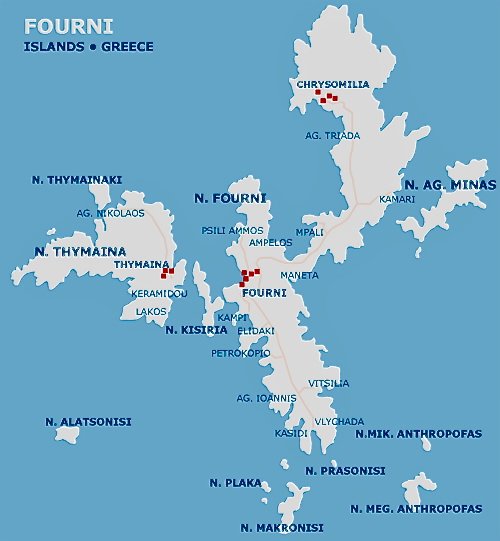
The history of Fournoi under Byzantines and Ottomans, a thousand years and more, is a blank. Rather than make their own history, pirates intervene in other people’s stories. What passes for pirate history are the legends of treasure, rumoured to be buried here or there on Fournoi, waiting to be discovered. Or the shipwrecks. Dozens of them have been found around the coast.
There’s really only one street in town. Of course there are backstreets, but should you ever have occasion to ask anyone who’s been, You know the street on Fournoi? they’ll be sure to understand. It’s crazy-paved, the joints picked out in white. Mulberry trees run down both sides. The mulberry trunks are also painted white and so are the mostly single-storey buildings along its length. It seems somehow exaggerated, almost a cartoon image.
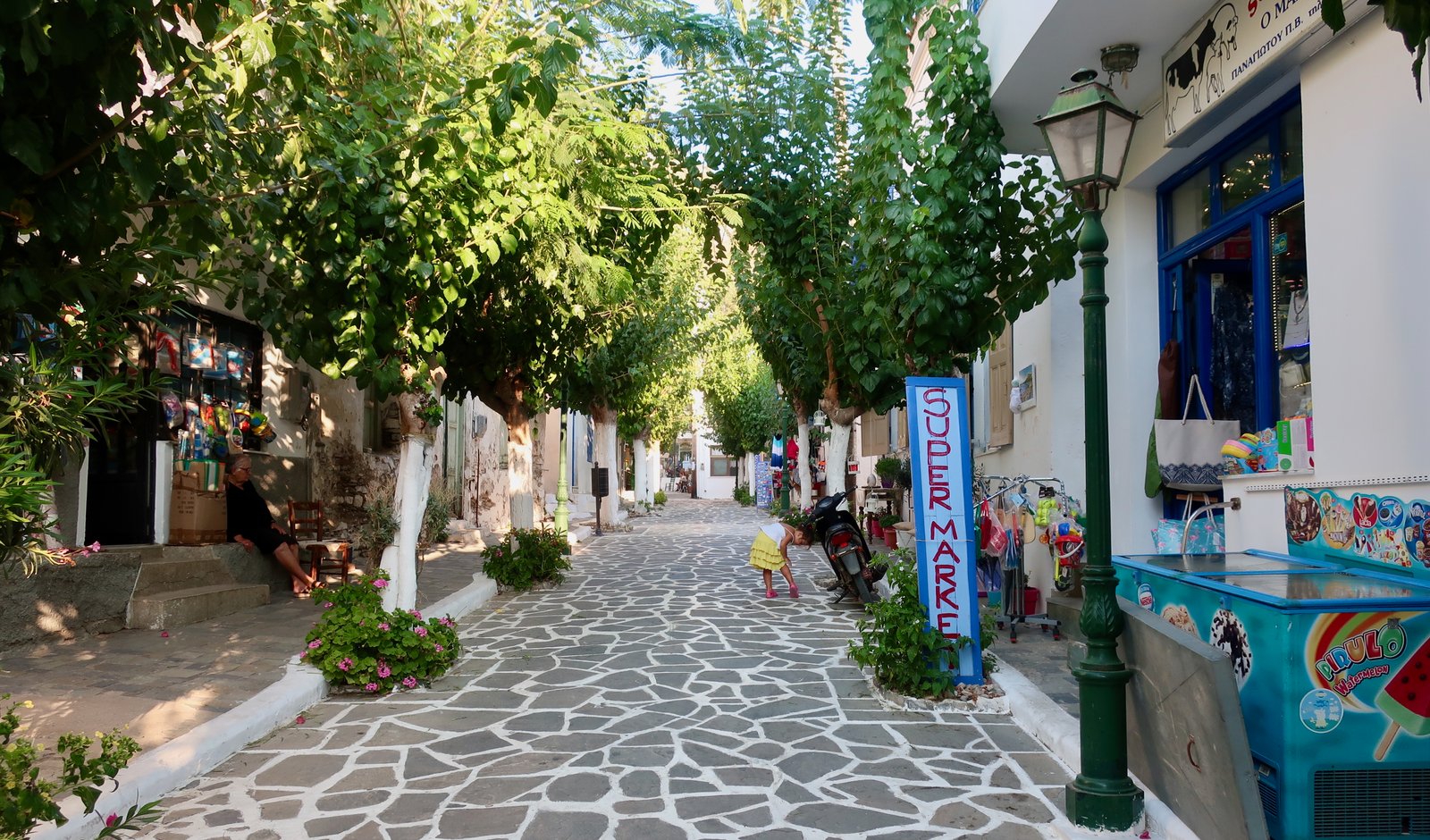
Because we’d read before going about the pirates, we couldn’t help seeing it all through that lens. It was impossible to walk down the main street without imagining the bordellos and bars, the carnage, the riot of the place. If this was America it would be a theme park, with the Long John Silver Bar on stilts over the water, Pieces of Eight would be a chocolate pudding and at Davy Jones Locker they’d dance until six in the morning to a thudding pirate beat.
The street’s wide enough for single file driving, although it’s mostly used by pedestrians and the odd motorbike. In the morning a fishmonger goes slowly along selling fresh fish from a handcart. By number of boats, Fournoi has one of the largest fishing fleets in the Aegean. Not so much by tonnage. Most of the boats are tiny, many suitable for one person only. In the evening you can sit down on the seafront next to the beach and it’s like a neo-realist film set, floodlights on ready to begin shooting; the colourful toy boats are pulled up so close you can wade out to them; raucous children are playing right there in the shallow water, watched over by their black-clad grandmothers. Just behind are several old-fashioned tavernas, a bar or two, people chatting, smoking, wandering by. There’s nothing fancy. Fournoi is resolutely unfashionable.
From our accommodation in the one square at the end of the one street we watched the local world go by. When we were shown in by the elderly lady who met us off the boat, who had puffed her way up the street, up the stairs, who once inside had collapsed in a chair and lit a cigarette to get her breath back, she indicated outside, the church, the bell tower, practically adjacent, and chuckled. When I looked questioningly at her, she smiled. You’ll see. The first time the bells rang they were so loud we scrambled to close the door to the narrow balcony.
On feast days the church ladies gather early. Tables are set up, plates laid out. People come, eat, go away with bags of food. It’s a Greek island theme. We see the same thing happening wherever we go: people, mostly women in their best, gliding through the villages carrying neat packages of virtuous food.
‘If I were called in to construct a religion, I should make use of food’, a Greek Orthodox Philip Larkin might have written, forsaking water.
On one side of the square the church, on the other a gigantic plane tree. Countless millions of cicadas roost in it. All day long they keep up a relentless headfilling din, the purest possible expression of baking summer heat. Occasionally, disturbed by the bells or the roar of a passing motorbike, all at once they stop. Soon afterwards they begin again, one at first, then the rapid exponential multiplication.
One whole, delightful, uninterrupted month of July we spent on Fournoi. The longest we’ve ever stayed anywhere. For us it still feels like nowhere else, our island. We would sit on the balcony in the early evening, joking that everyone was auditioning for a role in the upcoming Zorba miniseries for Netflix: that old lady dressed in black going ever so slowly down the street, a hand at her back as she walks, a nice touch; another lady, trying to stand out, has plumped for a striped black and white dress and wide straw hat; a man with a stick-on beard is doing an impression of a priest, bent right forward into a capital C, his hands joined at the small of his back; the young guy on a moped with a cigarette in his mouth and one hand on the handlebar, the other gesticulating at friends, he sees himself the romantic lead; and the sass player, just below the balcony there, the most brazen of all, is serenading a couple of holidaymakers, leaning over their table, but is holding the instrument behind his head, playing it blind for bigger tips.
About one thousand five hundred people live on Fournoi. All-year-round fishermen for the most part, and short-term small-time holiday hosts. In July a majority of tourists are Greek, many probably with island links. The town beach is usually good for swimming, a little windy sometimes. About a kilometre to the south is Kampi, sheltered from the north wind, so that even when the meltemi is keeping all the fishing boats in port and stopping the ferries from coming, when the short sea-distance between Fournoi and Thymena island across the way is blurry and spitting, even then the sea in Kampi bay is all but flat.
There are other beaches, a succession of small bays after Kampi as far as the ancient marble quarry, around which you can wander as if you’ve entered a world of giants.
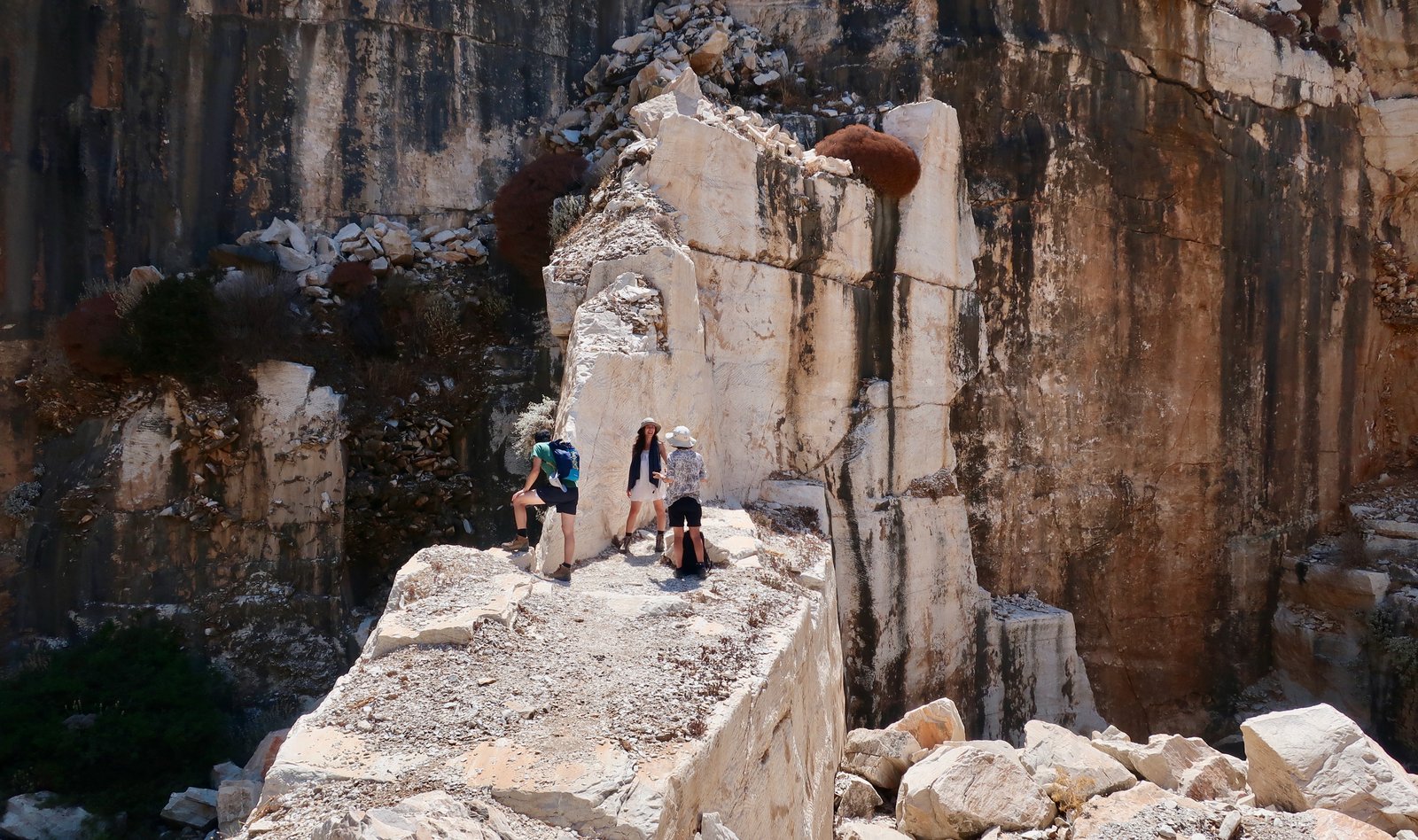
But they’re everywhere else too, all over the island, tucked into the tortuousness of Fournoi, most of them small and more or less protected according to the day’s wind direction. Most are empty of tourists too. Many, as you pass over the brow of a hilltop or around another complication of bay and headland to catch first sight of them, are the sort of secret places in which pirates would hide.

Others, many others, because this is Fournoi, are a little scruffy, a little unkempt. They have their imperfections: a bare and ugly breezeblock construction right in the middle of the beach; a tiny, remote farm whose owners leave their waste around as if the beach was their backyard – which it is; another which on closer inspection is a trap for flotsam and jetsam, a never, ever disturbed accumulation of plastic bags, bits of fishing net, odd flipflops, distressed ancient fishing floats, all manner of wood – sea-buffed bits of tree and shards of furniture – bottles, boxes, rope, more and so much more.
Three quarters of the island’s permanent population live in the port. Elsewhere, there are a few dozen people in Kampi, and small settlements in Chrysomilia, in the far northeast, and on Thymena island. Chrysomilia is an untidy village on a hillside overlooking a wide bay. On the beach below, a few fisherman’s homes have their feet practically in the water.
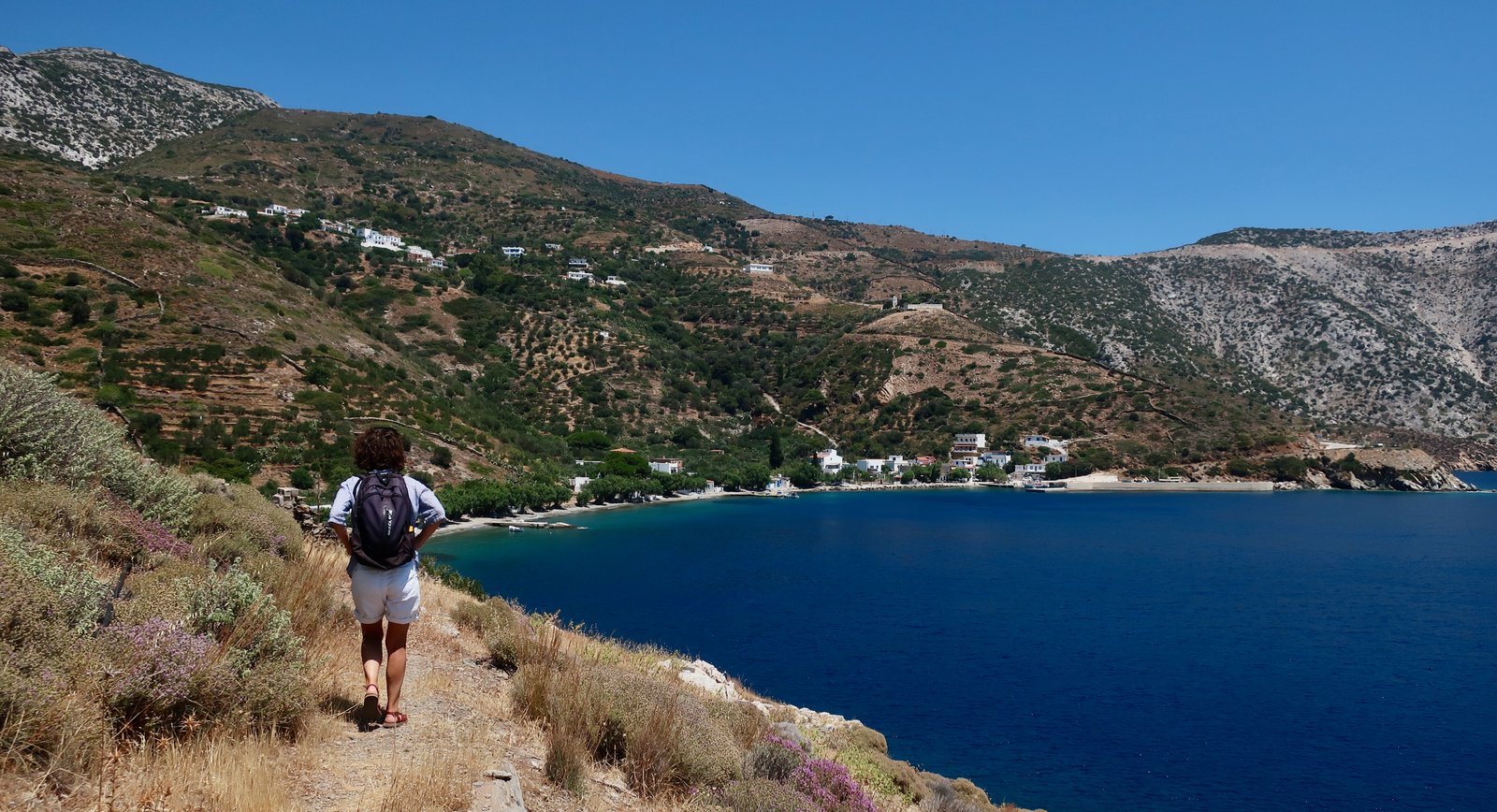
There’s a taverna, perhaps two, where they wait mostly in vain for car rental tourists to come from the port on a day out. We watched a fisherman on the beach there, sitting sewing at his nets. As we passed, he called to his daughter, perhaps ten years old, and gave her a football-sized octopus to deal with. She took it and sauntered down towards the water, paying it no attention, just as if it was a handbag, an inanimate thing, not this creature with its legs lashing softly at her forearm.
There’s a ferry service to Thymena island. Or not so much a ferry, more some local boat-owner who makes the trip back and forth, weather permitting. The bay over there, the tiny port, in typical Fournoi-fashion, is lovely, a little unkempt, authentic. A barking dog or two. Some rare signs of life – an elderly person, washing on a line, the smell of cooking.
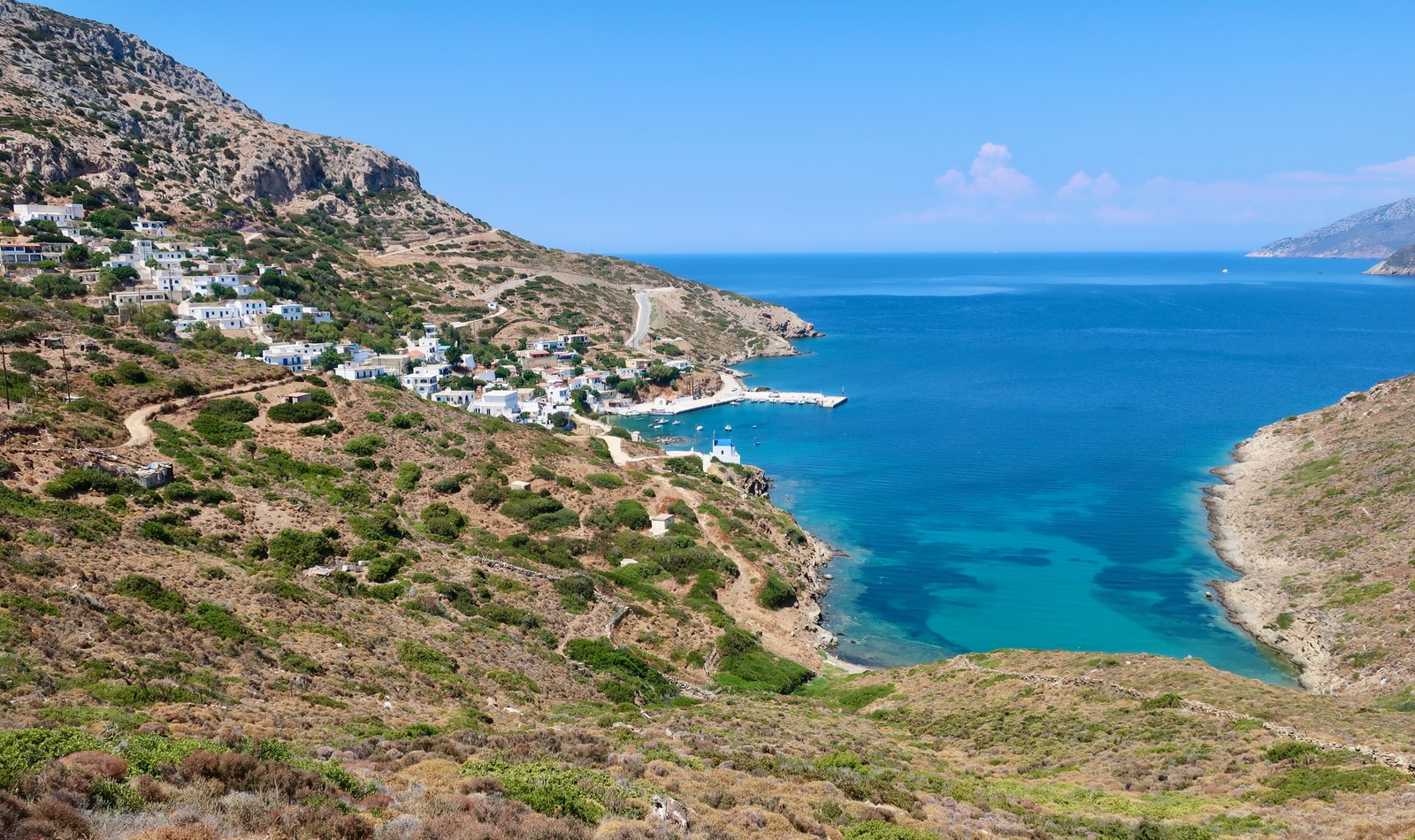
You can walk around the coast to Keramidou beach, yet another safe anchorage into which, as we arrived, an enterprising fisherman from Fournoi was coming, his little motor-boat gargling along. A middle-aged tourist couple in swimming costumes were squeezed uneasily shoulder to shoulder on the minuscule foredeck. The fishermen stood behind in the gut of the boat, far too big for the little cockpit. Music was blaring, Bella Ciao, Fellini-esque.
HIKING
A small number of hiking paths, unnumbered, undescribed, are marked on the Terrain Map. A small number of hiking paths are signposted on the ground. The two sets only partially tie up. Hiking on Fournoi is haphazard – path, road, track, goat pen, and cross-country through sometimes virtually impassable spike-land.
Distances are not great. From a base in the port, the longest possible hikes are to the southern end of the island, or out onto the far tip of the eastern pincer, Chrysomilia. Both would be in large part road walks. There’s no public transport. Unless you’ve managed to organise a lift, a taxi, if you go out on foot, you come back on foot.
One whole month on Fournoi. Our hiking was an expression of this yawning time, but also of Fournoi itself. Or rather, rambling, easy-going Fournoi suited the meandering way we passed our days, without urgency, without structure.
Where usually we’re well-organised, needing to balance available time and necessity as we see it – and this quite simply because there is only so much time and we want to do everything – in Fournoi we had all the time in the world.
HIKE 1
The most obvious, easiest small hike on Fourni, is the one that starts on Kampi beach and heads south, from beach to beach, down the west coast.
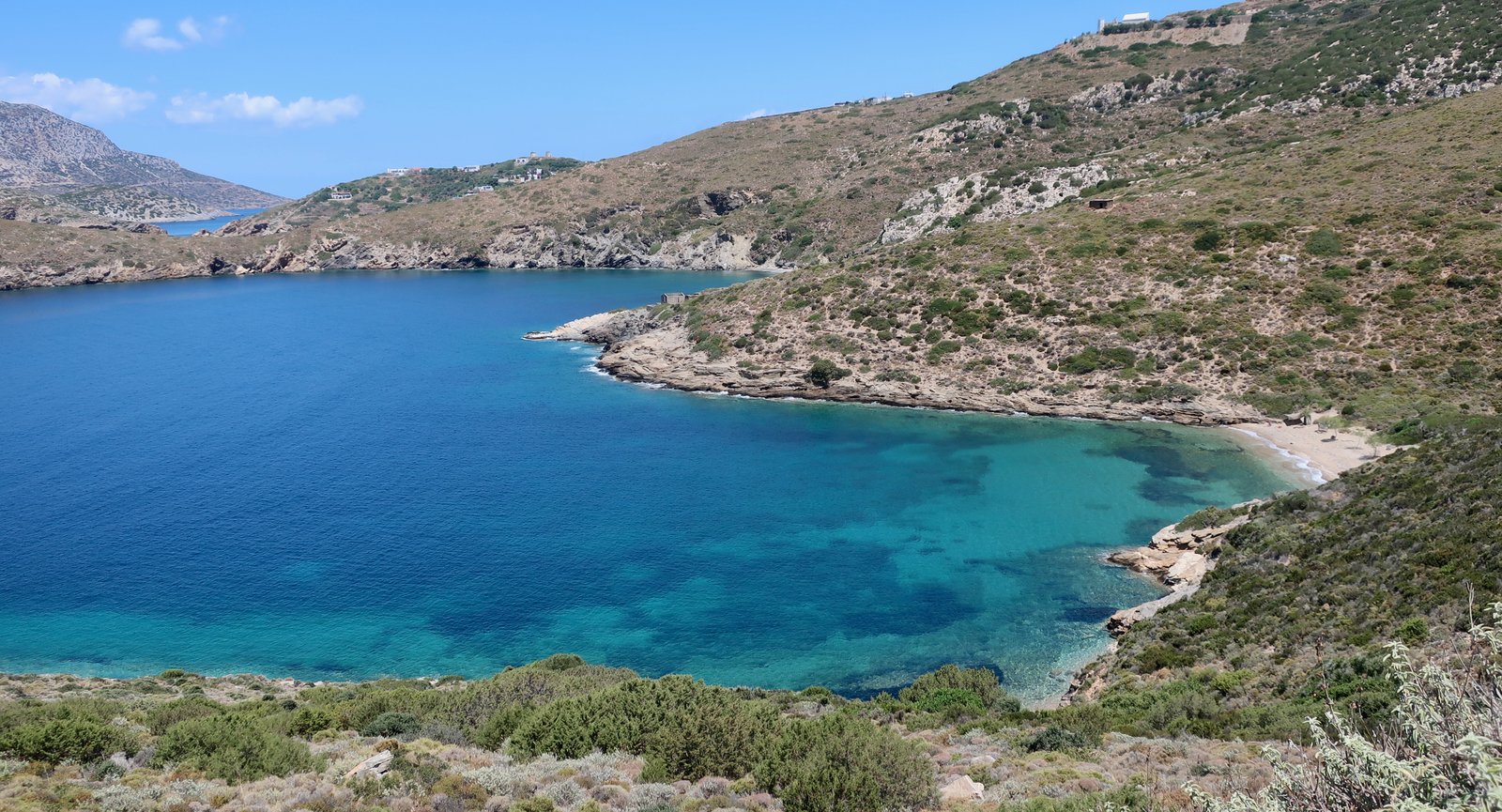
In places there’s a path. Otherwise there’s the beach and the logical progression along the coast. The route goes through four or five beaches, the last of them on the far side of Petrokopio Bay, just after the old quarry. Some of the beaches can be driven to, others not. In July, on each beach we found two people, as if they were human nesting sites, plus one beach-hermit who had strung up a hammock under the shelter of a low beach-cliff and appeared to be living there. From time to time we come across these solitaries, with scraggly beards and rough shorts and nut-brown bodies. They always leave us with a strong impression of our second-bestness.
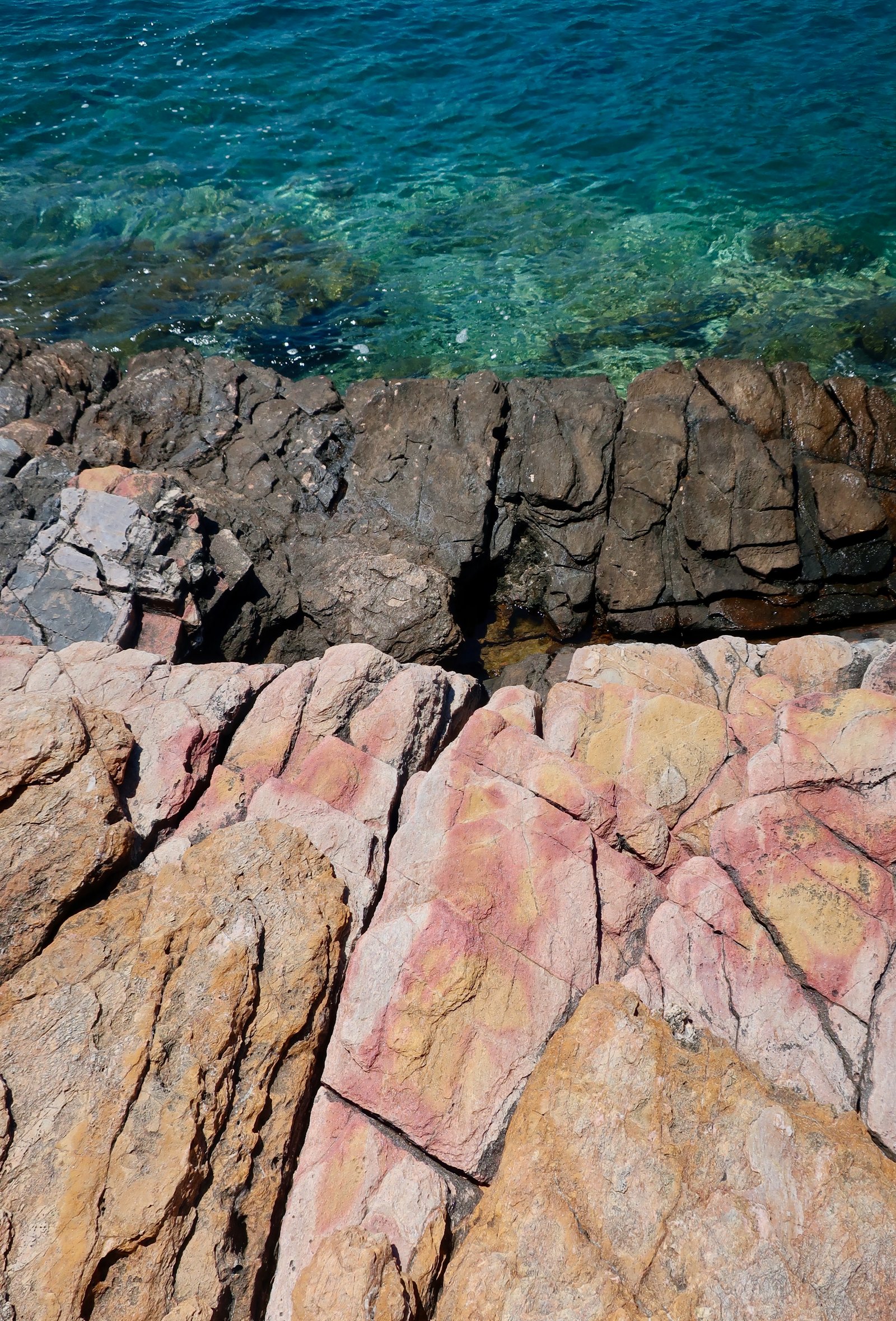
After the final beach, it’s possible to continue on around the coast, jumping and skipping from rock to rock. There’s no best place to stop. Everywhere you can jump into glassy clear water, and slip back up and out with the world to yourself.

HIKE 2
Looking down over the port is the church of Aghios Georgios, a place to go for breakfast, coffee, on condition that you take it with you. There are the remains of massive stone walls, dating to a time long before pirates. Classical remains have also been found around Chrysomilia, at Kamari on the northeast coast, and at the marble quarry behind the beach in Petrokopio Bay.
Several paths lead out of town up to the church. The best of them, not fully clear but marked on the map, goes roughly north. A couple of other paths, more obvious – although only one of them is on the Terrain Map – climb east or northeast out of town.
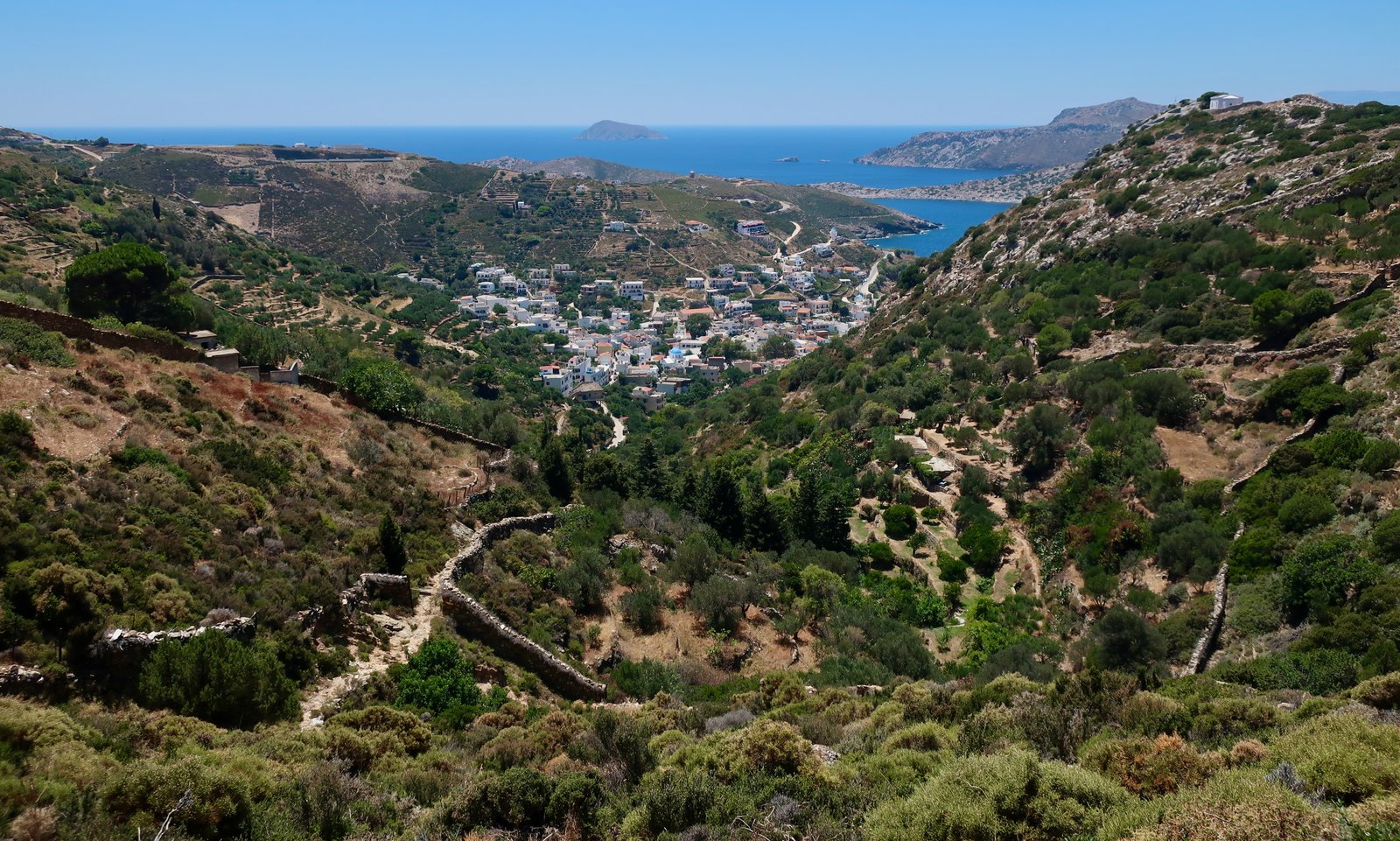
Once they reach height, a swing left can be made on a dirt track likely occupied by dozens of goats, including one enormous, strutting billygoat, who carries his giant goat stink with him, leaves it suspended in the air as evidence of his primacy.
HIKE 3
On the peninsula due north of town there are a number of paths. Some are marked on the map. We have walked along the west coast, from one scruffy beach to the next. We have walked up and down the east coast on the marked path which does exist.
The various paths through the highlands of the peninsula are mostly quite well-defined. A difficult-to-cross high wall runs along the ridge of the southern half of the peninsula, with only one way through that we found, a simple, walled compound through which goats are processed as if it was a pre-industrial factory, where they are penned and milked. Going through here early in the morning in an easterly direction there were no animals, but a strong sense of trespass. Coming back the other way later in the day, the gates were closed, the compound full. A lady goatherd, hearing bleating, came out of her milking pen with white dribbles spattering her front, but instead of wondering what we were doing and remonstrating with us for disturbing her animals, in her giantness of heart she wanted nothing more than to explain to us everything she knew, every single alternative path, every possibility.
On another day, coming north from the red-marked main road on the map, we turned left on a path a little after the church of Panaghia towards a similar closed compound. There another goatherd came out to see why the dogs were barking, and again wanted only to talk, about the life in America he had recently abandoned to come back home, about life with the goats in the hills of Fournoi and how he had thought of little else all the time he was away.
You can continue up to the hilltop, (311m), a boiling short climb on a windless July day, over rocky ground, through patches of juniper. Watch out for snakes, the goatherd warned us, there are hundreds of them up there. We did watch out, and saw nothing but the scorched cinema of the Aegean, the right-hand pincer of Fournoi.
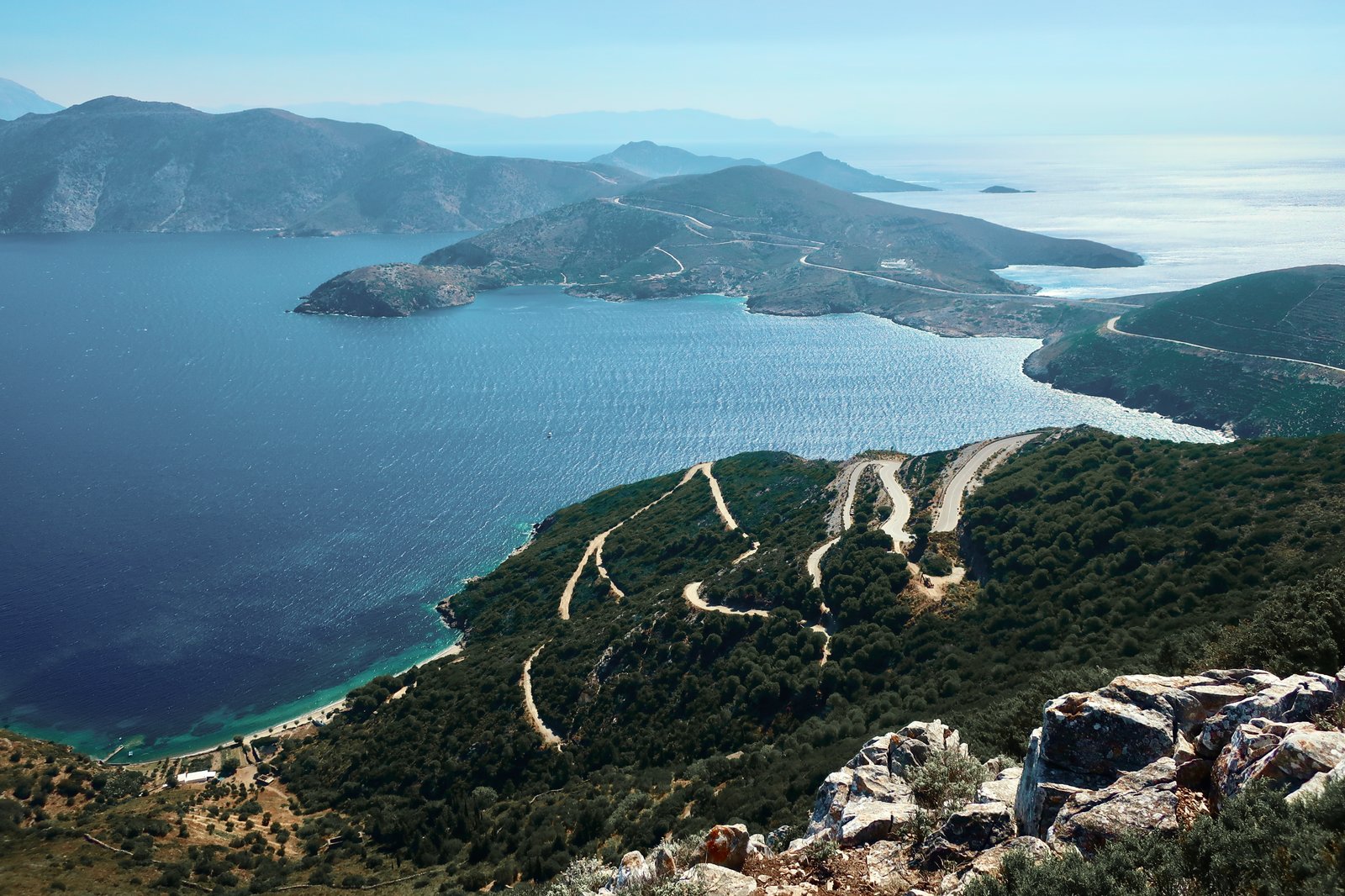
From the compound, to the east of and below the marked summit, a clear path, unmarked on the map, continues north into the highlands, where it hooks up with other paths and possibilities.
HIKE 4
One day we came up out of the back of town on a climbing path that hit the main red road near Aghia Marina. We turned south, and soon after turned left, where a trail is dotted on the Terrain Map. Near the beginning of this trail there’s another necessary transit through another rough goat-farm, maintained by another elemental island woman who opened and closed gates with a smile and warm greetings and such winning good humour just at seeing us there.
The beach at the bottom has several ramshackle buildings. It looks like pirates might live there still.

Turning right on the sand, and heading straight up just on the southern side of the stone wall that follows the ridge, at sixty or eighty or a hundred metres, there’s one of the most lovely threshing circles we’ve seen anywhere in Greece – and we’ve seen thousands of them, everywhere, on every island. This one has been hacked into the rock of the hill. Two thirds of the threshing floor is bedrock, smoothed to a shivered texture, like the surface of the sea with just a faint breeze. The rest is irregularly paved, in the way threshing circles generally are, not perfectly flat but flat enough. Around it the usual prehistoric ring of stones, broken threshing circle teeth.
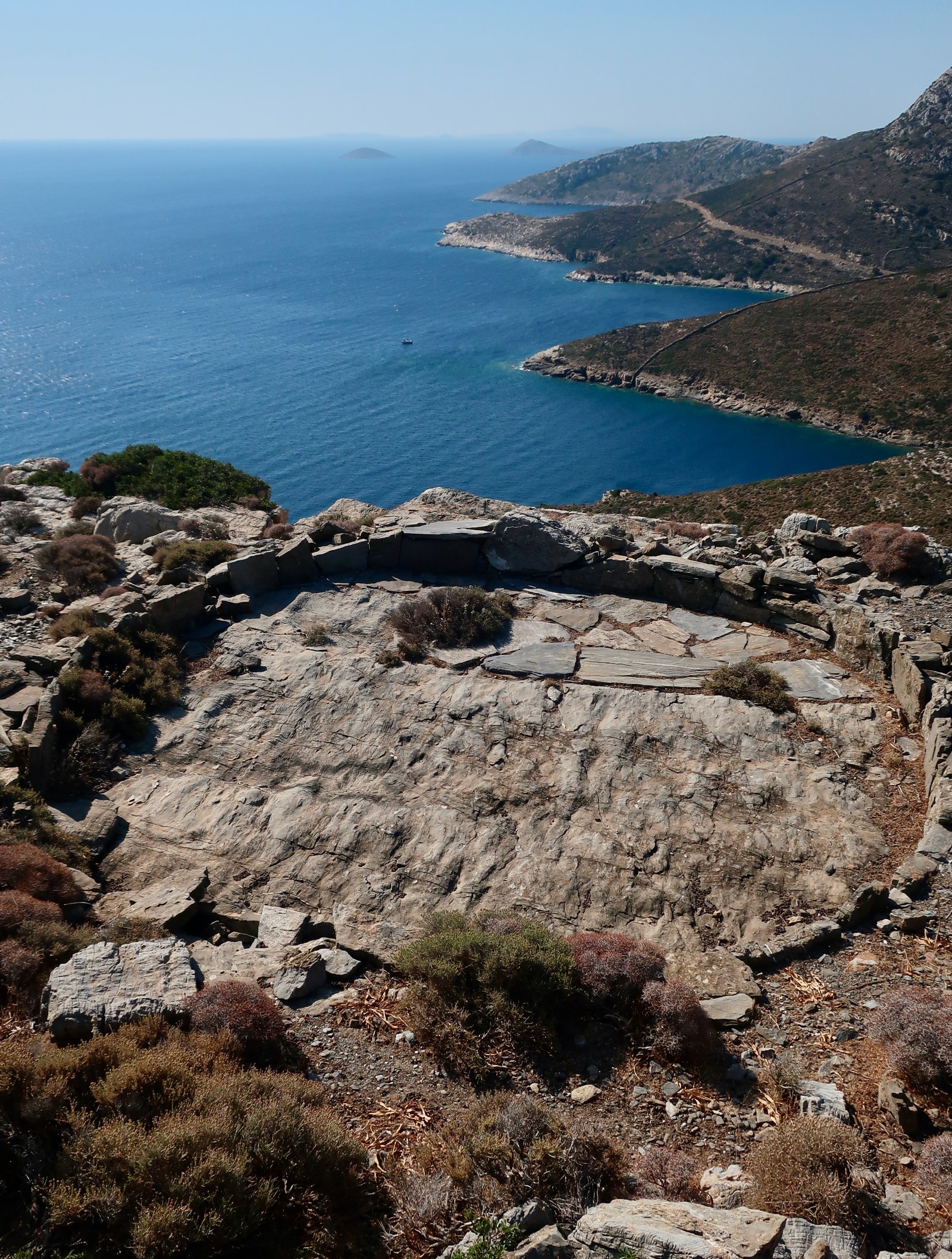
From here the view is uninterrupted again, over the northeast pincer past Chrysomilia , to the south pointy-toothed bay after pointy-toothed bay.
From the threshing circle we scrambled down to the first beach and swam, then walked on to the second and the third. Sometimes there’s a path, sometimes you have to make your own. A driveable dirt track leads to the third beach, Boulos Pavlos Bay, so there’s always the faint possibility you might meet someone enterprising enough to have set off north from the other side, and that you then will have to share.
After Boulos Pavlos Bay there’s a dirt track back up the hill to the main road that runs more or less along the ridge of the island all the way to the southern end. Or you can scramble a shortcut cross-country, mostly following the obvious watercourse, the fold, at a rough right angle up away from the beach, until you hit the road. There is no path. There are walls to get over, fences to get through. Time-wise it may not be a shortcut at all.
HIKE 5
And then there’s the stroll to Kampi beach in the morning, not a hike at all. A kilometre and a half from town, up towards the ridge of the hill on a newly-paved path with views over to Thymena, the low eastern tip of Ikaria in the far distance.
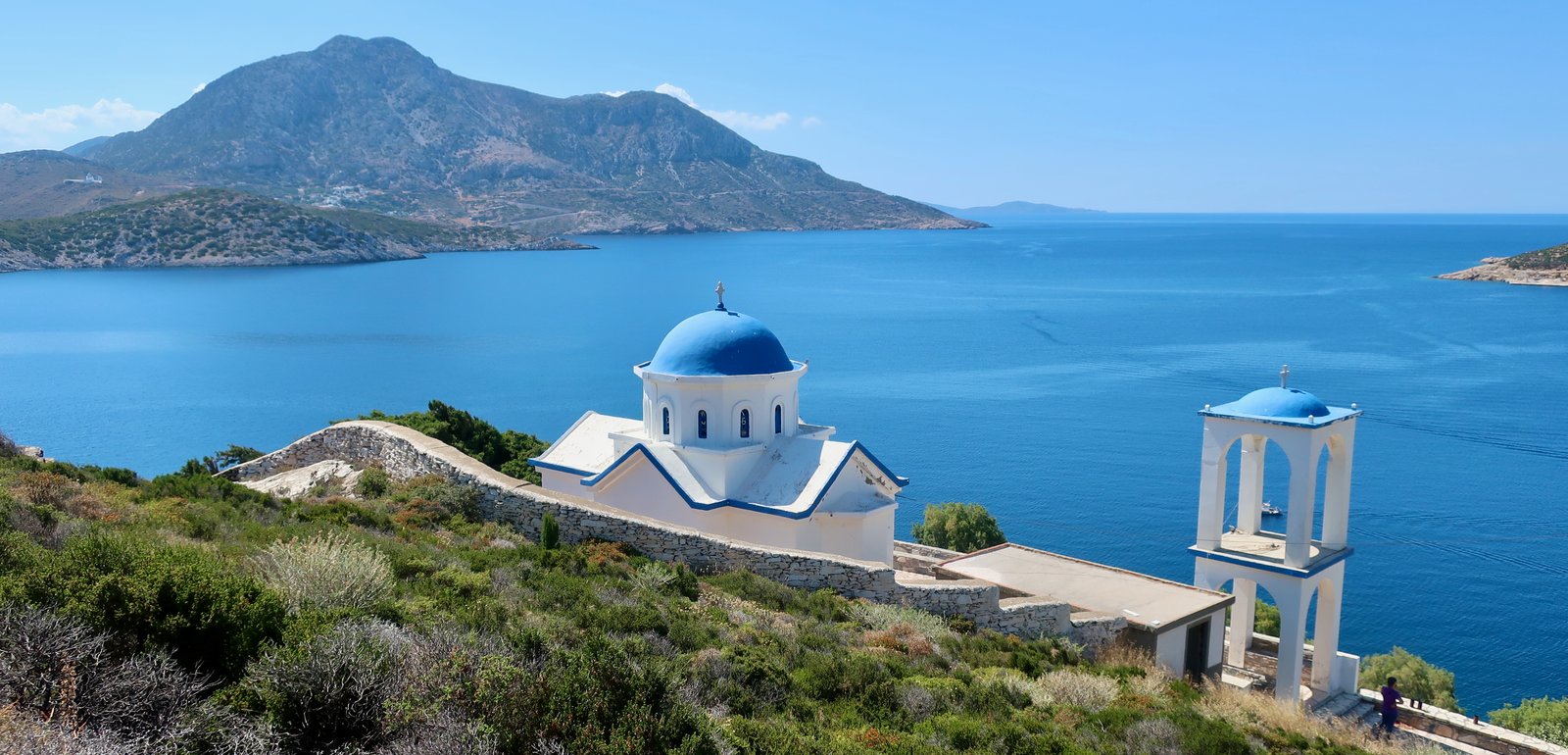
The path hits the road and almost immediately opposite, between two windmills, dives down towards Kampi. Cars can’t go much further. In the morning, early, before the full pressure-heat of the day, there may be a swimmer or paddler or two, and perhaps the hermit from along the way, who in perfectly cultured English may want to engage you in conversation about Epidavros and the parlous state of so many amphitheatres in modern Greece, or the invasion of the sea peoples more than a thousand years BCE, the ensuing Dark Ages in Greek history – you really will not have seen any of this coming – and dragging yourself away from him, ungluing yourself, you can slip into the water and swim, languidly at first, then stretching out, back and forth, back and forth, across the bay a couple of times, certain beyond any doubt that there is no better way to start any day in your life.
