


From a seat in a cafe in the small port of Mytikas, two hours by winding bus route from Missolonghi, Kalamos looms. Yvonne, just back from a walk around town, confirms it’s like the Pacific, the greenery seething everywhere, the humidity, the absence of movement. The water is blue and green and clear and Kalamos, just 1500 metres away, is like a dream, two high peaks covered in thick forest, with deep shadows and a steep shoreline this side, a fading of other islands behind. Some birds are sitting still on sticks in the water. Fans are turning. Greek people are smoking.
***
Kalamos is not quite what we imagined. Or not the town/port at least, which is scruffy, with chickens parading their mad scrawniness in the streets. A wild-eyed eighties-year-old man strolls about sizing up things he can steal, only to be chased away like a daily pest, a dog, a crow. When he leans towards a packet of cigarettes and lighter, invitingly unattended on a table outside the bakery, the baker, Spartan-bearded, almost equally wild-eyed, suddenly appears from the doorway and shouts at him.
The two supermarkets are a chaos of ancient shelving, baskets and boxes of odd cans and bottles and bags, with nothing that resembles normal-shop-order. Outside them the sweet smell of overripe bananas, spotty peaches, shrivelled red peppers. Heat. In the cafe they have no food. Nothing. Only a glass display case with a short list of what might have been, culminating in kruasan, plain or staffed. All over town are signs scribbled on old wood, or handwritten on what looks like torn corners of bedsheet then strung onto railings, advertising bakery, patisserie, traditional wood-oven bakery, or try our povan bread. They point off in various directions but all converge on the one bakery, which like some master of disguise is all these things.
When we arrived, the whole, small town smelt strongly of vegetable stock.
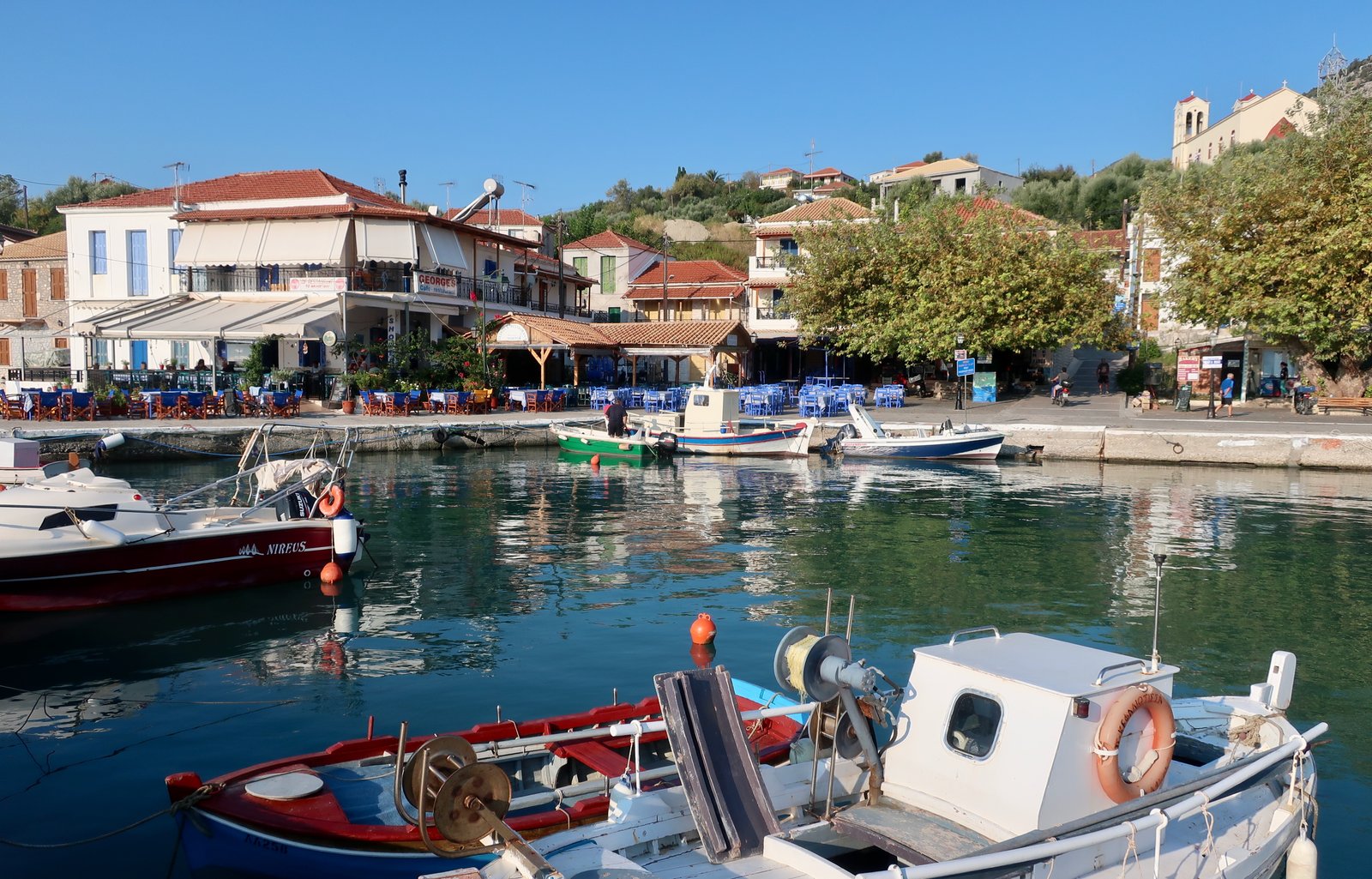
The island is only about eleven kilometres long, rarely more than three wide. Most days a small motorboat does the liaison Mytikas – Kalamos – Kastos. A similarly small boat comes less often from Lefkada. There are only four hundred and fifty permanent residents, almost all of them in the port. The only other settlement is Episkopi, on the other, northern side, with a population of perhaps twenty. Many houses there have been abandoned. There’s one café/taverna, still open mid-September, unlikely to remain so when the last holidaymakers, the few old island families who still have homes there and who come back for the summer, have gone away for another year.
Over much of the island there’s evidence of past olive farming. No-one does the harvest any more. There’s only fishing and tourism. The olive trees, and the terraces on which they were planted, have been swallowed up by forest.
Yachts visit Kalamos. All the Ionians are popular with yachts and here, with Kalamos and Kastos, the small islands between them, Lefkada too, there’s endless possibility for fun day-sailing, with shelter from the wind, deserted bays, places to call in for dinner or for stocking up.
There are no hiking paths. We looked on the internet and found zero useful information. Nevertheless we walked. The first day we did the eastern half, where the road is mostly narrow and overhung with trees. The woods are carpeted with a deep layer of brownish pine needles. They lie in heaps along the roadsides. Everywhere the ground is sponge.
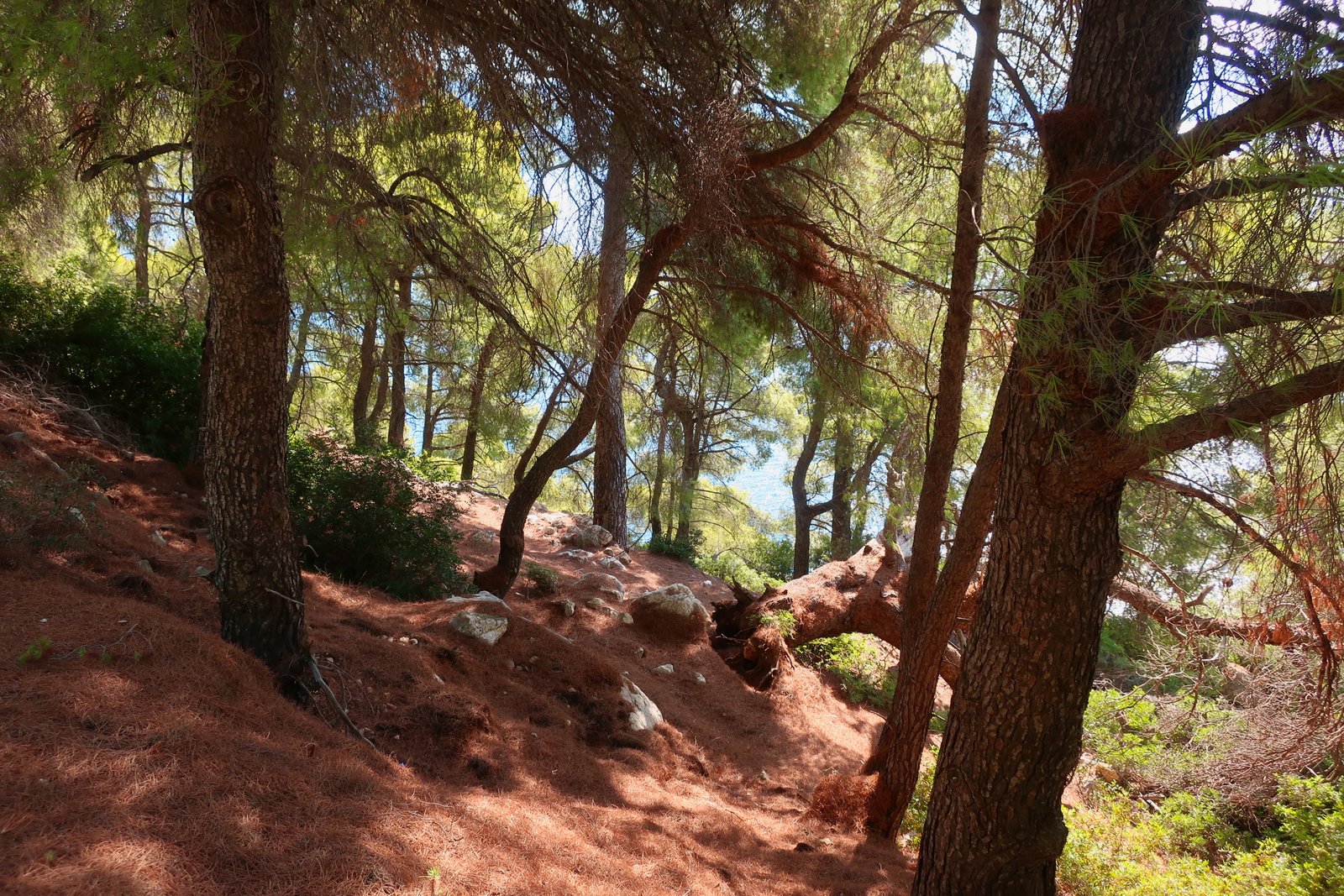
We walked the road from where we were staying – the southwest coast near the port – to Episkopi. Most of the way the road stays high above the water, one hundred metres, often more. You have to walk the road because the hills are impassable. Not like Aegean impassable where it’s low spike-bushes that block the way. Here it’s dense forest and knotted undergrowth. The land rises steeply, dark green and mysterious. Walking along the tarmac we passed places where we could see, just above us, the remnants of stone terrace walls, traces of past civilization. The undergrowth has taken over now. But everywhere, still, among this new-growth pine and fir, there are olive trees. It all looks like it has been here since the dawn of time, as if it was supposed to be like this, a natural forest of mixed pine and olive. But perhaps, long ago, before domestication and regular farming, this is really how it was.
There’s a ruined castle, or grand fortified house, on the northern side of the island just off the road. In a tiny bay near the eastern tip some boats are kept for going back and forth to the mainland. As the crow flies, it’s the closest point to Mytikas. A small, ruined church, whose stones are green and damp, marks the place.
Walking through Episkopi we saw one elderly woman on her balcony and one man with two yappy dogs. There are stone houses of consequence, slowly falling down. An abandoned school. A church of course. Schools and churches, the necessary building blocks.
The woman in the taverna told us that in the past the postman used to take a path over the top to get to the port on the other side of the island. She didn’t say exactly how long ago this past was. Probably not very. Changes have happened so quickly in the islands. There’s no path now, she said, no way over, no-one’s been that way for years.
The story of the postman has lovely resonance, it’s loaded with such a mesh of history. It’s practically possible to see him slogging his way up and over the hill, leather post-satchel over one shoulder. Of course we wanted to do it as soon as we heard.
We followed a dirt track that leaves from the back of Episkopi and heads west past a long, low building and a ruined church. When the track died out we doubled back. At a certain point we dived right, up into the forest, looking for the old path. At first there were some markers, impossible to follow for long. During the second part of the ascent to the saddle that marks the point the path logically used to take, we had to force our way through thick undergrowth on an increasingly steep slope. The forest is so dense it’s hard to maintain a clear direction.
Yvonne, head down, gripping at roots and branches, is toiling away just in front. She stops to tell me that it’s childish, wanting to force a way through thick underbrush on a foolishly steep forest hillside, determined to make it over the top like storybook explorers. It’s childish to spend days doing this sort of thing. Then, having said her piece, she continues on up. But when we reach the top, the sheer pleasure of it, the absurdity, the blind effort, makes us laugh.
From time to time we stumbled across the remnants of a path, mostly overgrown. Only at one or two points where it slightly opened up could we actually see where we were going. Now Yvonne’s last decent shirt is torn. She managed to cut her hand too, though not badly. Our clothes are filthy and sweaty. It was so steep in places that even as we were scrambling through the trees and branches and over rocks and dragging ourselves up almost vertical banks, Yvonne was saying, ‘I’m not coming back down here, no chance, we have to find the way.’

This small climb, maybe an hour, is the closest we’ve come anywhere in the islands to jungle. It corresponds precisely to that earlier impression we had, in the steaming afternoon in Mytikas waiting for the boat to come.
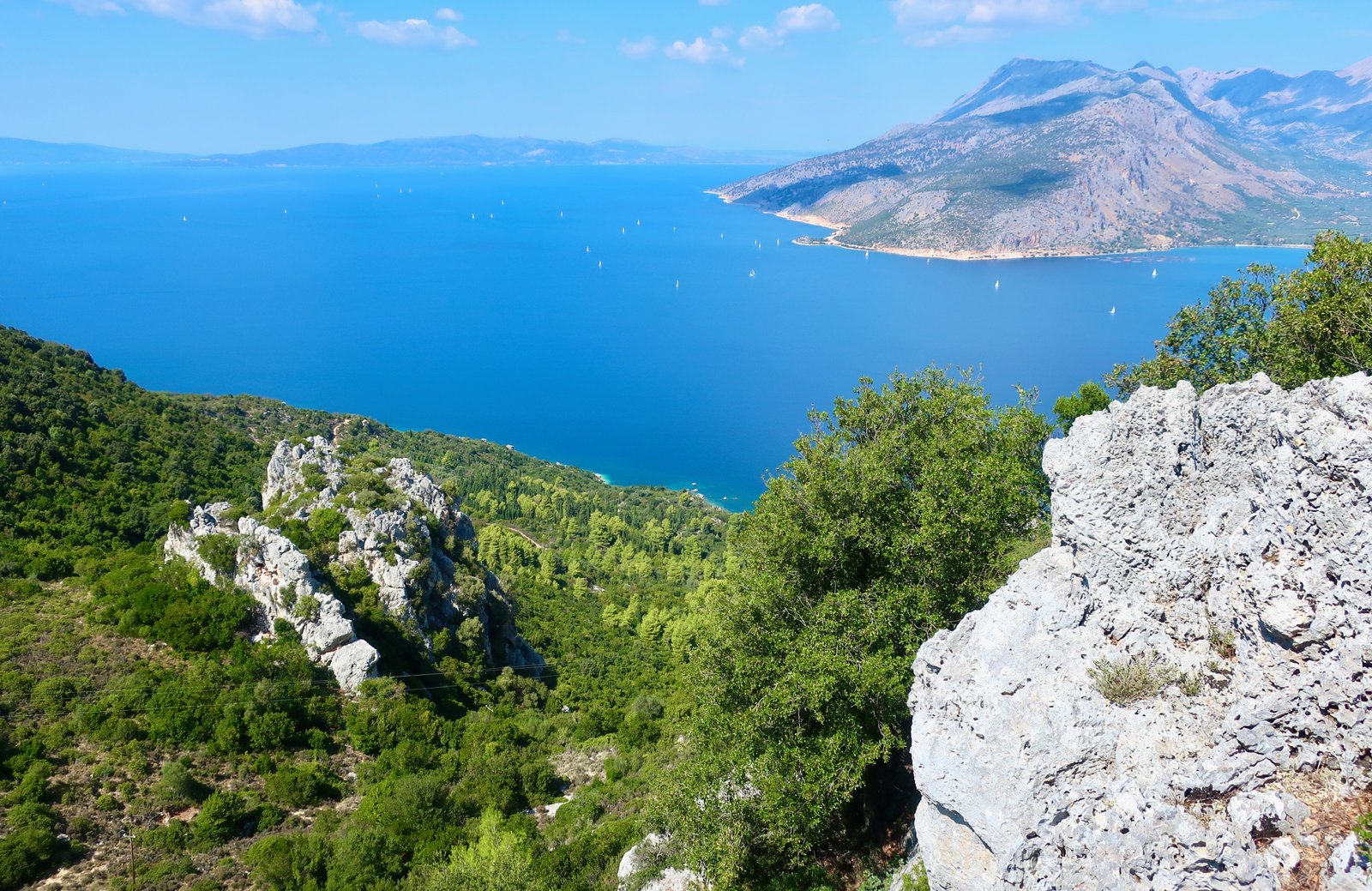
Eventually – and some parts were just so beautiful, and quiet, and mossy, and old – we made it to the top, from where there’s a view north to the mainland, west to Lefkada and Meganissi, with dozens of fragile white sails on the water between.
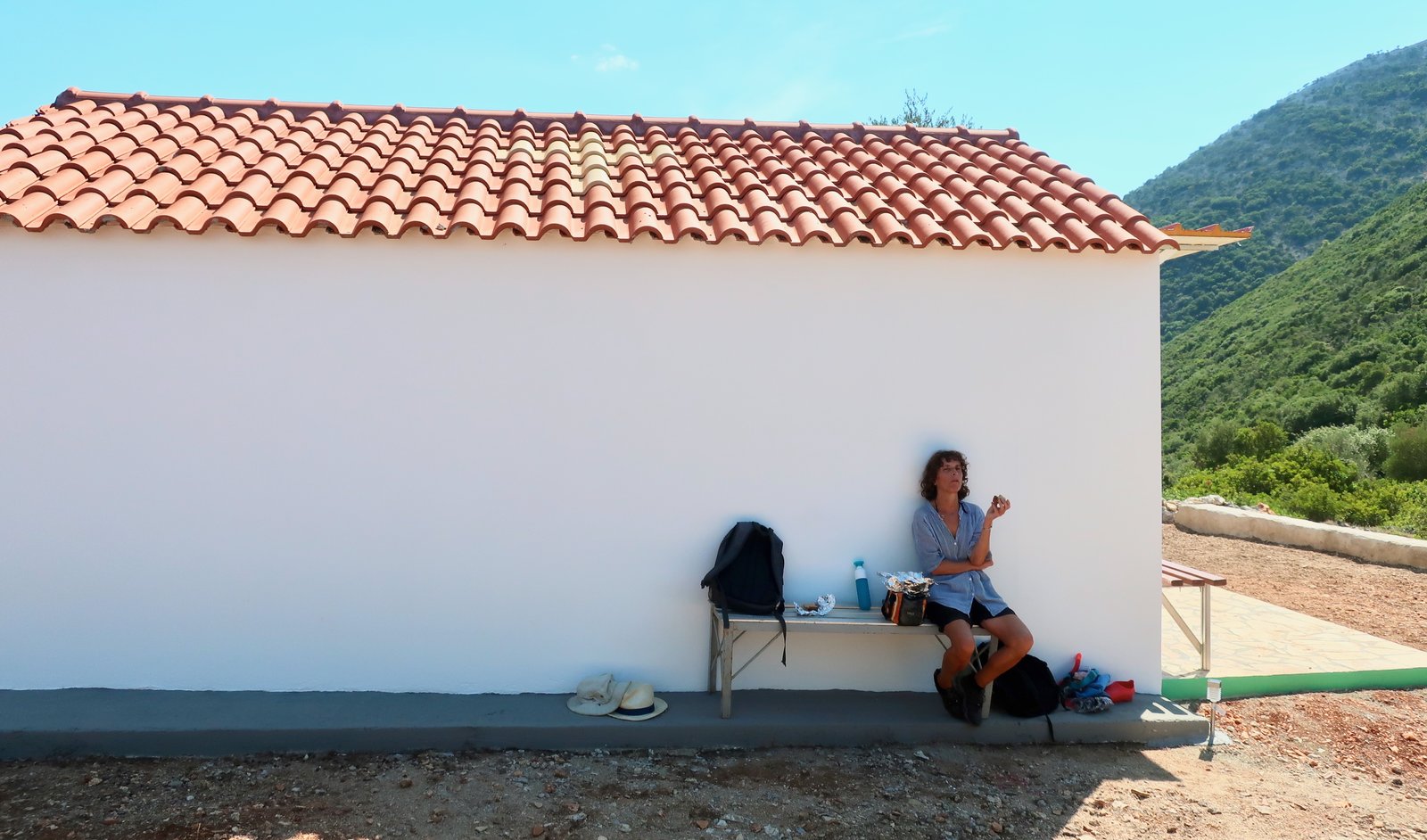
Just over the ridge, Agia Panagia is a particularly unattractive, small new-build rectangular block planted on what is still a dirty brown scar of a building site. From it an orange-dirt track has been sliced into the hillside all the way back down to the port. In time it’ll blend better. For the moment, it’s brutal.
We have regrets. We could have done more. When we were at the church we could have turned right and climbed to the high-point of the island, 754 metres. From there maybe all the way along the ridge and on down to Gerolimnionas on the southwest coast. On google maps, an overhead view, it looks easy. Although when we look at the photos we took from Mytikas or from Kastos, with Kalamos north or south looming, both sides of the ridge are steep. Perhaps very steep. And even with the inaccuracy of google maps there are some obvious outcrops of rock, which it may or may not be possible to skirt.
We should at least have tried. But sometimes days are not long enough and anyway, we were keen to get back home because by a rare slice of chance we were staying in a small studio that was so much nicer than expected, with a garden that descends in stone-wall levels all the way down to a small beach, where no-one’s ever likely to go except the owners of the house, and by extension us. The water there is warm and clear and there’s a place to sit and have coffee, or a bottle of wine or beer while the sun sets. And further up another place to sit, just in front of our little studio, among the trees. All this and unexpectedly the very lovely owners had gone away and left the whole place to us, the grounds of their house, the path down to the water, even their canoes, saying Use it all, it’s all for you, we’ll be back on Friday, have fun. This was in our heads to weigh against the walk along the ridge of the island, this and the succession of dazzling little white-sand coves normally reserved only for yachts, suddenly made accessible to our latest, paddling selves.
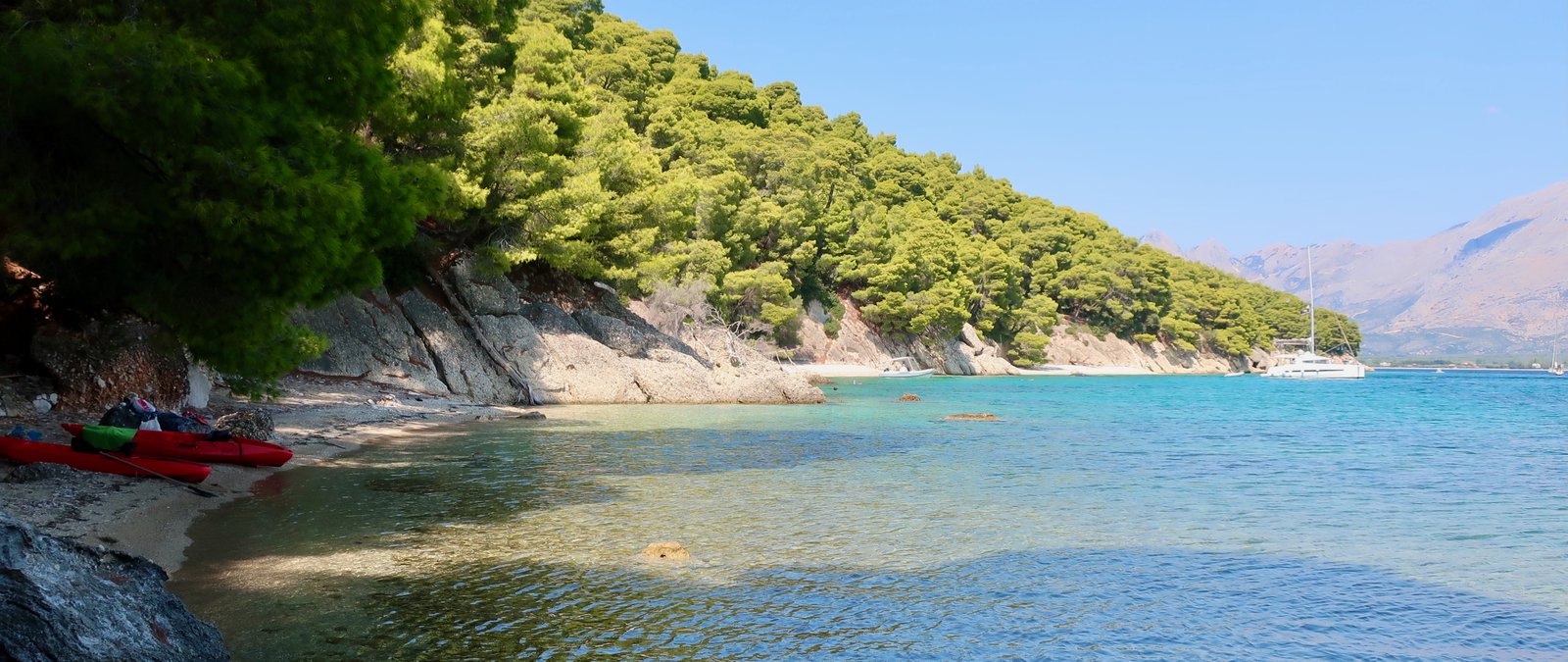
Another day we walked southwest from Kalamos to Gerolimnionas, a small waterside settlement abandoned in 1953 after an earthquake. The road ends there. Episkopi one way, Gerolimnionas the other, the sum of all roads on Kalamos. As far as possible we walked along the beach, or hopped over rocks, but most of the way it’s a hot road-walk, there and back.
At Gerolimnionas there’s an idyllic bay where yachts come to drop anchor, everyone on board no doubt gasping at the Greek Islands, the loveliness. There are tumbledown stone houses, a church in good repair, an old olive press factory right on the water. There are thousands upon thousands of olive trees on low terraces that are being overwhelmed not by pine forest here but by mastic and other low bushes. At one time they must have made oceans of olive oil.
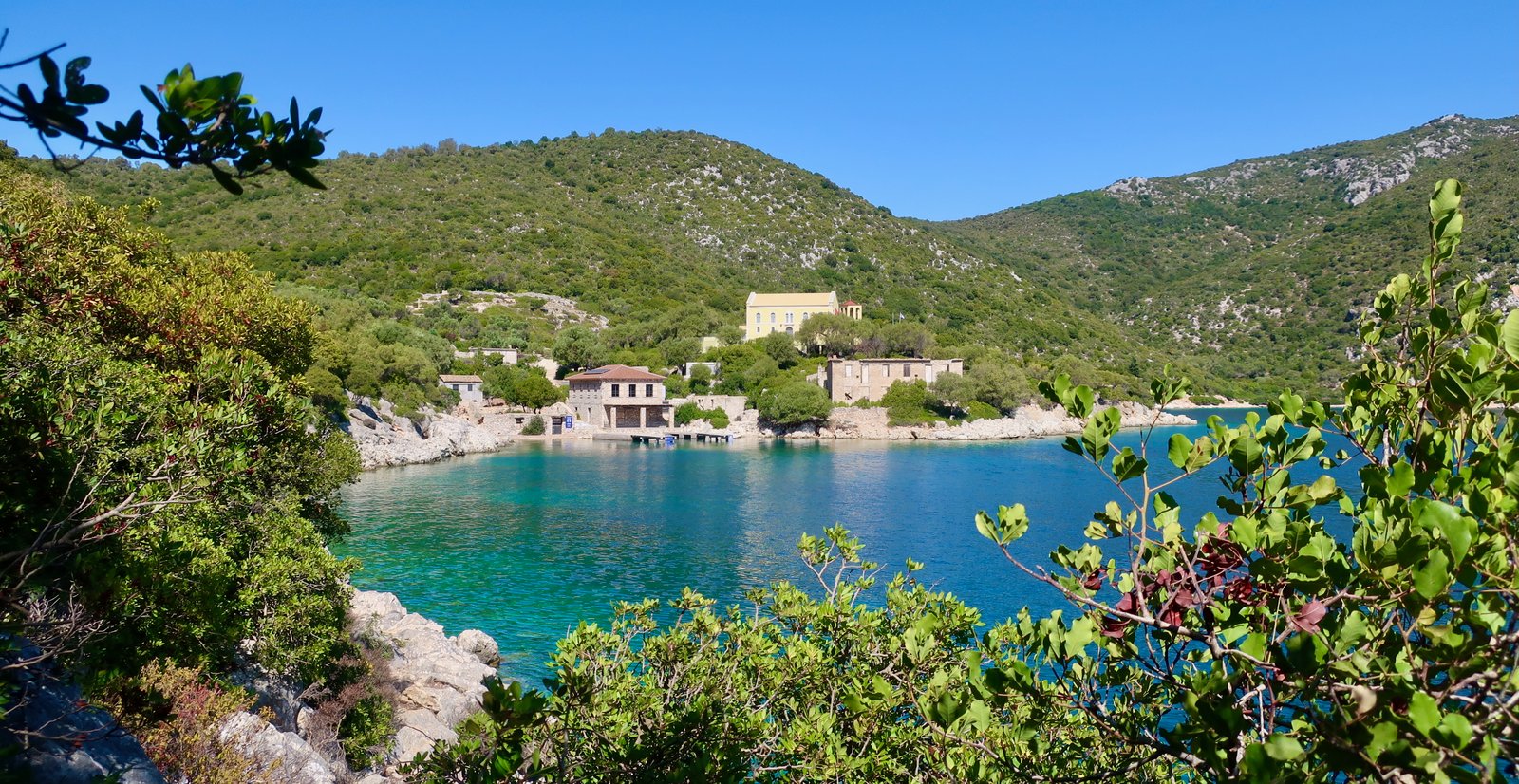
Gerolimnionas is the other point from which we might have tried to make our way to the ridge that runs down the middle of the island, the reverse direction, with a view to seeing if it was possible to get back to Agia Panagia. Even by studying the map, and the pictures, such as they are, I’m still not sure which direction would have been more suitable, or even that it’s possible.
Looking at google maps now, just up above the bay to the west are the remains of an old village, the rectangular shapes of a handful of buildings. Had we known, we would have investigated.
And more, looking at the map there’s another bay, Vathy Limioni, opposite Gerolimnionas on the north coast, with two sandy beaches. Perhaps there’s a walkable way across, a north-south connection. It isn’t far, even if there is the ridge along the middle of the island to potentially complicate things, even if a stroll across has just become a little less attractive since, looking carefully, the satellite view shows the telltale signs of a large fish farm on the other side, the bay half-full of monocles of various sizes, and who is ever keen on swimming near fish farms, where the water can be blurred like fishtank-food…
***
Because, essentially, we don’t take risks, only very rarely have we got into trouble when hiking. One of these occasions was on Kalamos, and was wholly improbable. We were on a beach. Not on a rocky path through the mountains or inching across a steep slope aware that a fall really wouldn’t be a good idea. We were on a beach and could see there was no way to continue along the water, that we would have to get up to higher ground and go around. Rather than go back, and up, we chose to scramble directly up a small slope at the back of the beach. Easy.
We were halfway to the top before we really paid attention to the fact that it wasn’t a slope, but a clifflet, and that the top of it, the last few metres, was vertical. In fact even more than vertical, there was a slight overhang. At the same time, the ground we were on, which we also hadn’t paid proper attention to, was unstable. A shaley, dirt slope, increasingly steep, increasingly loose, with just a few solid points, little rocks on which to put our feet, and at the top, roots to hold onto, whiskers stretching down over the edge. We were quite blithely three-quarters of the way up the slope before we knew there was a problem, by which time it would have been too difficult to go back down. So we both shut up, tensed up, and concentrated, and pointed out holds to each other, and didn’t even begin to have the conversation we were wanting to have, the jesus-what-are-we-doing-here? and how-do-we-get-out-of-this? and which-way-now? not until we had hauled ourselves up over the top lip, very gingerly, using roots and small branches barely big enough for such use. Then we did, lying there, relieved.
I’m recounting this because you can’t be too careful. You really can’t be too careful. Even after having walked thousands of kilometres all over the islands. Perhaps especially after having walked thousands of kilometres all over the islands, prone to being a little blasé. On an island on which anyway there’s no hiking, where all we should be doing is getting back to our accommodation, there to spend the week we did spend, mostly idling in a very, very beautiful place, with cold white wine, a book and lazy swim-safaris along the coast, all it takes is one small moment of inattention.
