

They say Donoussa is laid-back. People like to think islands have enduring characters. But I don’t know. It may be that nowadays the direction an island takes is fluid, the chance result of a particular group of people being custodians at a particular moment. If so, given its situation just a short ferry trip from Naxos, and the fact that people on Donoussa are by now aware that their exceptionally pretty little island turns heads, the current custodians are doing a more than reasonable job. In another incarnation there could be discos and nightclubs and fifty euro beach loungers and I am here and Have you seen me? For now on Donoussa there is none of that. They used to say Mykonos was laid-back and who saw coming what happened there? Wherever we go in the islands there’s always Mykonos, the lesson to be learnt.
Who knows what the future will bring? For now the islands are hauntingly beautiful and meaningful and deep and it’s possible, respectfully, to go to all of them. I can’t say it enough, this is their moment. For even though we don’t believe in golden ages or the good old days, don’t ever want to ascribe to the belief that (because this is our time) this is the best time, it’s still hard to conjure up a future within which people will not look back to now, and sigh.
***
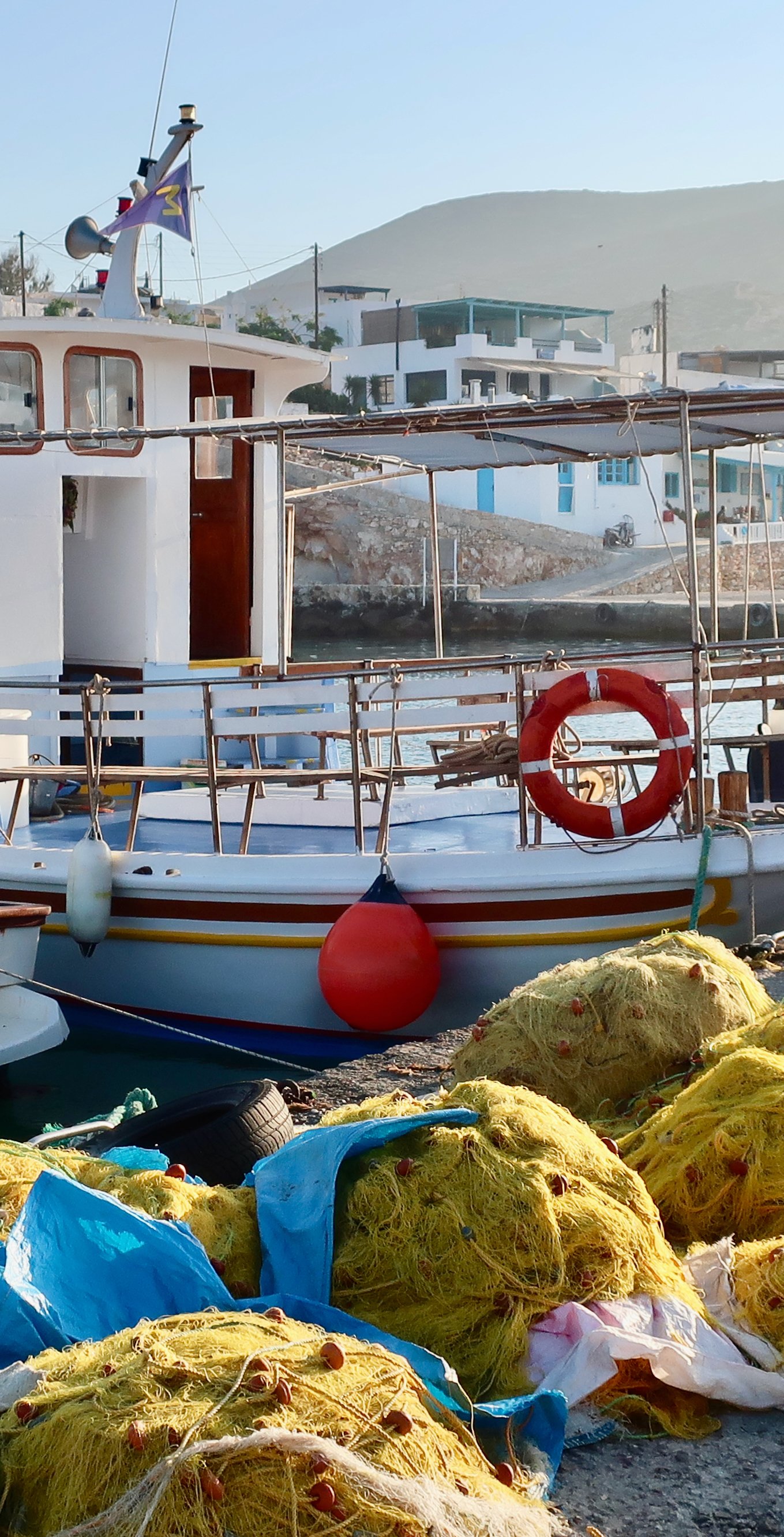
Stavros, the port and main settlement on Donoussa, is a collection of buildings that doesn’t seem quite to have coalesced into a village. The hub, which in Stavros is the port itself, with some fishing boats and the ferries coming and going and a couple of bars, is so tiny. Buildings straggle out and up the hill. There’s a loose cluster on the other side of the beach and a few more behind it. The public places – bar, taverna, shop – are scattered here and there.
But what a sight, coming in on the ferry.
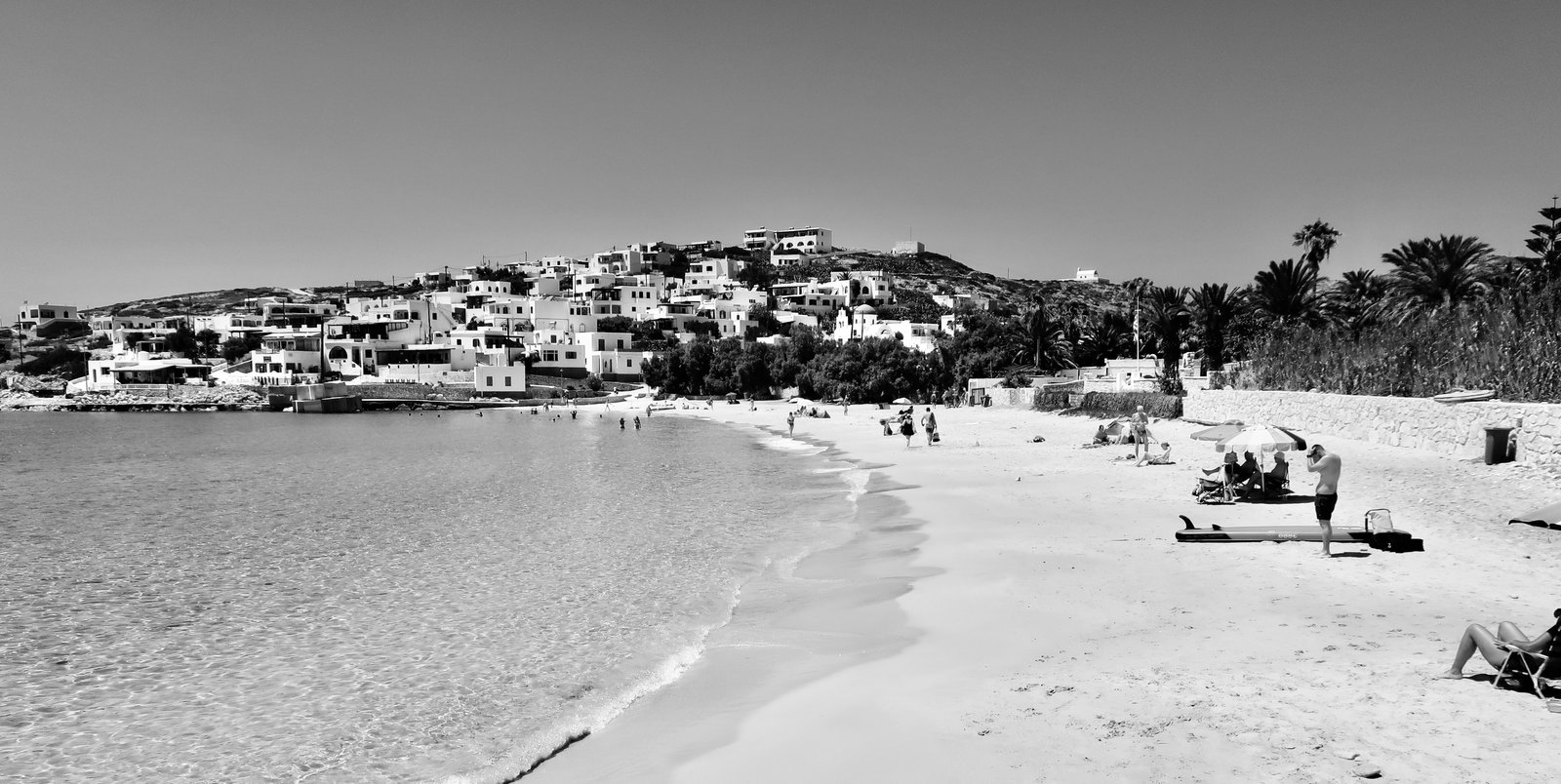
Is there a more lovely port beach anywhere in the Aegean? Tilos is good, but not as good. Perhaps Aegiali on Amorgos. The scale is different though. Oh, Pserimos. Pserimos, the second paradigm. If Mykonos represents an uncontrolled expansion, Pserimos, set around its achingly beautiful bay, is a diminution, a shrinkage.
The beach is about two hundred metres across, slightly curved, pale sand, some tamarisk trees, water perfectly transparent. In June we met an Australian there, out early every morning, back and forth, back and forth across the bay as if he didn’t want to miss a moment. All dripping and buff, he explained: The water’s warm, it’s clear as glass, there’s no sharks. Heaven mate.
About eighty people live on Donoussa all year round. Aside from Stavros there are a couple of other settlements, or ex-settlements, almost uninhabited now. One early May we walked to Kalotaritissa in the north, expecting a café. When we were first in the islands, for a surprising length of time we remained spectacularly naïve, seeing place-names on the map, unthinkingly imbuing them with a structure we could relate to. Kalotaritissa, the place, is nothing but a dozen or so lonely buildings at the head of a large, sheltered bay. In the second week of May there were a few goats and some chickens. There may have been one elderly woman, we might have heard the sound of her voice and it might have been the wind.
(According to internet-information, one of the buildings turns into an unlikey end-of-island tavern in season.)

Most visitors probably don’t venture away from the southern beaches, none of which are organised, meaning no ranks of parasols-and-loungers-for-rent. There’s a lot of casual naturism. Although most of the islands have naturist beaches, usually more or less out-of-the-way – it’s part of the Greek island vibe – Donoussa is especially free and easy. Not the town beach though, designated family-friendly, to separate it from the rest.
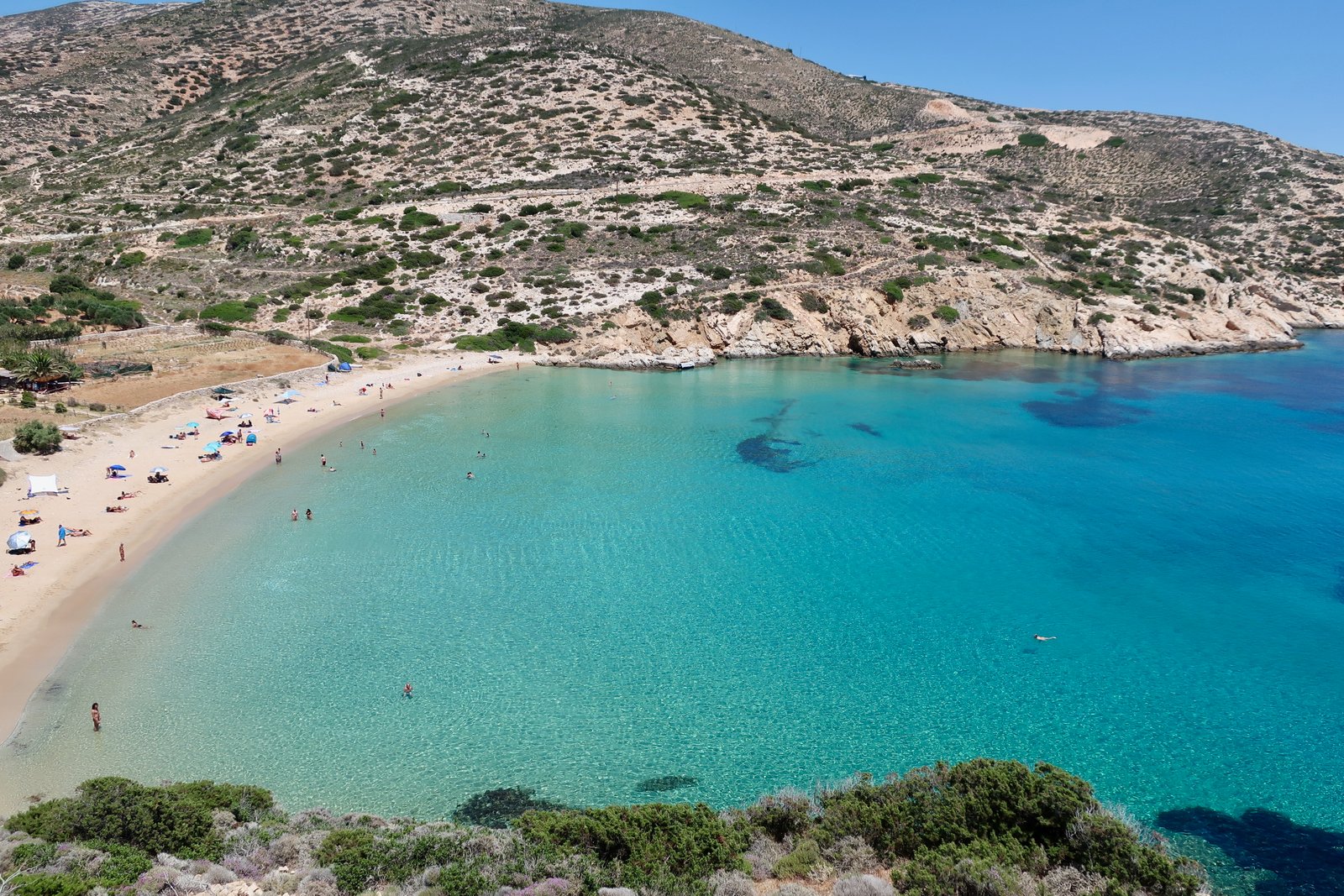
The island’s two other main beaches, Kedros and Livadi, are randomly mixed, clothes and not. Kedros is a short stroll from the port, a kilometre or so, and would make it onto anyone’s list of best beaches in the Aegean. We aren’t so beachy, don’t have the patience to spend time sitting and browning, but still, walking down the hill towards Kedros on a sunny day you can’t help but gape. There’s nothing but the beach and one beach bar – also great, as if a logical extension of the perfection of the beach – and the quite unreal turquoise water. Photoshopping or colour-enhancing are entirely superfluous.
Further along the coast at Kato Mylos, a narrow, rocky promontory near Limenari beach, are the minimal remains of an ancient geometric settlement (900 – 700 BCE). Some low walls sketch out the shape of a dozen or so dwellings. The Aegean is full of places like this. Where elsewhere, records of ancient settlements have mostly been erased, smudged away, the islands are adamantine. Despite the blasting wind and weather, the past persists.
We walk around the site working out the point from which attackers might come, we impossibly try to grasp the reality of living in such a stark, inhospitable place, trapped by the small protection it offered against the pervasive violence of the world.
***
Donoussa, a short history:
The island was inhabited as far back as 3000 BCE.
We read that it flourished during the Geometric period, but have almost no understanding of what flourished might mean in this context; too far away, too little left, too dark. It’s difficult to see Kato Mylos and imagine anything more than a limpet-like clinging on.
Like so many other islands, the Romans used it as a place of exile.
The Byzantines appear to have largely ignored it: there’s no ideal place for a stronghold, thus too difficult to defend against the attacks of pirates, others.
Venetians and Turks came and went, saying it was theirs.
Pirates used Donoussa as a base from which to raid other islands.
For a while in the late nineteenth/early twentieth century the population swelled. Most people worked in mining, on the island itself or on nearby Keros. When the mines closed they migrated elsewhere and the population dwindled again.
In the 1980s a port was built and electricity came to Donoussa. 1980, no electricity, an almost pre-industrial subsistence.
Since then, tourism has slowly been increasing and life has changed for the better, we are told.
HIKING
Although no one goes to Donoussa specifically for the hiking, there are some trails, and the island is unusual in that it can be circumnavigated on foot in a day. Which is a pleasure. It’s a roughly twenty-kilometre circuit, depending on diversions.
Trail 1 heads north out of Stavros. Halfway to Kalotaritissa, you can take a diversion to the top of Mt Pappas, the highest point on the island at just under 400 metres. We don’t exactly collect Greek island mountain tops with their concrete marker posts, but in the course of things have been to most. Yvonne perches on the post for a photo. Sometimes I stand on top and have my picture taken too, arms out as if flying, never quite sure what else to do with them.
The track that descends towards Kalotaritissa would once have been the main path connecting the north to the south of the island.
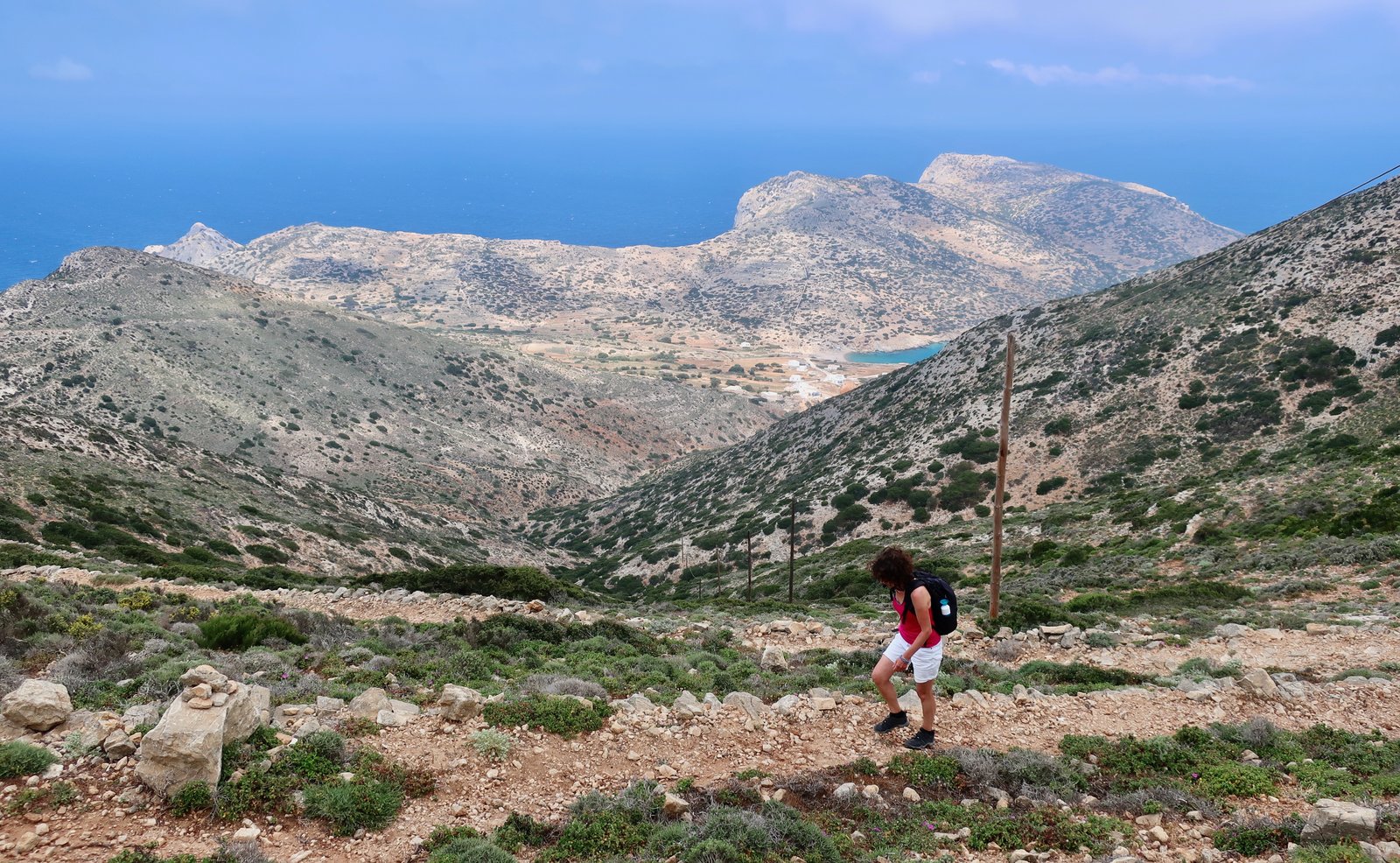
At Kalotaritissa there’s the seasonal tavern, perhaps, and a diversion out onto the promontory with a minuscule, no-longer-functional light-tower at the tip. It’s like a toy moon-lander from Tintin. There are also three small beaches, and a large protected bay where yachts hole up in bad weather.
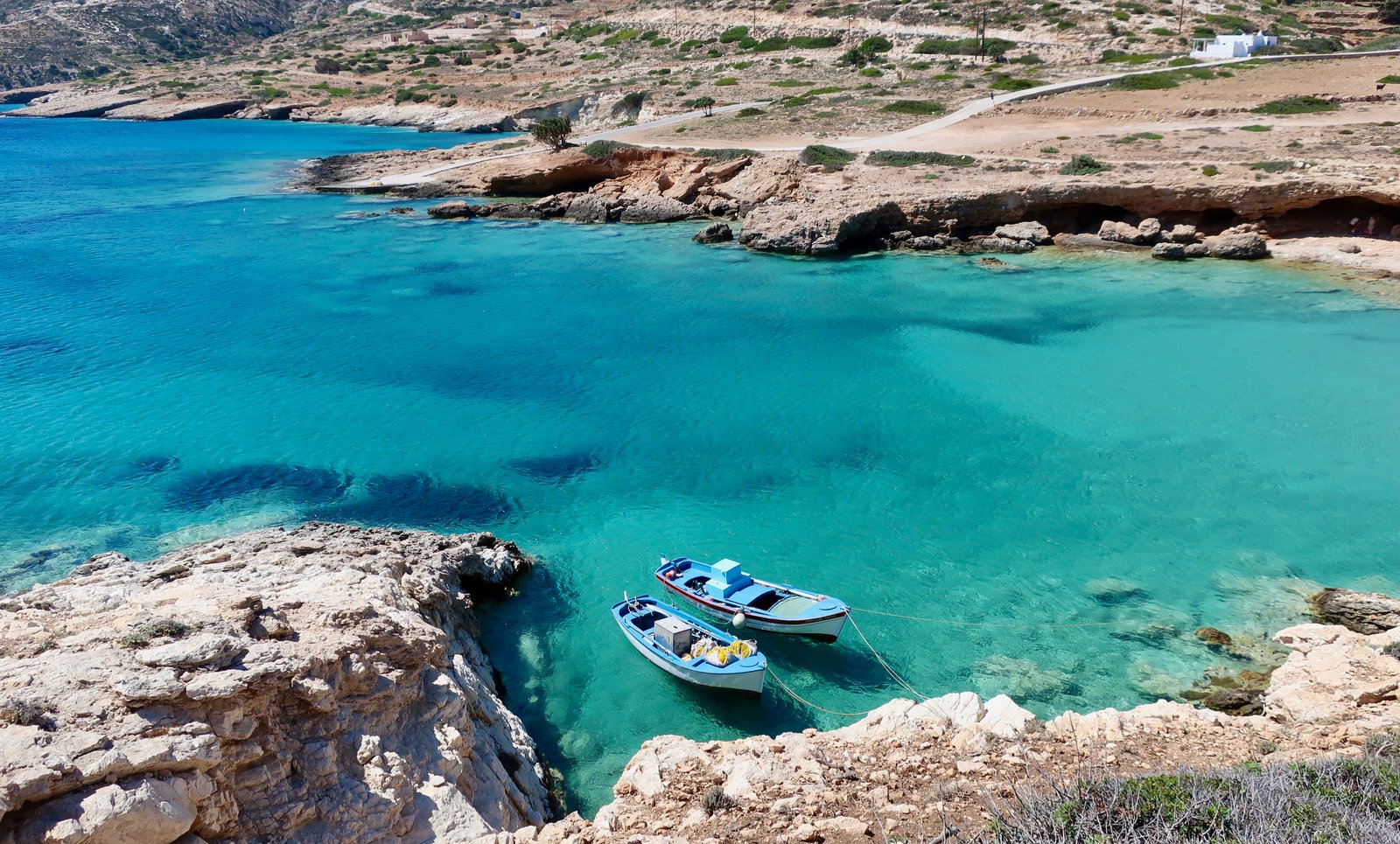
Between Kalotaritissa and Mersini the way mostly follows the road. At Mersini, once a farming village with a spring and its portion of fertile land in the valley that drops down towards the coast, there’s little now but dust, stones, rough concrete, a few animals, heat and wind and a handful of elderly people, who may emerge from their homes to watch you passing.
The path goes from Mersini down to Livadi beach, where in season several times a day a few tourists are dropped by boat from Stavros. There are some tamarisk trees for shade, but no facilities of any sort.
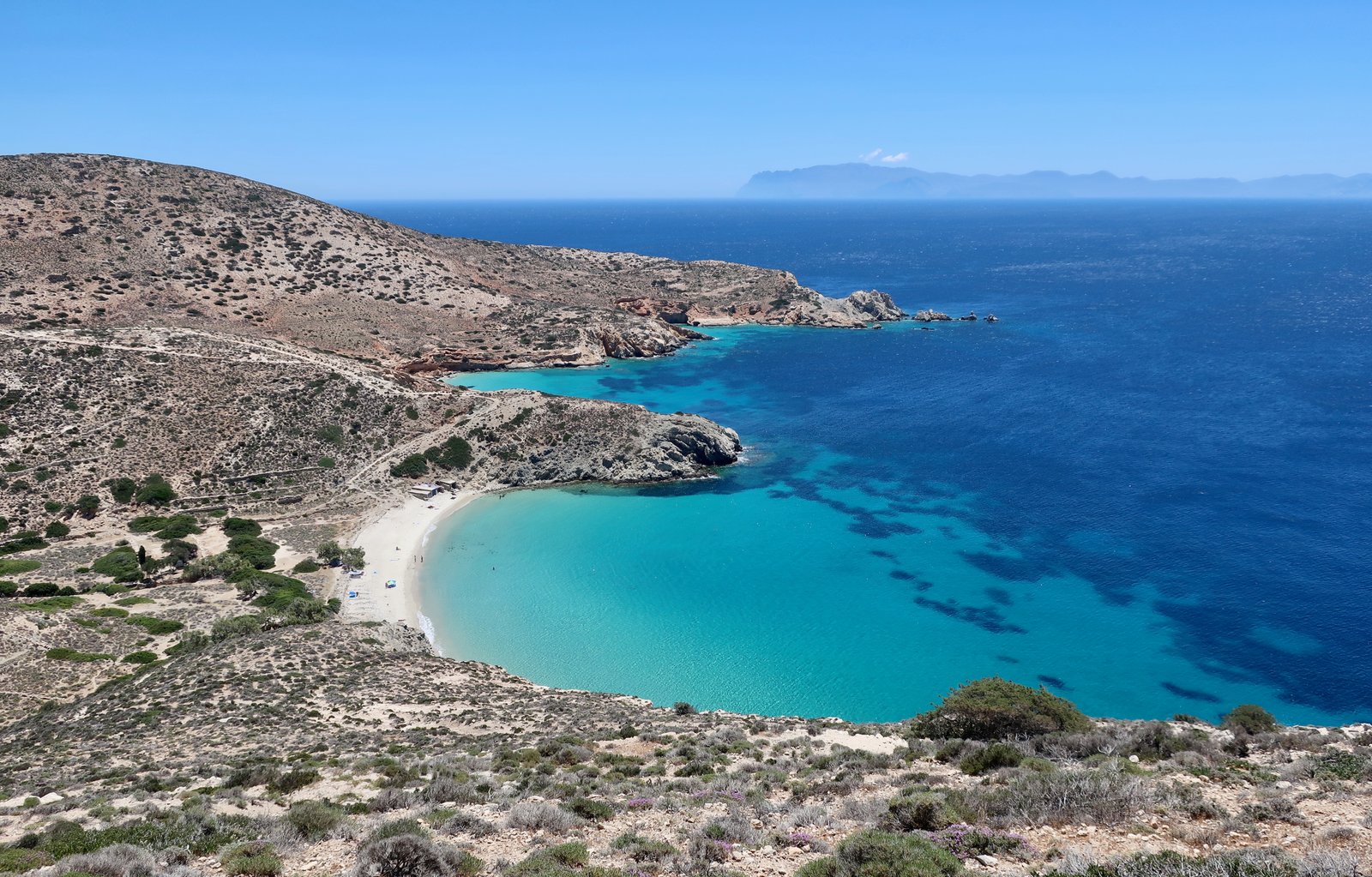
The trail climbs up away from Livadi, then settles onto a cairn-marked way just above the water. The ground is pale rock, moulded into rounds and spikes, melted or wind-sculpted. The path is lovely. There are narrow inlets, with rocks from which to launch yourself into the brisk pre-season water. There are several small beaches at which to swim or bask. On one, someone had made a heart of dark stones, a sort of lover’s SOS visible from the hill above. We were sitting just at the water’s-edge when four Italians arrived, and, touched by this private and public declaration wanted to know, was it us, the heart? They smiled knowingly, disbelieving, when I told them no.
The path goes on to Limenari beach, then Kedros and the new stone path back up to the road and on to Stavros.
***
Another marked trail leads east out of Stavros, past a sea-pool almost enclosed by rocks, and on towards the western point of the island. It’s only three kilometres, but feels more. A wild place. On one side a slope of rock angles shallowly into the water, on the other it’s vertical. From a distance you could imagine water-skiers sliding up the face and leaping off into the air.
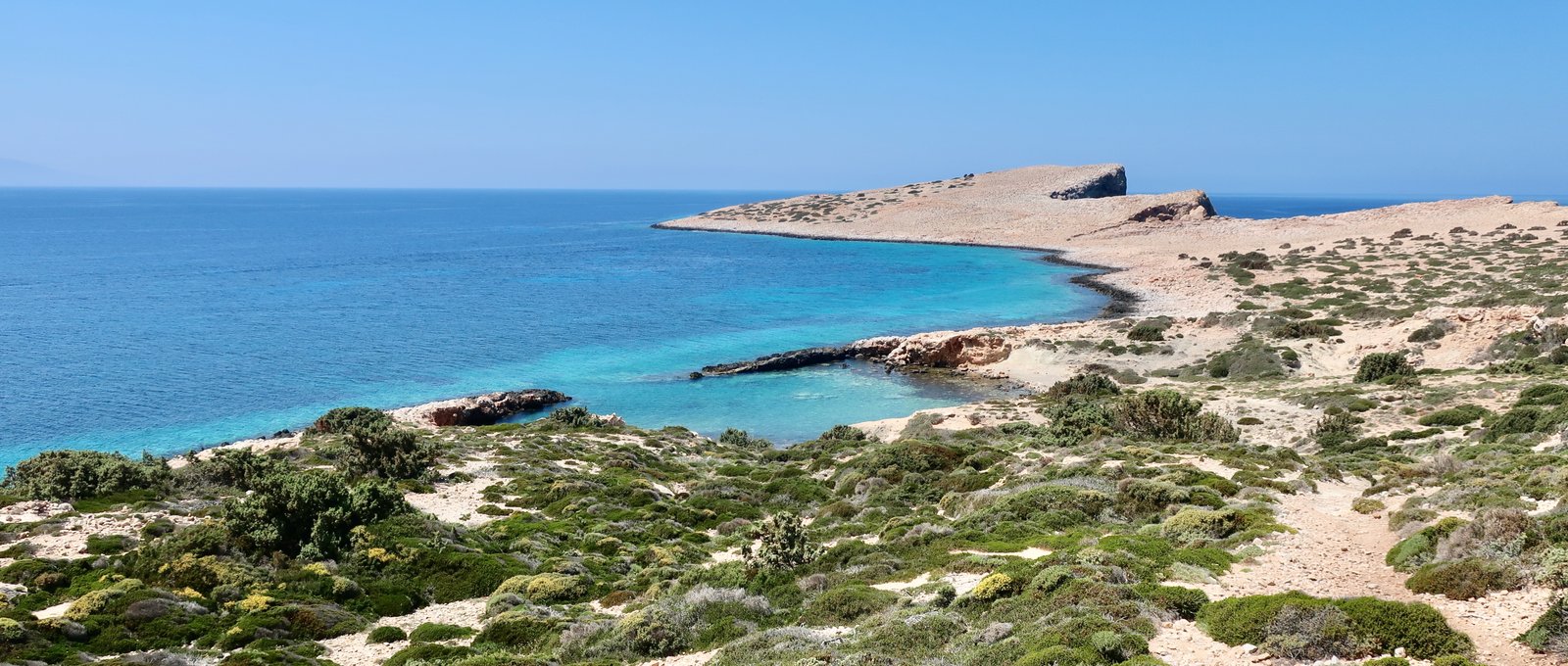
There are seabirds here that don’t take kindly to even small incursions during nesting season. They squawked and dive-bombed so insistently when we tried to pass we couldn’t make it past them to the tip.