We went to Mykonos in late January during a spell of freezing weather. To the north, the snowcapped hills of Tinos looked more Patagonia than Greece. Coming across on the ferry, the sea was heavy grey, the saloon windows so steamed up we could hardly see out.
When we reached the accommodation, our hostess told us she rarely got winter bookings, but that she had had a young Chinese couple just before us.
Why would anyone come to Mykonos in winter? she said, There’s nothing. She shook her head.
Um…what’s summer like? I asked.
She stopped writing, looked up and made a face. Summer is hell.
***
MYKONOS – A VERY BRIEF MODERN HISTORY
After the Great War, because of the proximity of Delos, the nascent archaeological work there, the first cultural visitors arrived on Mykonos. No-one lives on Delos.
In the 1960s the rich and famous began coming. Aristotle and Jackie Onassis, Sophia Loren, Brigitte Bardot, Grace Kelly, and so on. Someone must have come first by something like chance, to set the ball rolling. Photos appeared in glossy magazines of a summer Greek island where celebrities mixed carelessly with the locals. Mykonos quickly gained a reputation for bohemianism, a place where everyone could be themselves and people from all walks of life were equal. Then came a snowballing.
Skip forward to one possible future.
It’s ironic, the idea of Mykonos as magnet for the unconventional. What Mykonos has become.
***
Kostas who we stayed with on Serifos says that the girls from Mykonos are rich. He met his wife there and presumed she was rich. It turns out she was neither from Mykonos nor rich. There was a misunderstanding, he said.
Some islands are more expensive than others. Santorini for example. In Santorini you get something for your money: the drama of the crater, the views, the much-hyped sunsets. It may or may not be worth it, but you do get something.
In Mykonos, which is outrageously expensive, you get a larger-than-average-sized, attractive, coastal Chora, built in classic Cycladic style. In the intricate nest of streets, where it’s almost impossible not to get lost at first, you get Gucci and Louis Vuitton and all the rest. You get some nice beaches, although no nicer than beaches on many other Greek islands. You get good weather and warm, clear Aegean water, Greek food and Greek-island-landscapes, all of which exist elsewhere. You get access to Delos, the sacred island whose centrality in the Aegean gives the Cyclades their name, although that certainly isn’t why most people come to Mykonos. And besides, Delos can be accessed for day trips from several other islands. You get night life. Maybe that should be NIGHT LIFE. Or NIGHT LIFE! Whatever that means. But mostly you get to have been to Mykonos.
If you want to go to Mykonos because you imagine its fame must be the result of its loveliness compared to other Greek islands, don’t do it.
In a way Mykonos is like the story of the Emperor’s New Clothes, except not quite, since some people – maybe a large number of people – must see Mykonos relatively clearly and like what they see.
I recently read an article by an Athenian Greek, which began, Mykonos is not Greece. As if somehow, despite the obvious geography, despite the language, despite the history and culture, in some profound sense modern day Mykonos is an imposter, plugging a Mykonos-sized hole in Greece from which the real Mykonos has disappeared.
In January it is just as unvisited as other islands. The town is all but closed. A few cafes are open along the front for the all-year-round locals. The small supermarket near our accommodation was mostly frequented by migrant building workers, their clothes stiffened by splatters of cement and plaster. It was impossible to get a proper impression of what it must be like in season until we watched a video-stroll through the summer town on Youtube. It was dazzling. Every single closed-up anonymous winter façade a commercial premises. There’s a level of illumination, of theatricality, that makes it all seem like performance, like being permanently in the moment of the flash going off.
A few days ago there was a piece in a daily newspaper about saturation and Mykonos. Sun loungers seventy euros a time. Nearly a quarter of a million visitors in one July week for a permanent population of ten thousand. A gargantuan new development financed by the Gulf States. New airline deals bringing in direct flights from more and more destinations. And Elon Musk. Lascivious detail on just how much he paid for his Mykonos yacht rental, his two or three-hour speedboat trip. Zeros clocking up. He went to Delos to visit the archaeological site, the mayor of Mykonos underlined. This is the sort of cultural tourism we wish to encourage.
HIKING
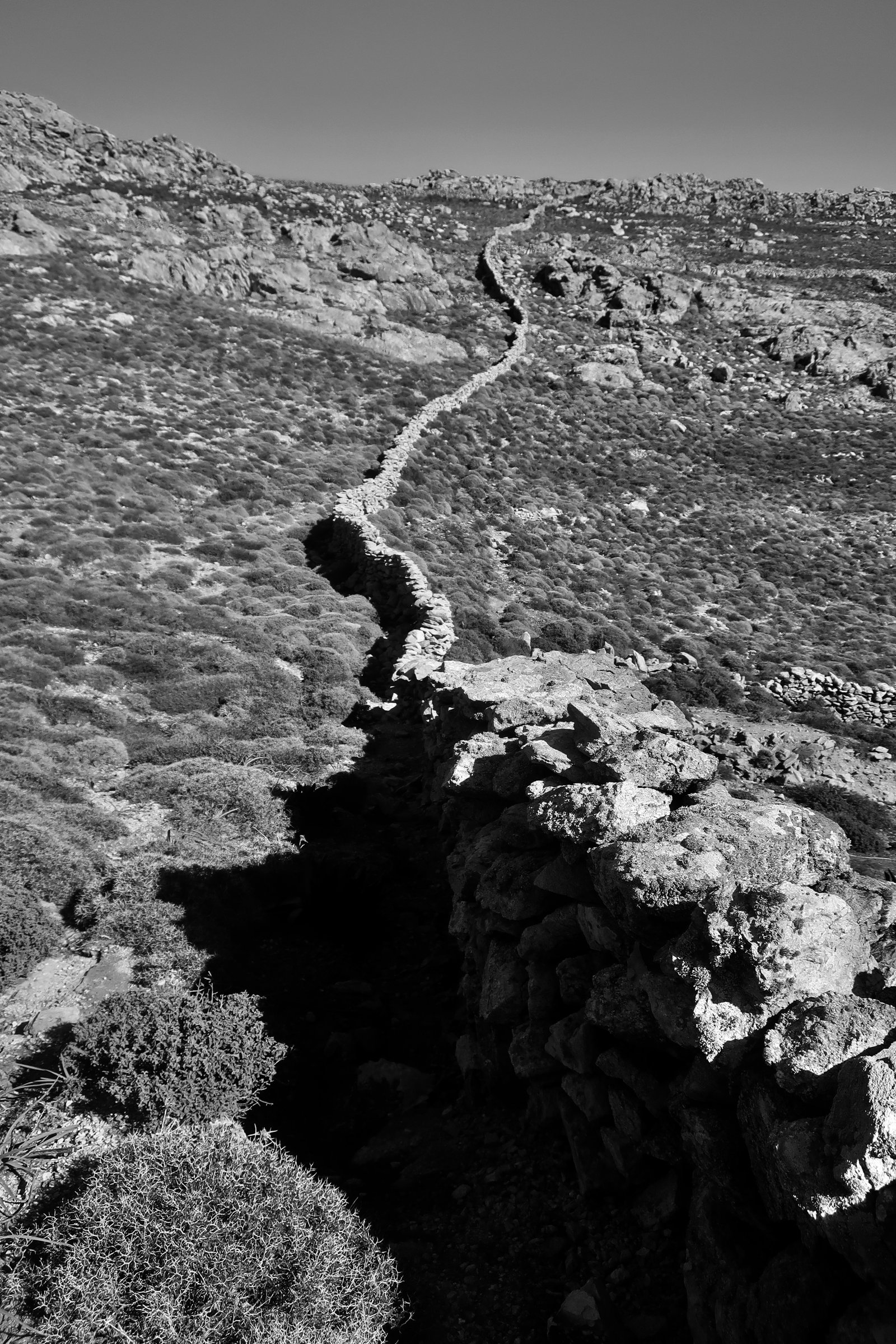
There are no proper hiking trails left on Mykonos. In the past there must have been the same sort of network as elsewhere, a tracery connecting the island in all directions. The remnants are mostly in the north, the less developed areas, many of them on hillsides from which they haven’t yet been altogether erased. To some extent we spent our time on Mykonos not on paths but scanning the countryside for these vestiges, seeking confirmation of where they used to be.
Most of the three days we spent walking we were choicelessly on roads, asphalt or rough dirt. But if the volume of traffic in January is anything to go by – in particular construction-site traffic – walking on main roads during the tourist season would be impossibly uncomfortable, even dangerous.
We used the Anavasi map of the island and phone GPS, neither of which were entirely trustworthy.
HIKE 1
The Chora to Ornos Bay. Diakoftis. Back to town on a more inland route.
20 kms
South from the Chora along the coast, well wrapped against the bitter wind, sticking as close to the water as possible. Between the Chora and Ornos Bay the route was fifty per cent asphalt, fifty per cent beach.
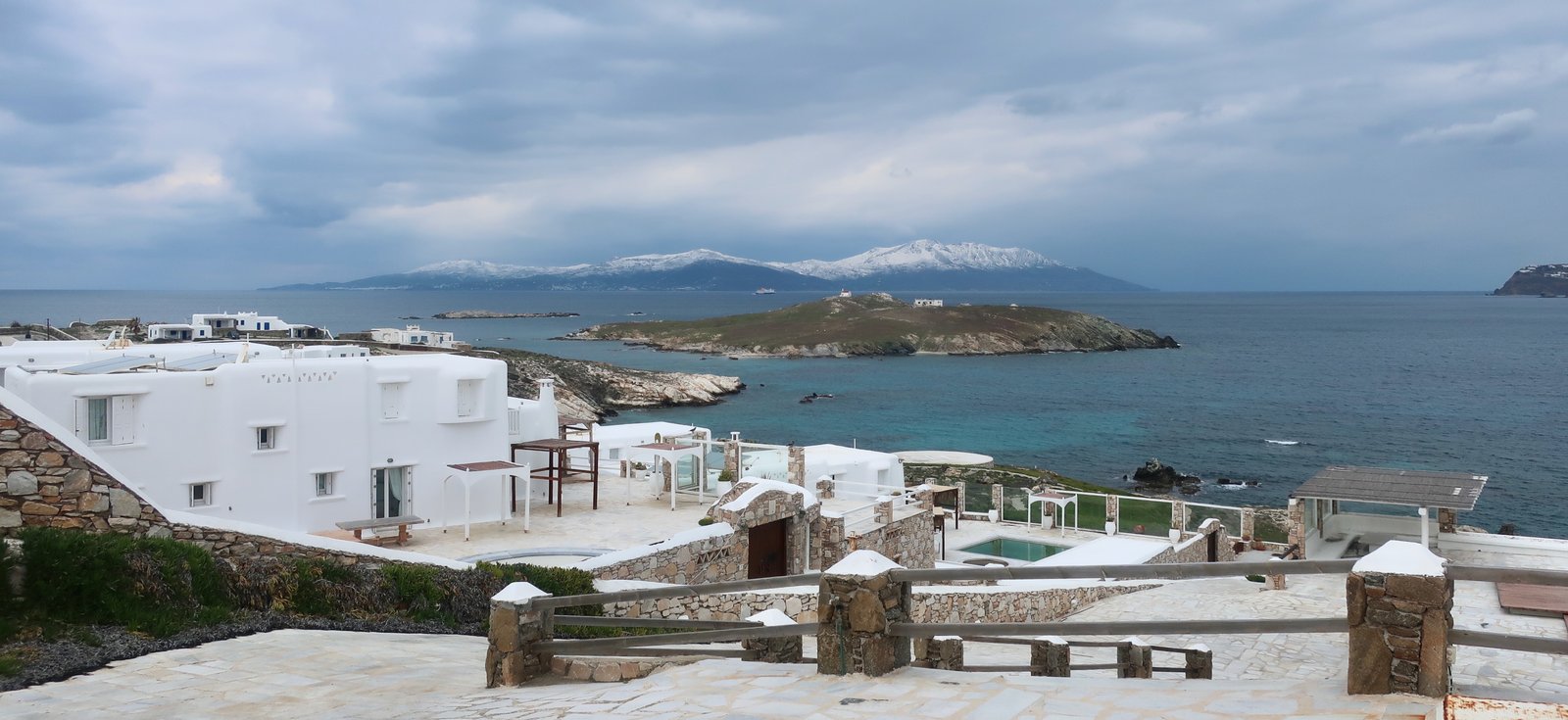
As soon as we start walking we’re happy. Or content. Or something. I don’t really know what to call it.
It could be the motion itself that causes it. Is the motion something, biologically? It could be the fact of turning up. Opening up to experience. Conversations we otherwise would never have had. The calm. I just know that it works every time, and that I’ve spent too much of my life not knowing this.
After Ornos we walked up and around Diakoftis, the lump on the southwestern end of the island. A dirt road, lorries and dust, construction. More views north to snowy Tinos, southwest to Delos and Rineia, southeast to Naxos, its top half also airbrushed white. Some of the lanes on the map are closed – privatised now, or built that way – forcing us to divert up and over old stone walls.
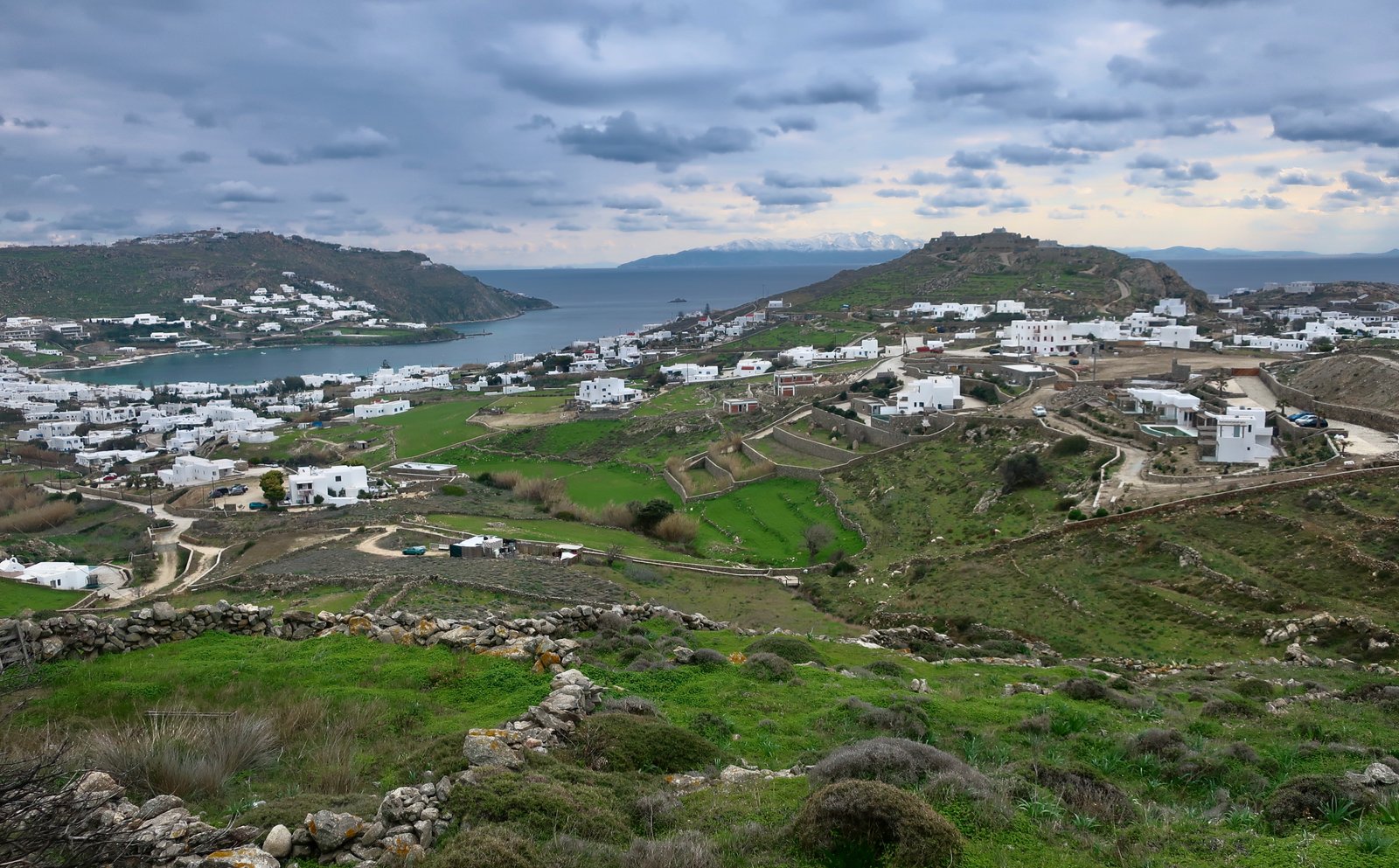
Coming back around to Ornos, after the main beach we tried to continue along the coast but were blocked by a security guard. No way through past a new, fancy development to the little church marked on the map, visible a few hundred metres ahead.
We’ve said elsewhere, the question of ownership of the foreshore in Greece is tricky. In theory it’s public property. But how should one sidestep a bulky, inflexible sentry employed precisely for his bulk and inflexibility?
We went inland instead, up into the low hills between the southwest coast and the airport, came several times to dead ends, had to turn and try different options. Eventually there was a tiny church where we could sit and eat lunch looking back down over Ornos. On the slopes just below was a smallholding with chickens and goats. A muddy pool by the house. Barely a blade of grass. Some small stone buildings for animals on the rocky outcrop in front, a perfect view from there down over the bay. The land must be worth a fortune. We imagined them at first as romantic holdouts, the owners of this prime real estate, refuseniks against the tidal wave of commercialisation. The real reason for the continued existence of this little island is probably more prosaic: either they’re waiting for a really good price, or, more likely still, are simply tenants and the owner is selling his land bit by bit by bit, in no hurry at all, confident in the future.
After lunch we wandered north through backroads towards Mykonos town. Everywhere the buzz of activity, lorries and other vehicles.
The distance walked was in part because of the back and forth, the no-through roads, try again, repeat, find a way through, get blocked, try again.
HIKE 2
Bus to Ano Mera. Around Profitis Ilias on the eastern end of the island. All the way back to the Chora, via Ano Mera again.
28/29 kms
Because it was too far to walk all the way there and back from the Chora, we caught an early bus to Ano Mera, the island’s second-largest settlement, plum in the island’s centre, the old agricultural heartland. It’s mostly unlike new-Mykonos, although tourist construction is edging closer.
From there we walked on minor asphalt and dirt track towards the northern side of Profitis Ilias. (On Mykonos there’s one Profitis Ilias in the east, one in the north.) On the way there’s a huge landfill where even in January streams of lorries come to offload earth and stones they’ve dug from building sites around the island.
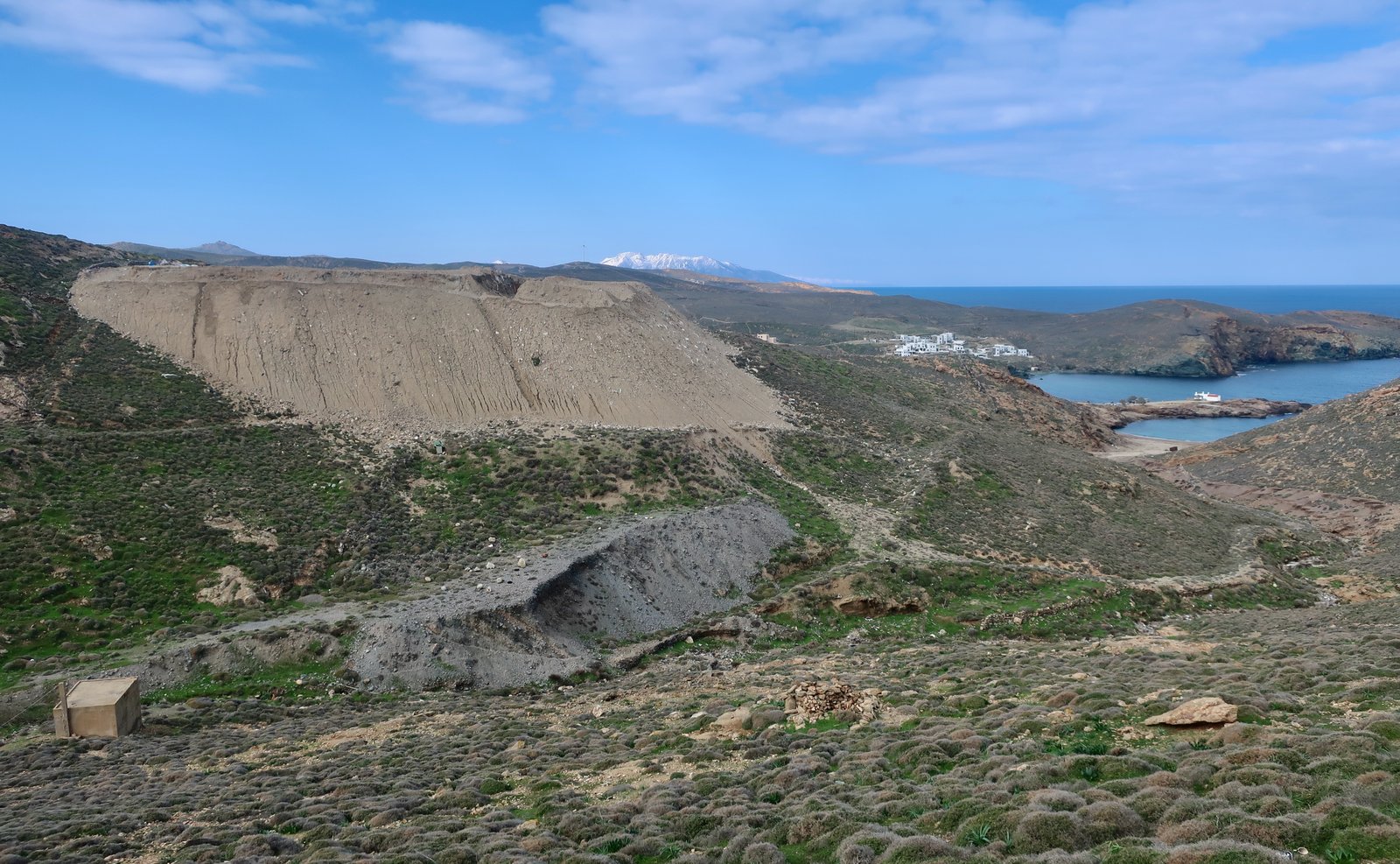
Over the course of two days we saw several other landfill sites, mountains-in-the-making. The guts of the island are being moved from west to east and north, these out-of-the-way places. The old weight of the island is shifting, to be replaced by the new weight of concrete.
An ugly dirt track runs around the lower circumference of Profitis Ilias. On the far, eastern side, where there’s no construction of any sort, where no-one ever goes, is the dump.

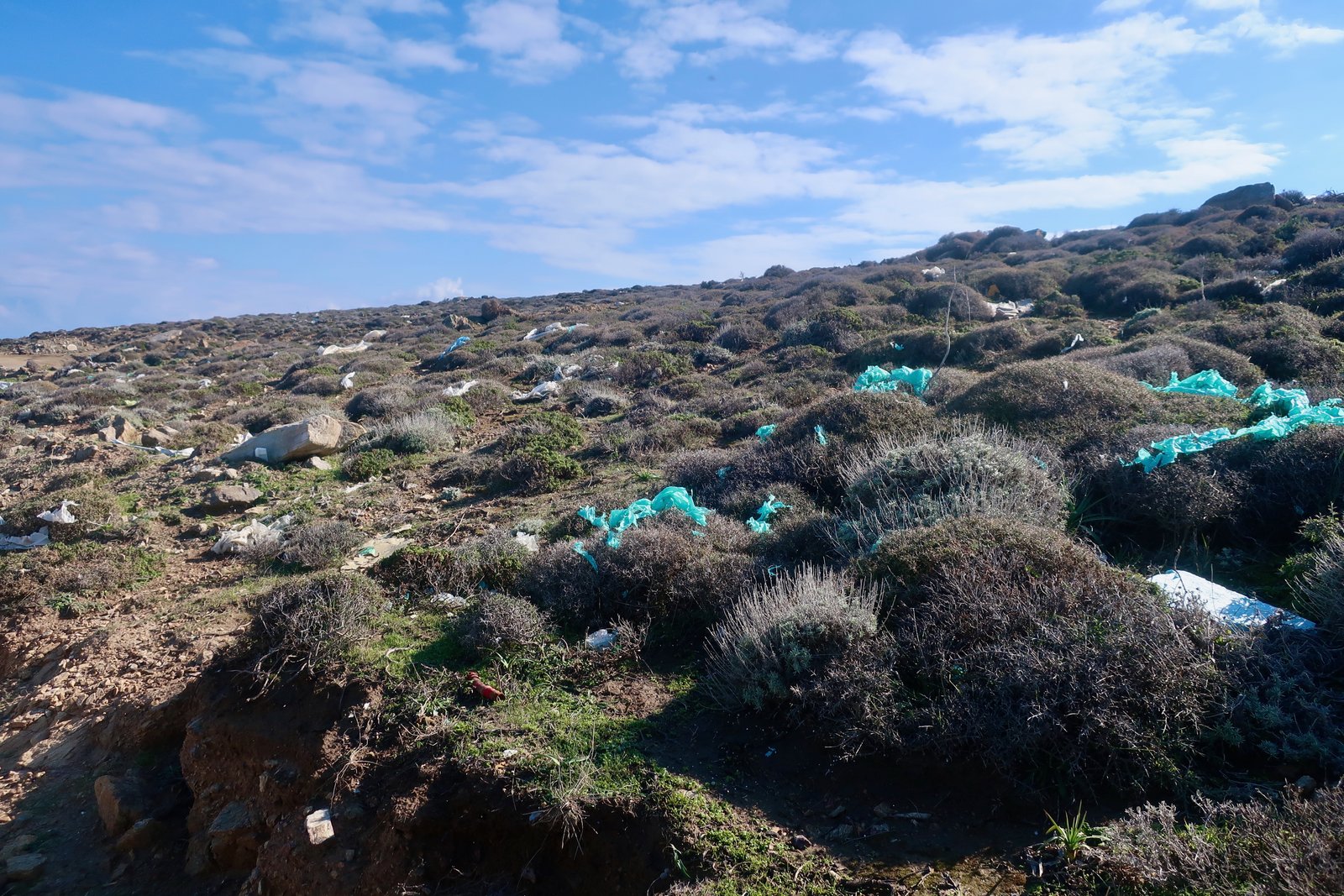
All islands have dumps, many of them disorganised and brutally ugly. Mountains of rubbish are tipped. On Mykonos the problem is particularly acute. At time of writing two million tourists visit annually a small island with a population of ten thousand. The heavy junk piles up while anything that can be moved by the wind is splattered over the eastern slopes of Profitis Ilias.
Coming around the south side of the hill there are views down over the southern beaches. In the cool of January, it’s green and gently hilly, more Cornwall than the Aegean.

Walking back into Ano Mera, a continuous flow of lorries was moving in both directions on the narrow roads. We had to squeeze against walls, duck into gated entrances.
In Ano Mera we just missed a bus, and rather than wait two hours for the next one, walked back to town along the main road. There was a lot of traffic, almost a commuter rush it seemed, to add to the lorries, and mostly no pavements.
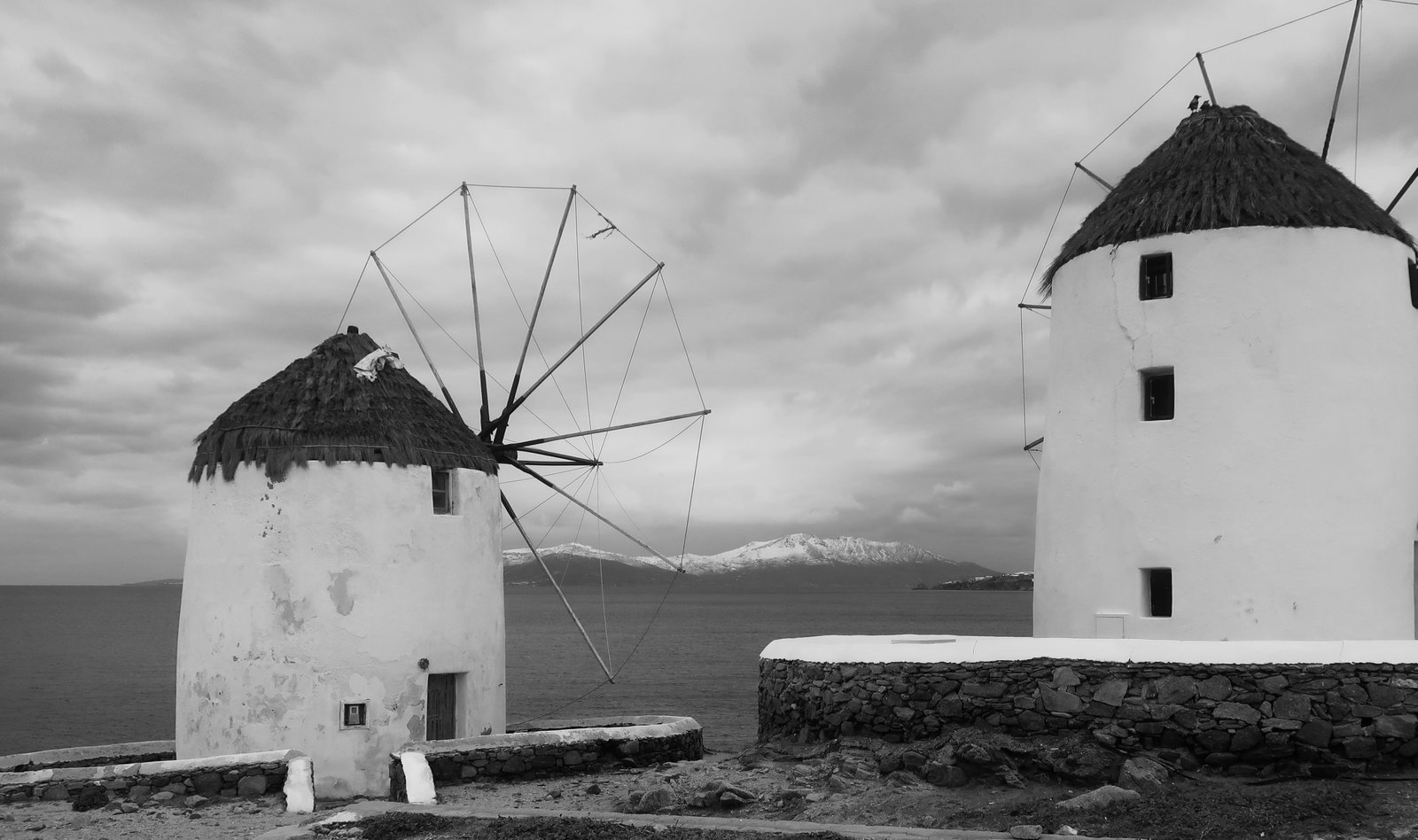
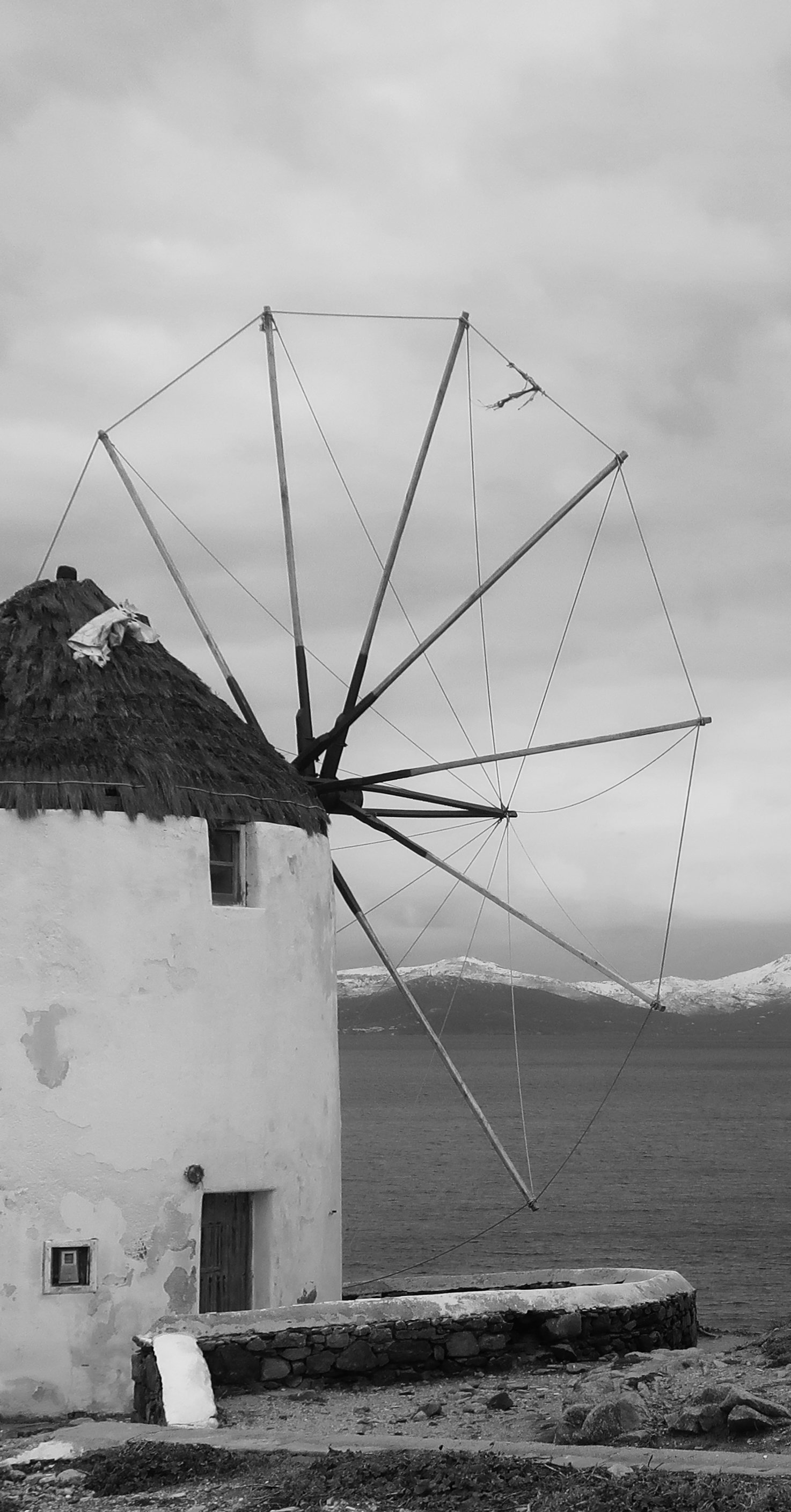
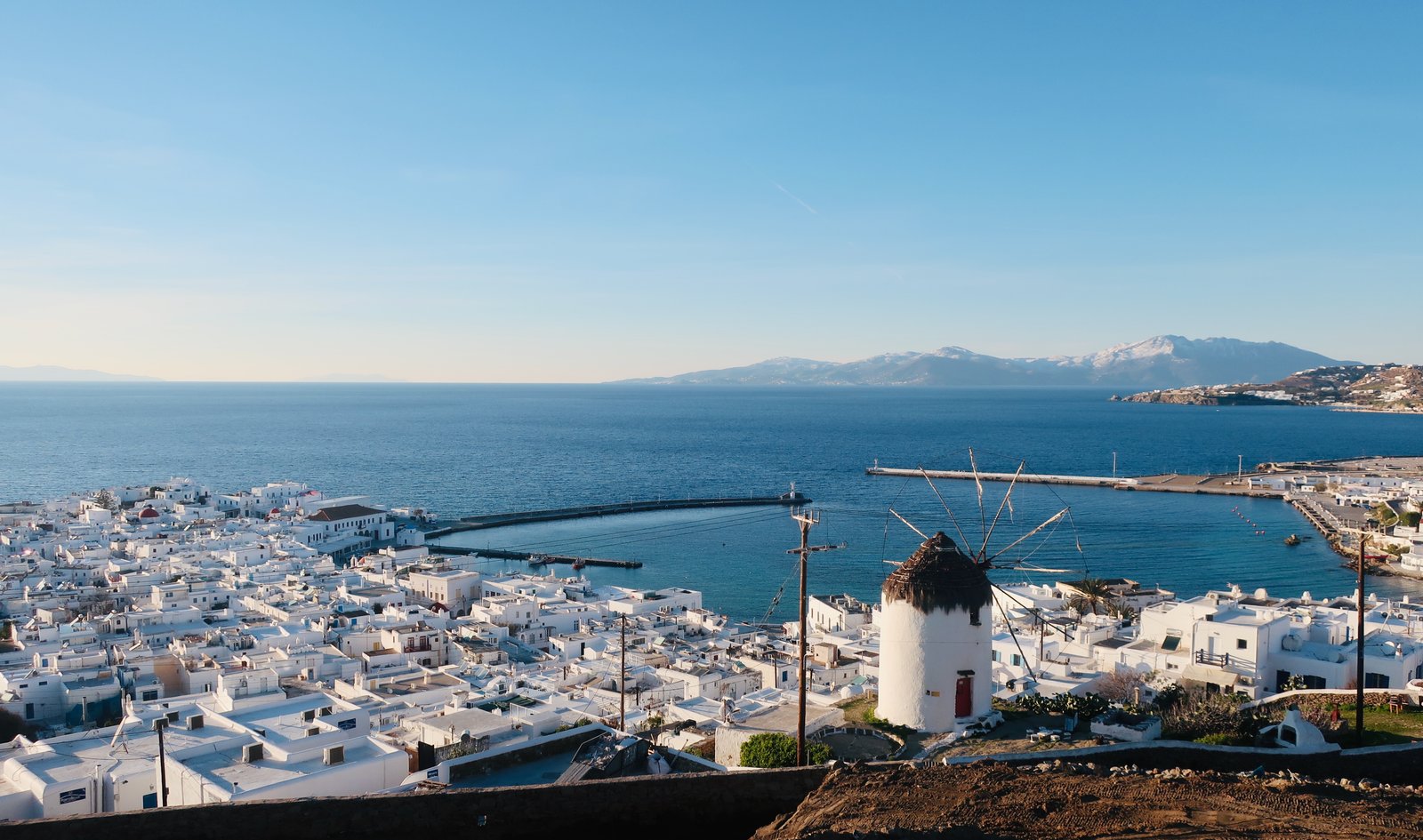
Coming down from inland towards the coast, Mykonos town is a photo opportunity, spread out below with the sun shining on the lovely cubic whiteness of it all, an iconic windmill in the foreground.
HIKE 3
The Chora to Marathi Lake. Left turn just before the lake. The northern Profitis Ilias. Vardies peak. Agios Stefanos beach. The Chora.
22kms
Having done south and east, we headed north out of town towards the other, slightly taller, Profitis Ilias (386 metres), the highest point on Mykonos.
A left turn just before Marathi lake. Pretty soon after, the asphalt changes to dirt track. Holiday developments are creeping further and further out from town, gradually making their way up these slopes.
We were almost at the top of the hill when suddenly there were red dots on the stones, just as if we were on an actual hiking trail on a Greek island. For several hundred metres until the summit, we followed these dots through lumpy, scrubby, dirt-land.
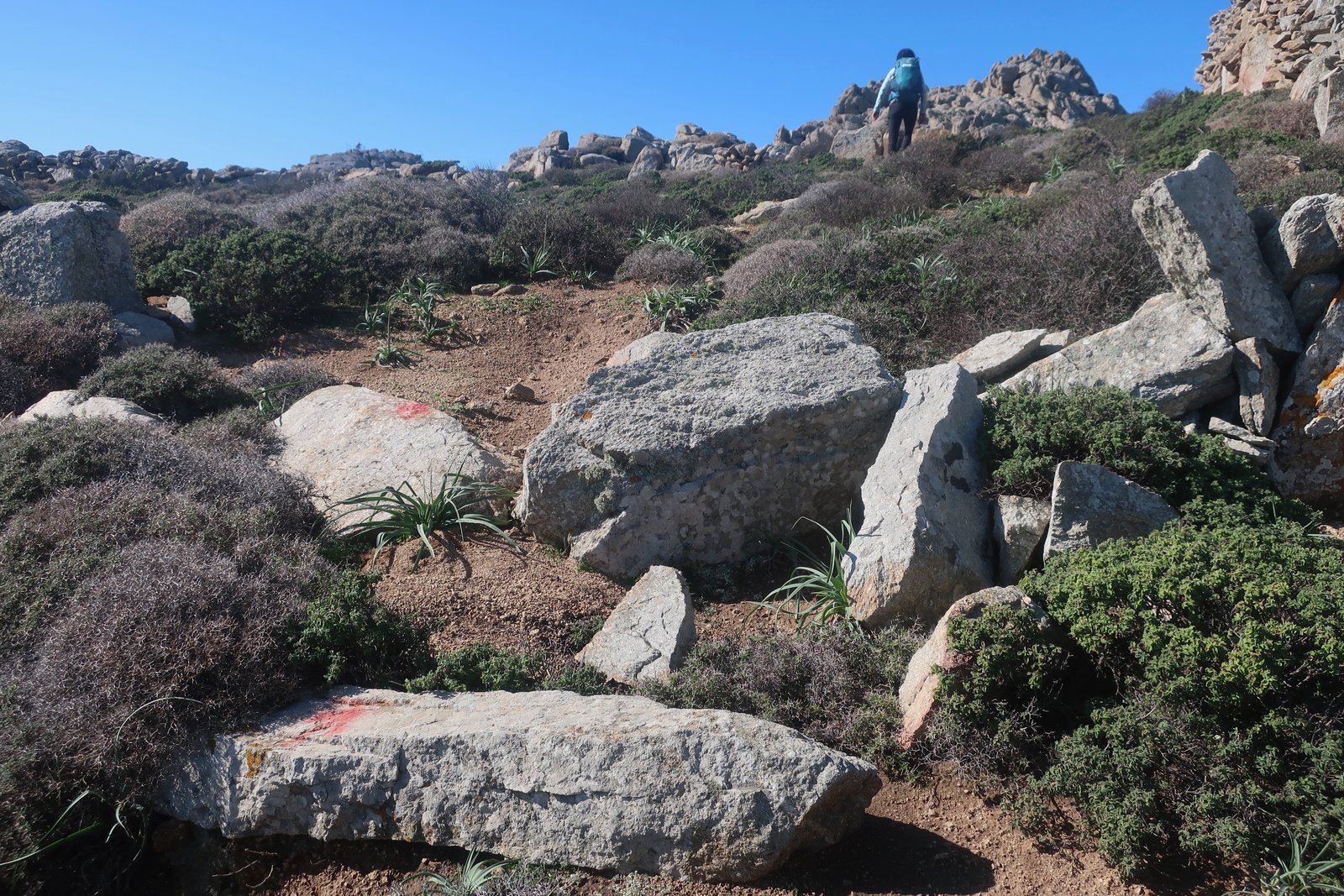
The path hasn’t been maintained, the red paint is patchy and faded, turning in places to the brownish of dried blood. The only evidence that there is a path are the dots and arrows. It’s only a few hundred metres long and objectively speaking hardly worth mentioning. If it were on some other island we probably wouldn’t. But this is Mykonos, this was the first trail we had found. The scale of our excitement was wholly disproportionate. As soon as we stumbled onto it from the wide, dirt track we had been following, there was such lightness.
It’s the best thing on Mykonos, Yvonne said, sitting at the top of the mountain where the red dots led us, drinking coffee on the grey-painted steps of the tiny chapel of Profitis Ilias, hunkered down away from the north wind in what was also the very best place from which to view the whole island of Mykonos.
Due south is the Chora. There’s no clear border where it ends, it just becomes less concentrated, with larger and larger gaps between the buildings, so that it appears to be moving, leaving in its wake a trail of white, geometric structures – paper, pages – scattered across the fertile centre of the island. The illusion of distance, and of wet winter, has turned the land down there into a soft green plain divided by stone walls – although from the hilltop they could as easily be hedgerows. It’s a classic painting-by-numbers scene, the irregular shapes of the fields having to be filled in with marginally-differentiated shades of green. The foreground, the higher land – also divided by stone walls – is darker, rougher, an overall olive-brown of spike plants and rocks. In summer all of it will be shades of baked.
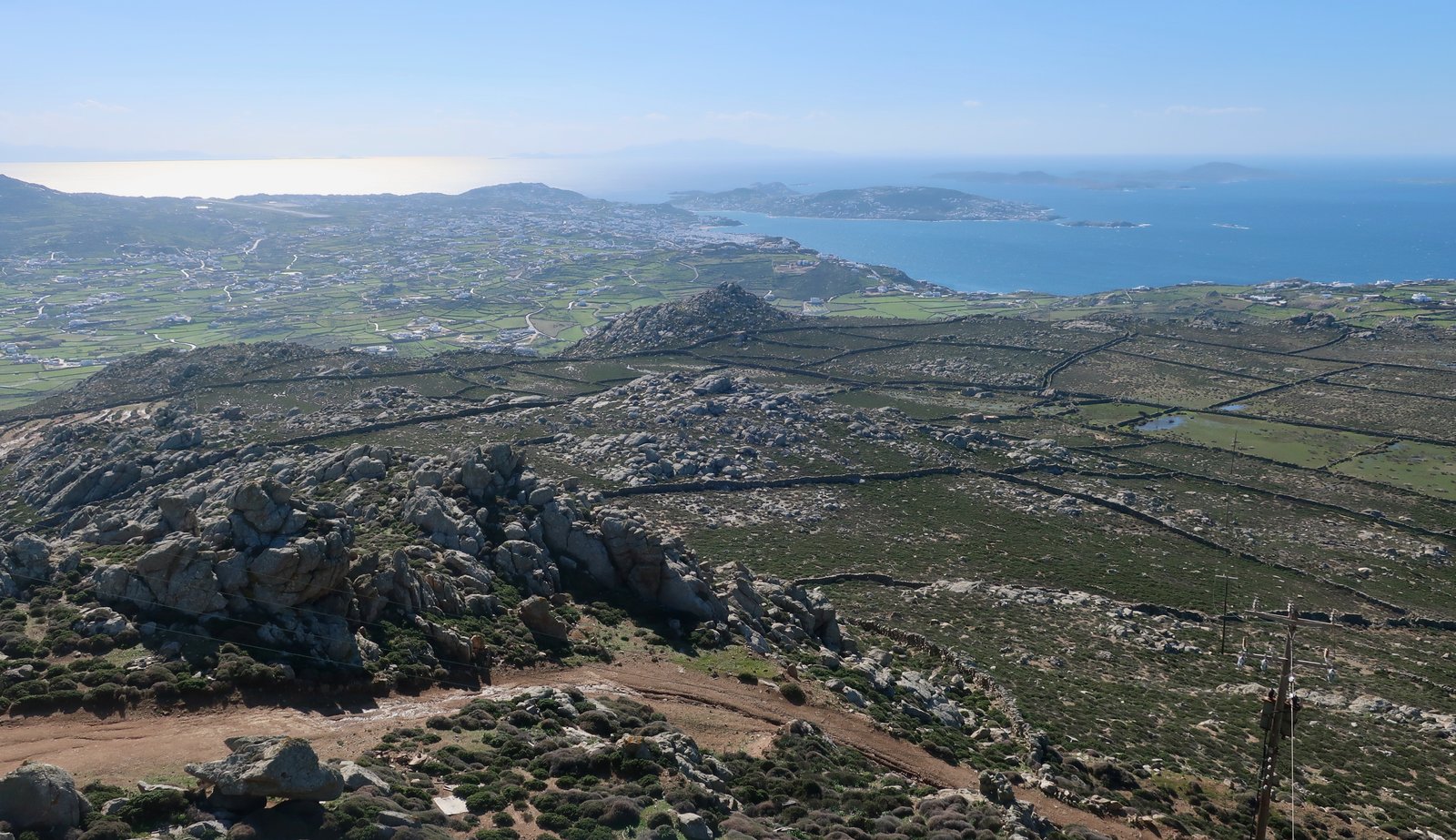
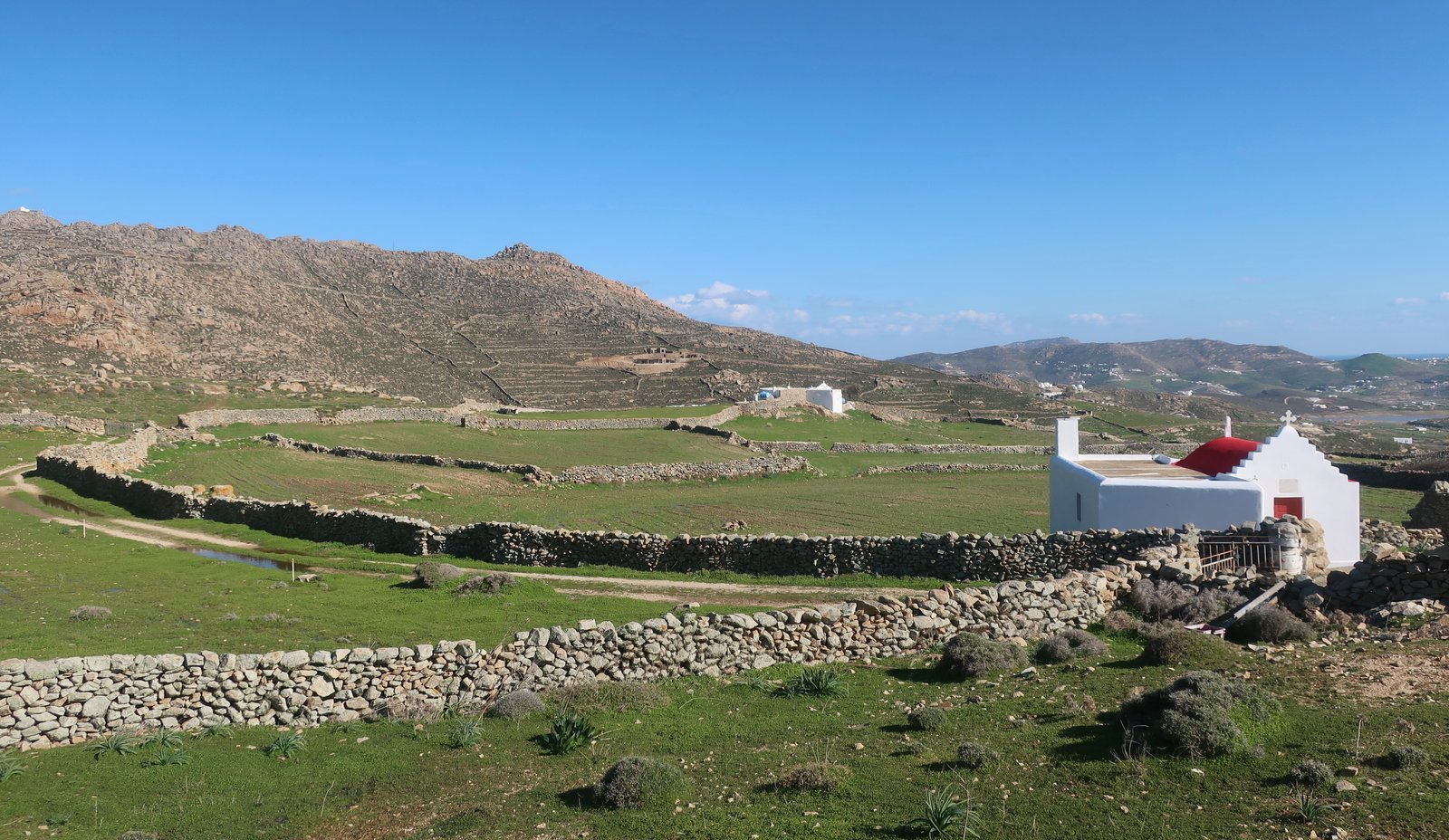
From Profitis Ilias it is only about a kilometre as the crow flies to the peak of Vardies, almost as high, across land anciently divided into fields by stone walls, blistered here by the eruption of heaps of rounded rocks. Through the middle of this terrain, a little over halfway across, is a parallel track of stone walls, an old footpath. We made for it, found more red dots between the walls, dodged around blockages of spike plant and rubble and veered left into a meadow where the dots disappeared and the land seeped water as if we were in Ireland or Wales.
At some point in the recent past this was farmland. According to the Anavasi map there was once a Kastro somewhere close to Vardies, but even with much imagination we found nothing.
The way down to Agios Stefanos beach, just north of the main port of Mykonos, is typical Greek landscape made all the more achingly lovely because of where it is. There is some necessary scrambling over fences because of blockages, some more cross country diversions because of lanes that become private, churches to which there is no longer access. The whole, long day was a deep, unexpected, Greek island breath.
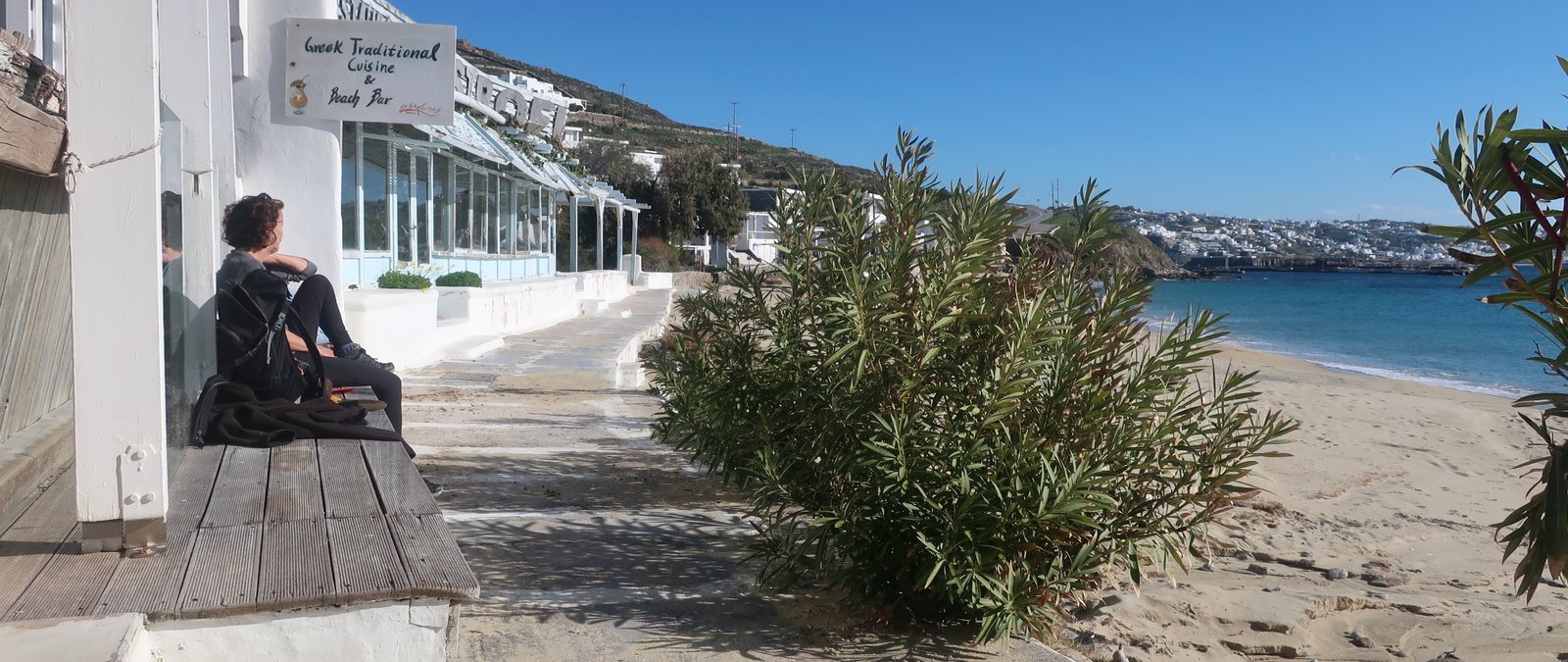
The beach at Agios Stefanos was closed and empty. While we sat there, almost warm away from the wind in the January sunshine, one woman came to run her dogs.
***
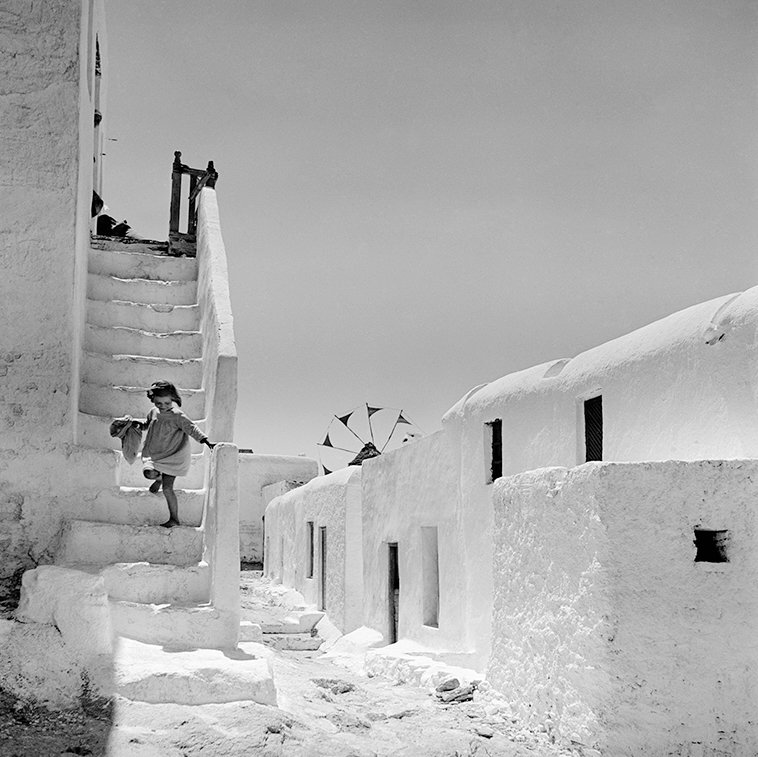
In the 1950s the photographer Voula Papaioannou took a series of black and white images of Mykonos. Although we often come across similar images – island history on the walls of cafes and tavernas, in guest houses, in boxes of curled postcards outside secondhand shops – these are among the very best. First because of the quality of the photos themselves, their radiance. But also, these are Mykonos. They have such poignancy, they take your breath away.