
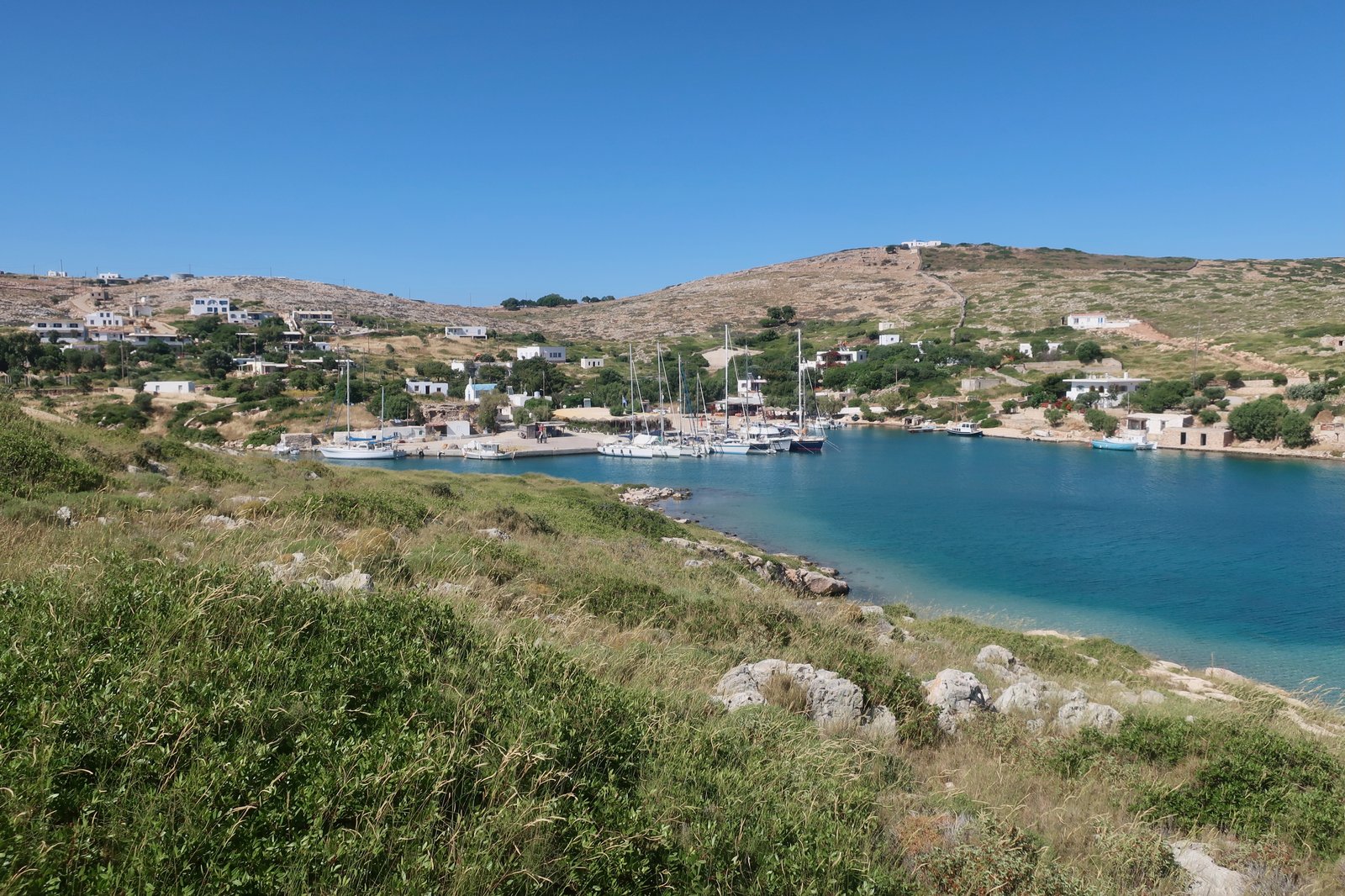
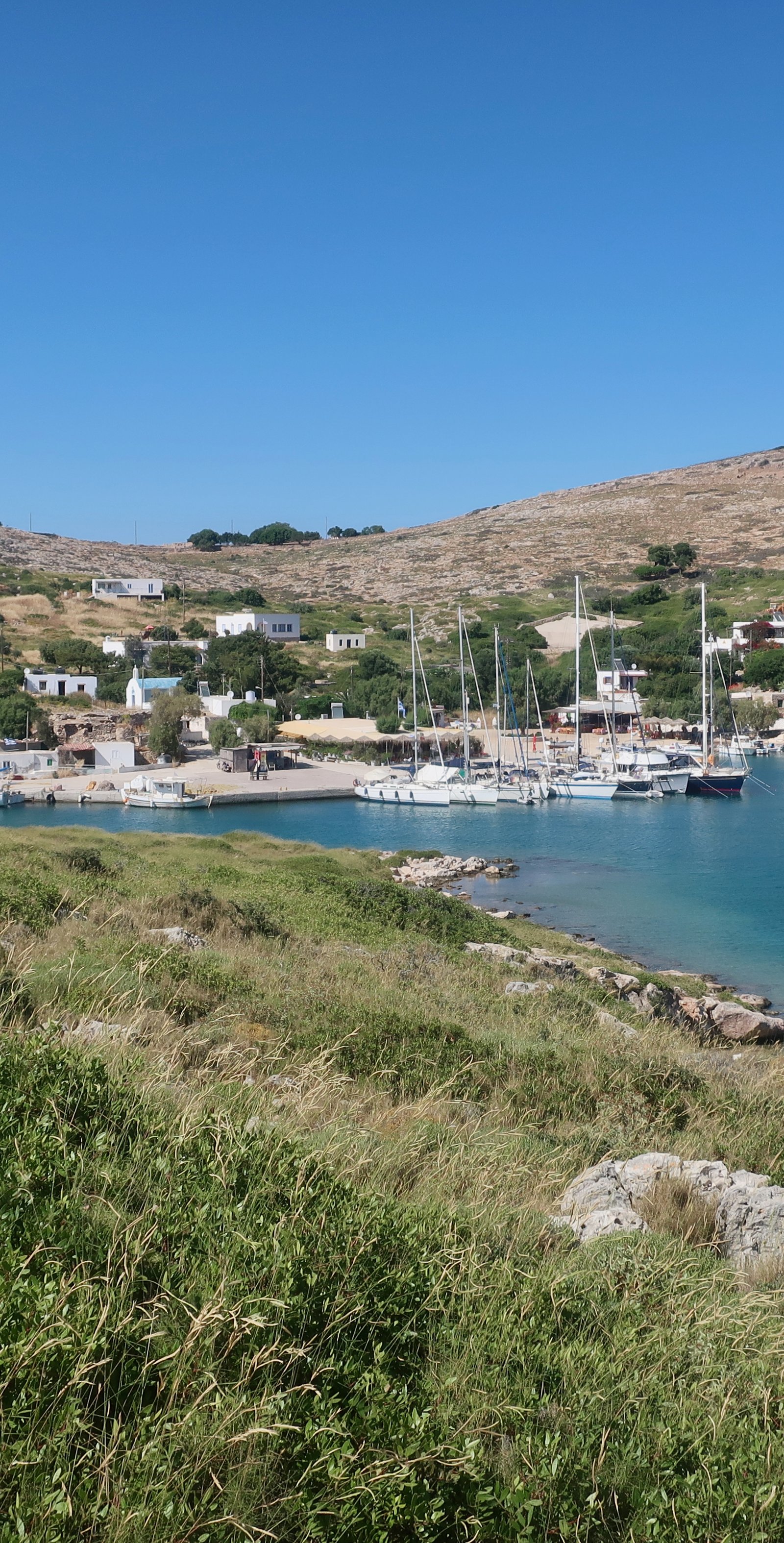
Most people come by yacht to Arkoi (ark-ee), which like its near neighbour Fournoi (for-knee) is a Greek plural, a small and lovely archipelago of low-lying islands. Overnight yachts call into the port, the only settlement. Already at the beginning of June when we were there, eight or nine or ten a day.
In the summer, tour boats from Patmos, Lipsi and Leros also visit, on day-trips to Tiganakia beach in the south, famously turquoise.
At last count forty-three people lived on Arkoi, including one school age boy who was part of the small reception committee when our ferry pulled in. He sat with us in the back of the truck that took us the two hundred and fifty metres to our accommodation. Before that, he it was who caught the mooring-line a crew member threw towards the jetty as our boat docked. Later, we saw him painting the toilet block behind the middle of the three tavernas. And in the early evening, before his shift serving in the restaurant, he was down by the water de-scaling a bucketful of fish.
For a child, there are various ways to deal with being alone. One of them is not to be a child.
Almost everyone lives either in the port or in the few scattered dwellings further to the south. There’s very little tourist accommodation – at time of writing, in December, nothing at all shows up in a google search, although there is a phone number, so maybe someone would open a room if requested. But who will go to Arkoi in winter? I am by the by doubtful that the forty-three residents are all there, all year-round. What would they do? There are some fishing boats and a large number of goats, but the yachts are so pivotal that it’s difficult to imagine any focus at all without them.
There are three competing tavernas in the port. Yachts arrive mostly mid to late afternoon. They tie off the necessary lines, check out the neighbours, then head for one of the tavernas/bars, all within a handful of metres. In the morning they depart. In the next bay to the south, where there’s only one taverna, the same thing happens, but on a lesser scale and without the choice.
A few islands – Pserimos, Mykonos, (which could hardly be more different from each other) – have reached a point at which, for now at least, they’ve been transformed in such a fundamental way that they’ve lost themselves. Arkoi is close. When people come in on a yacht and stay just one night they see the small, pretty port with a few tavernas, a place to tie up the boat. How could they understand, departing in the morning loaded with their stories of the night before, that far from being incidental visitors in the story of this place, they are the central characters around which it revolves? Them, and the goats.
The village is surrounded by a barrier impermeable to goats. On walking paths all over the Greek islands we pass through agricultural gates. Sometimes they carry a brief notice in Greek, or even in English, asking that walkers be careful to shut the gates behind them. It’s understood that the purpose of the fences, of which the gates are a part, is mostly, although not exclusively, to stop animals escaping, even if often it’s far from clear what it is they should not escape from – a valley, a whole mountain, half an island? On Arkoi the fence is there not to keep the animals in but to keep them out. There is a sense of being under siege. There is a sense of zombie-goats at the gates.
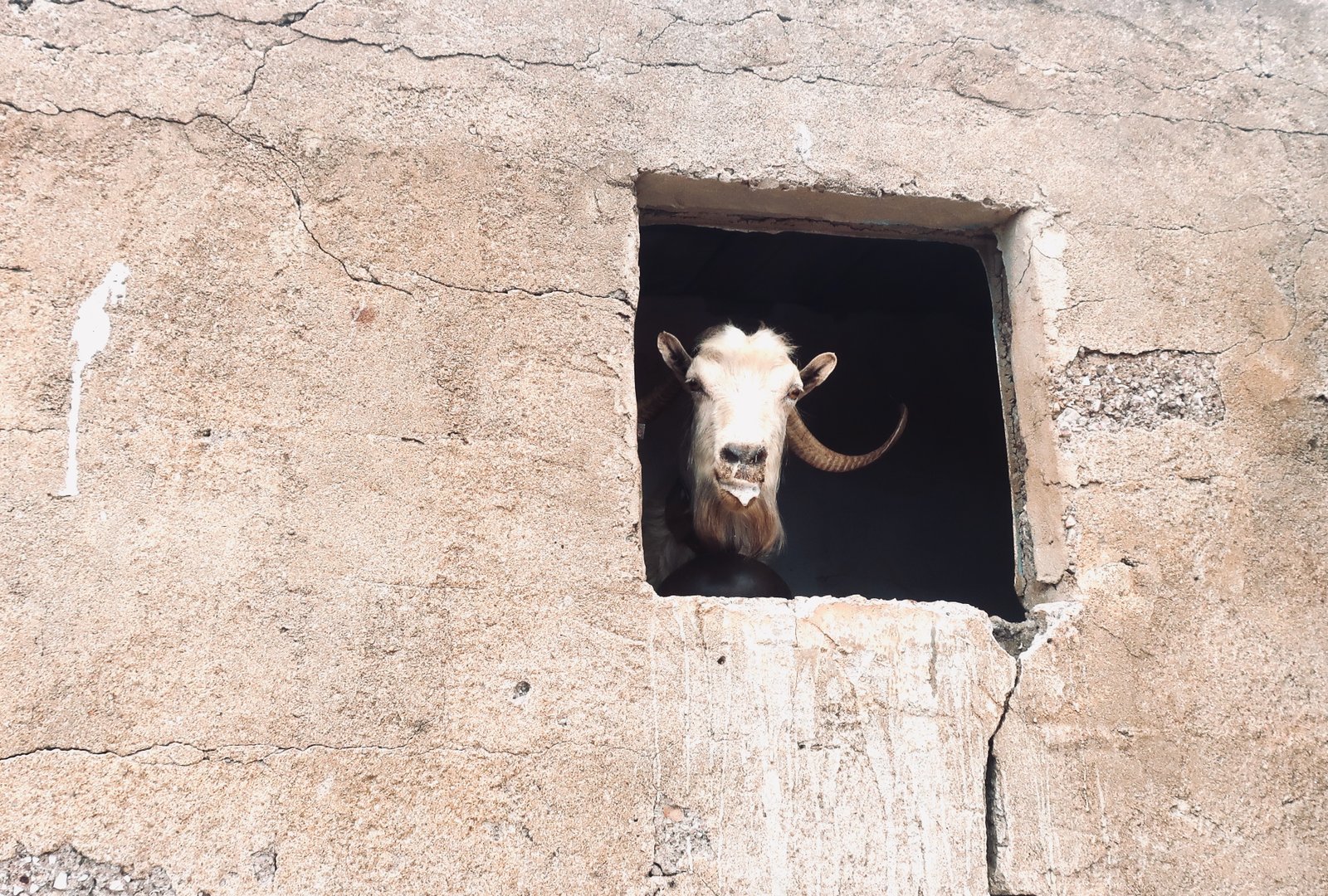
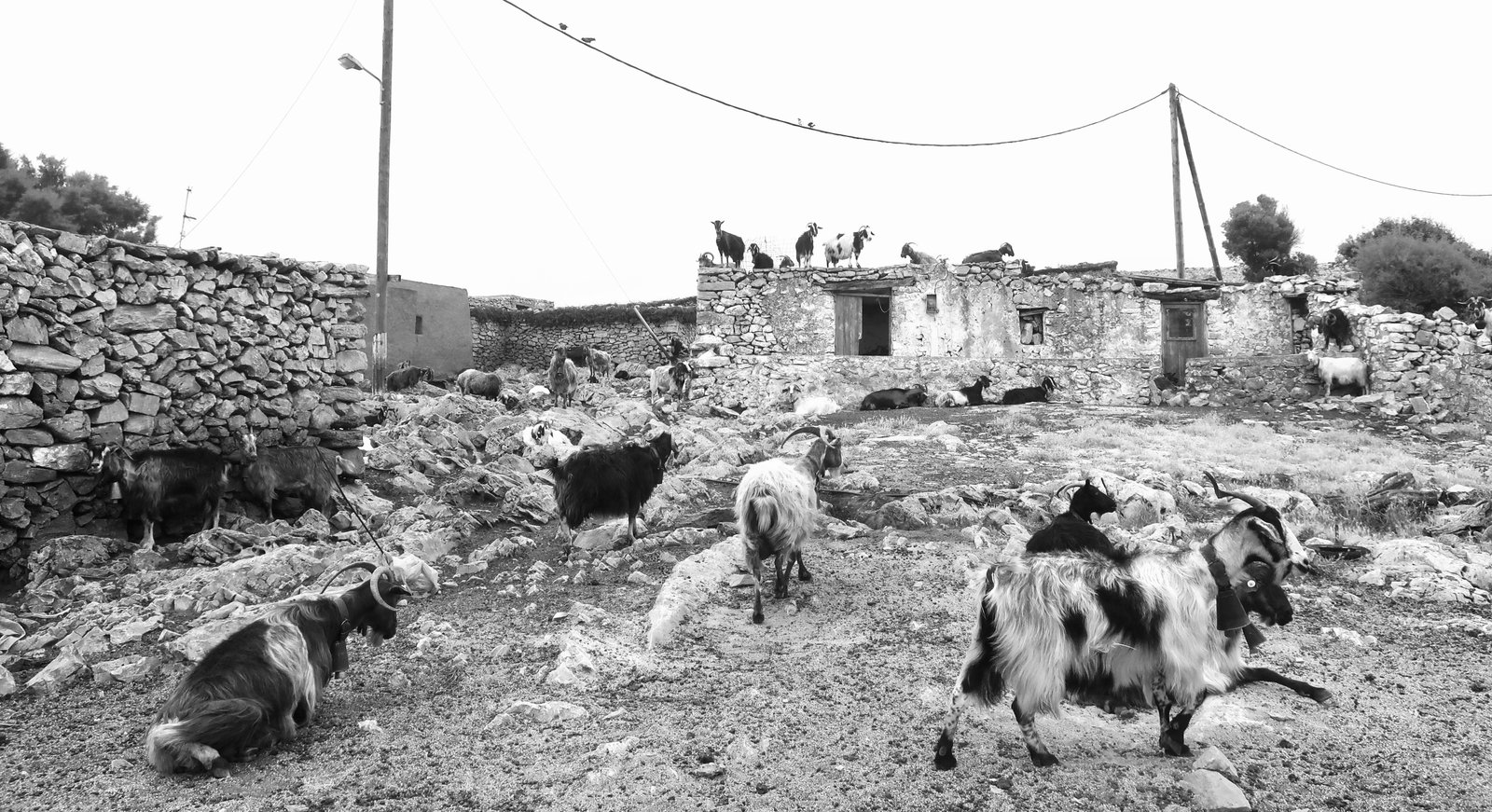
A satellite image of Arkoi gives an idea of where goats are and where they are not. Most of the roughly northern half of the island is as if shaved, brown and bare. The goats have stripped it. Their appetite is almost, but not quite, limitless.
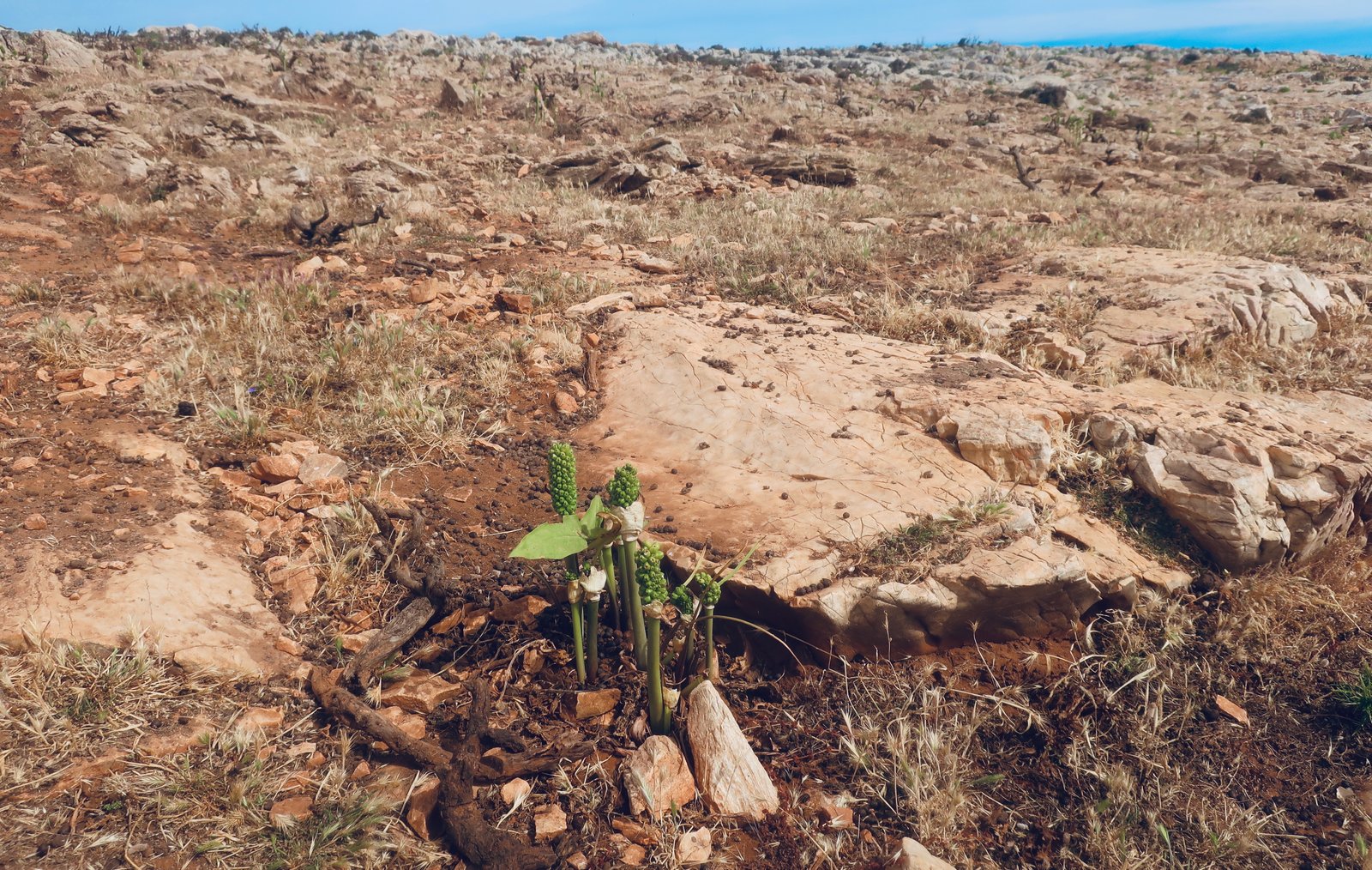
The far northwest is an exception. A barrier runs straight across the width of the island, a sort of Greek island Hadrian’s wall. Outside the land is greener. It isn’t full-on green, because this is a Greek island, goats or not. But there is a clear difference.
Occasionally when out walking in the islands we take a wrong turn, end up lost, and have to clamber over walls. This wouldn’t happen on Arkoi: first of all because it would be difficult to get lost on such a small, flat island, but also because here, in order to be non-porous to the hordes of goats, the walls are perfectly constructed and maintained, and even, in order to be sure, mostly topped with dry spiky branches and/or jabbing sticks.

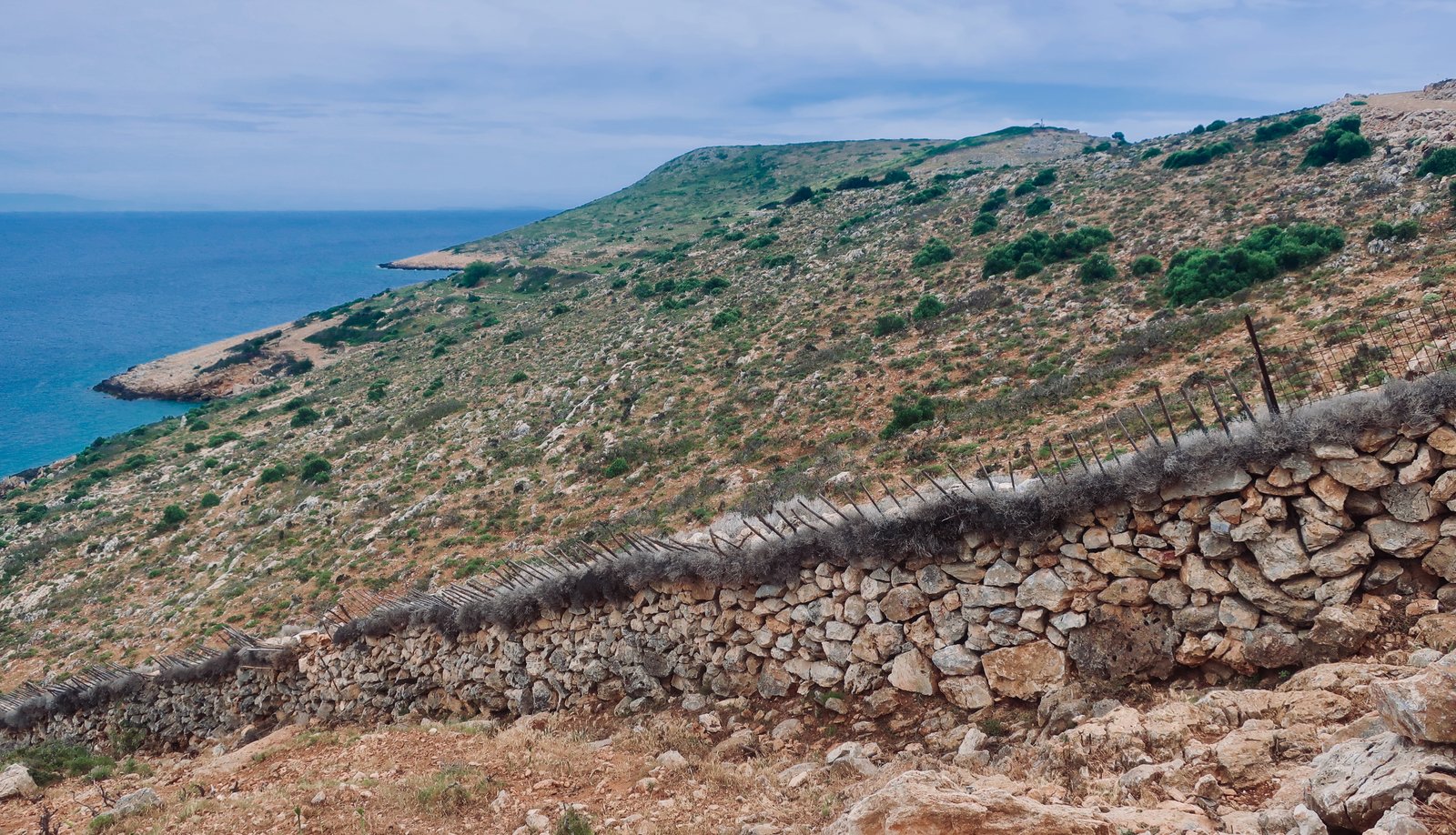
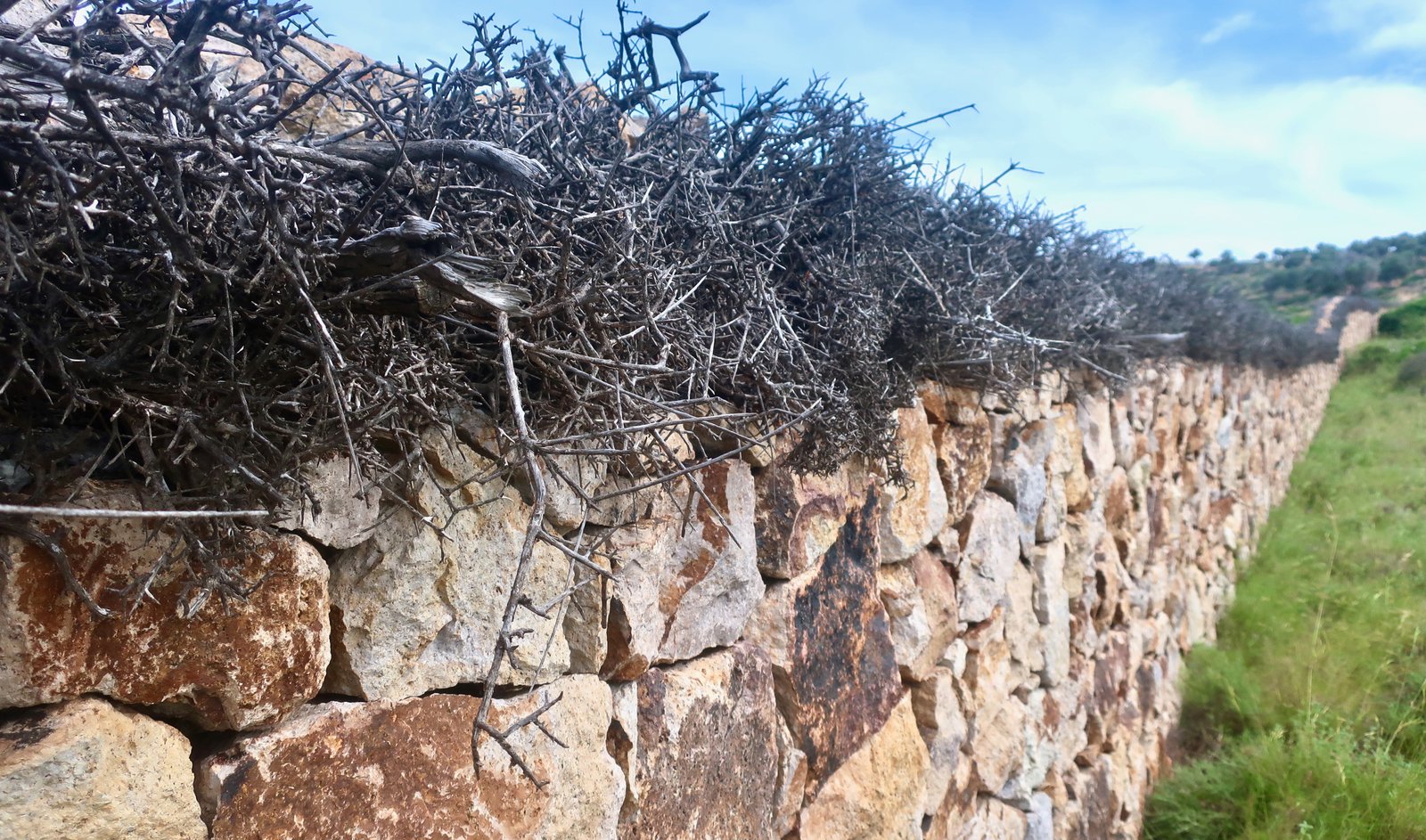
If the goats were to penetrate these barriers in any number, the result would be catastrophic total desertification.
The summit of the island is just one hundred and fifteen metres above sea level. As on other island high-points, there’s a small concrete pillar to mark the spot. As usual we make for this point, and suddenly, there, it makes no difference that Arkoi is being eaten away from the inside, or has lost its way, or lost its identity, because we’re on the high-point of a Greek island, looking down over one of the more lovely maritime pastoral views in the Aegean, over Marathos, Stroggilos, Agreloussa and the other islands of the archipelago, with behind them to the west Patmos, to the south Lipsoi.

Back in the port two hours later, a group of Swedes travelling together on two yachts have taken over. They’re on the terrace of one of the tavernas with a guitar, a ukulele, and a harmonica. Two teenage children travelling with them make themselves scarce as the grownups launch into their repertoire – sincere, hearty versions of The House of the Rising Sun, Hallelujah, Losing My Religion, Somewhere Over the Rainbow. A cute dog is sitting in the middle of the square between the tavernas. A restauranteur is being touchy-feely. And it’s all like a movie, the title sequence of which is a cartoon version of this reality, with drawn lines and colours and jaunty cartoon people and in the background generic happy Greek tavernas with colourful chairs and sunshine.
HIKING
The Terrain Map we used has one trail, that runs from the port to the Italian Outpost in the north. It isn’t exactly a hike. The whole island is only six kilometres tip to tip. Having exited the enclave of the village (securely closing the gate behind us), the way heads north along the middle of the island. Mostly there’s no actual trail, just an easy-to-follow direction. And there’s no question here of having to high-step over spiky undergrowth, because the goats have eaten it all. Unusually, it’s possible to wander at will.
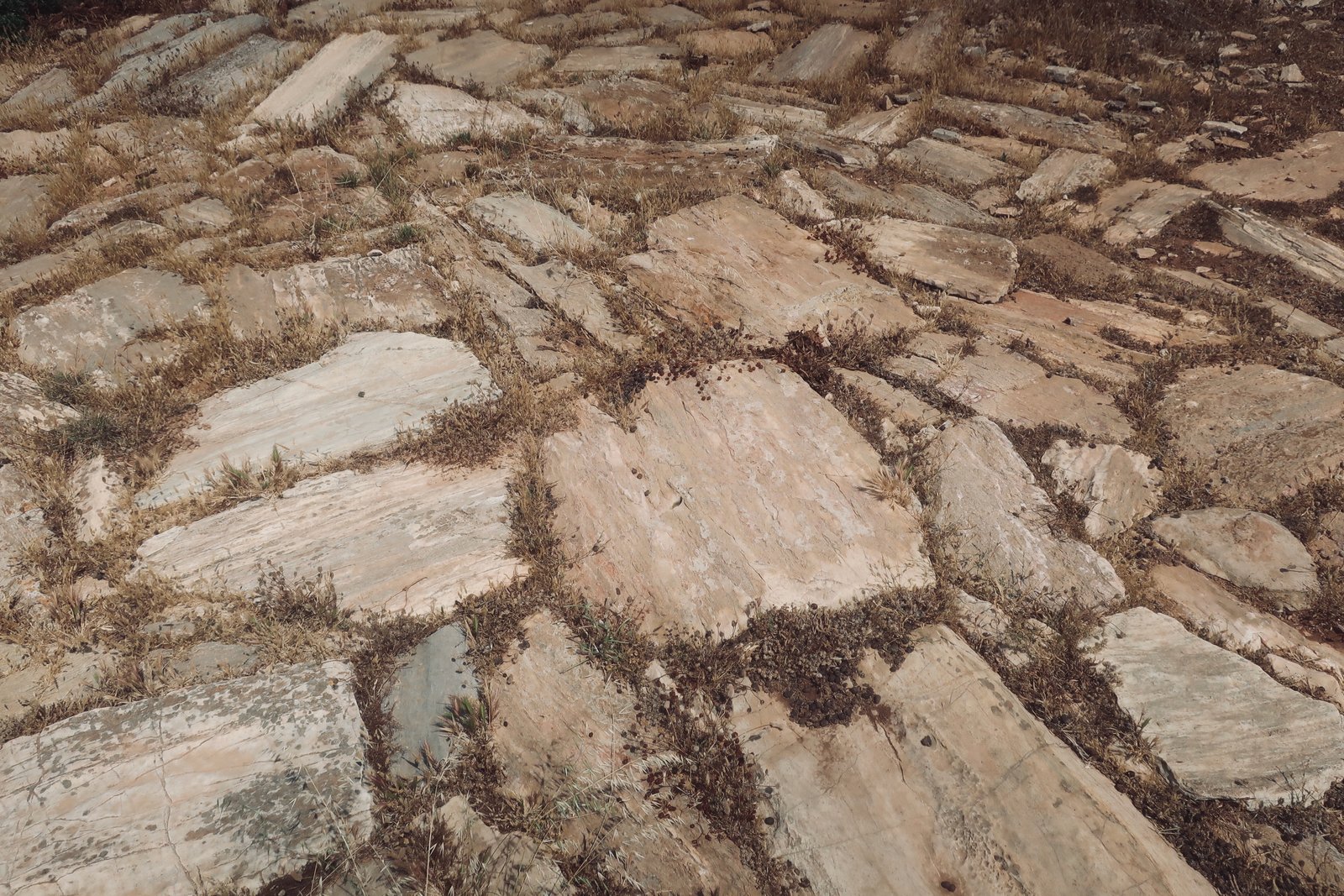
Almost exactly in the middle of the Hadrian’s goat-wall there’s a gate. On the other side some old walls and a threshing circle whose chaotic floor-stones time and heat have transformed into an artwork.
The ruins of the Italian Outpost are another kilometre further on. All over the Dodecanese, occupied by Italy from 1912 until 1943, are the remains of similar structures – outpost, observatory – places from which Italians watched. Most of them are necessarily on vantage points, hilltops and promontories, away from the small centres of population. In the name of Empire, a portion of glory, a hundred years ago Italian soldiers left their noisy villages and towns to come to these lonely, windy places.
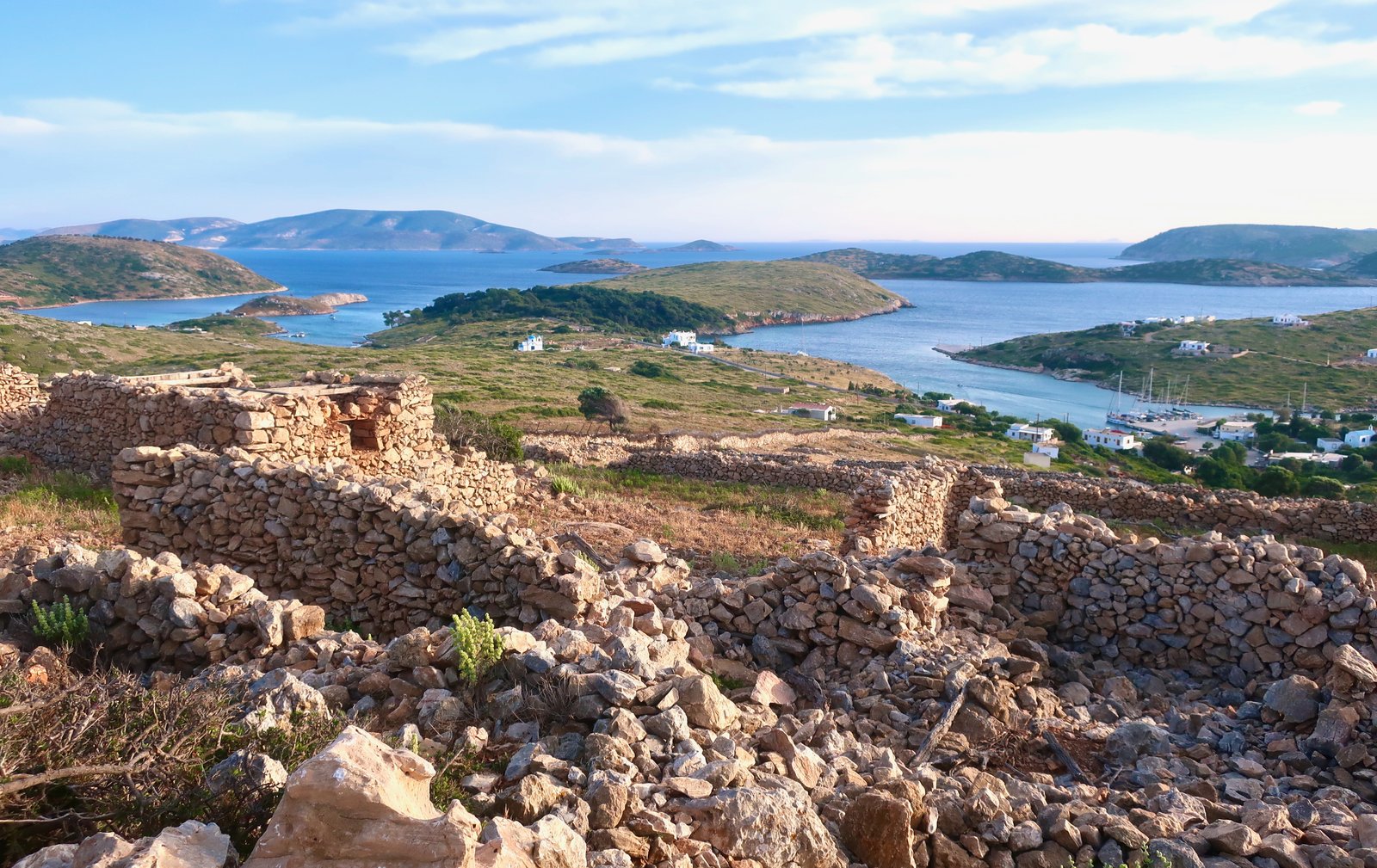
On the way back to the port, having made a diversion to the Panagitsa church, with views southwest down into the port, northeast towards Agathonisi and beyond that to the Turkish coast, we wandered into the remains of a small agricultural settlement, where an old goatherd, sitting on a heap of stones, almost invisible in his dusty stillness, was being the ghost of Arkoi past, looking down over the port as if he had been there forever.
You can walk south out of the village too, where sometimes, because the goats are kept at bay, there’s long grass and the world in early June is green and waving like an ocean. If they can see this, the goats, they must look so achingly over the fences or through the gates to this strawberriesanddoublecream, for now mouthwateringly inaccessible.
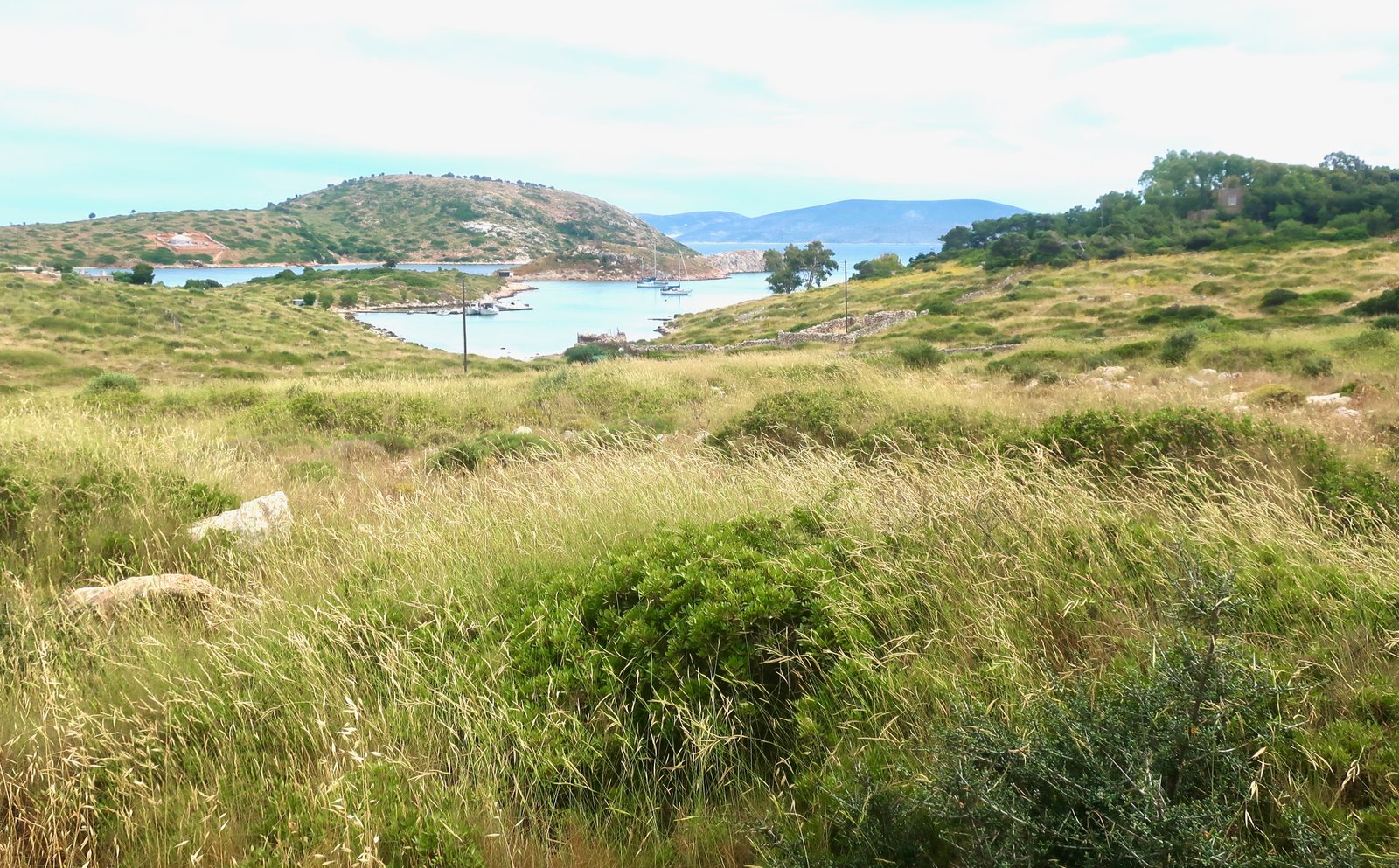
It’s barely two kilometres to Tiganakia where the tourist boats come, the beach is pebbly, the water irresistible.
